Peace for the World World ! Your War Our Lives

The Dalai Lama
A Brief Colonial History Of Ceylon(SriLanka)
Sri Lanka: One Island Two Nations
A Brief Colonial History Of Ceylon(SriLanka)
Sri Lanka: One Island Two Nations
(Full Story)
Back to 500BC.

Wednesday, February 28, 2018
Ranil’s Radical Road to Ruin

By Sarath de Alwis-2018-02-27
We will correct our mistakes and make some radical policy changes
- UNP backbenchers after
LG Polls.

In year 2014, this writer desperately wanted him out. Today, in 2018, this writer frantically awaits his return. The tyrant and his enforcers are preferable to tricksters and rip off artists.
Political Power is the ability to form, reform or maintain institutions. What was enacted inside the Presidential Secretariat on Sunday - 25 February, told us quite unambiguously where power lies today.
On Sunday 25th February, Charitha Ratwatte 'Consigliere' and 'Dutch Uncle' of Prime Minister Ranil, was watching brother Suren – CEO of Srilankan Airlines participating in the 'Iron Man' contest. In the edifice nearby, his Royal College classmate was conclusively demonstrating to President Sirisena who was the 'Iron Man' and who was the 'Straw Man'?
In a democracy, power is the ability to form, reform or maintain institutions. In that sense, President Sirisena is not a lame duck President. He is a sitting duck president.
Readers will note, that I do not make a reference to the President. For a good reason. The 19th Amendment has made him 'Functus officio. We can make it more picturesque. Ranil and his Royal College pals Malik, Sagala and Lakshman have made our Yahapalana President the principal player in their version of the ballet 'Nutcracker'. When it is that tight, it surely must hurt.
After much post-polls breast beating, Ranil succeeded in persuading UNP backbenchers that he would initiate some radical reforms. He has now delivered on his promise. He has opted for a radical road to ruin for the UNP.
Cabinet reshuffle
The Cabinet reshuffle has not resulted in any change in the internal dynamics or balance of power in the Cabinet. The smug look of amused contempt in John Amaratunge's countenance was more than adequate proof that the gravy train was firmly on track.
We mistakenly believe that Cabinet government is collective and presidential government is arbitrary. Now we know better. Let us hope that Jayampathi Wickramaratne will spare us further charlatanry.
Cabinet reshuffles are a means of ensuring ministries' efficiency and vitality. In the case of Ranil Wickremesinghe what matters is not ministerial vitality but ministerial servility.
Infighting and alleged corruption were the primary factors that precipitated the reshuffle. The polls verdict was only a mild reminder. The reshuffle has not addressed the issues raised in the Bonds scandal.The Prime Minister continues to be the Minister-in -Charge of the Central Bank and National Economic Policy. It means that his advisers will continue to be the puppet masters. The condescending lectures of the Prime Minister during the recent elections are nothing compared to his post elections counterfeit course correction.
What is wrong with Ranil? He is frozen in a world that no longer exists. He is convinced mistakenly of course that he can do what his famous father has been erroneously credited with doing: creating and shaping opinion. He is also mistakenly sold on the idea of a meritocracy the confines of which he has arbitrarily demarcated for himself and his buddies. That is not the world we live in today. We live in a world where privilege is a commodity and not a birthright. The drawn-out protest against SAITM has not taught him the lesson of contemporary social order. The natural social hierarchy is the result of a process that matches the hardest-working and the most talented to the most difficult, important and remunerative tasks.Delegation of duties and responsibilities should be according to a transparent order. People rise or perish according to success achieved or failure arrived at.
That is not what Ranil and his type of UNPer believe. They wish to pull the ladder up after they climb up. Or rather he would selectively lower it for those he would like to share his perch with. That is called 'oligarchy.'
We made a mistake on 8 January 2015. We dared to hope and hoped too much. Hope is betrayed sooner than later.
It is not people who rule. We are ruled by those whom we trust to rule us. That is a complex conundrum in the concept of popular sovereignty. Democratic leadership is based not on trust but on distrust. That explains why a good section of our people prefers the King.
The reshuffle was demanded by the President. It was a kneejerk reaction to the drubbing he received at the LG polls. He should have known better. Ranil Wickremesinghe is made of different stuff. Course correction midway is not his style. Ideally, a Cabinet reshuffle is a strategy adopted by the head of the Cabinet – in this case, the President to discipline the members of the Cabinet and curb or control ministerial capture of bureaucracy. It is too late for that. He should have appointed the Bonds probe commission soon after the parliamentary election in August 2015.
That would have given the presidency emasculated by the 19th Amendment at least the advantage of a commendatory public reaction. The present reshuffle exercise is not a positive act in response to a public scandal by a President above the fray. It is a consequence of an electoral setback suffered by his side of the coalition. President Maithripala Sirisena can come out of this crisis a winner. He can insist that his new Minister of Law and Order produce the former Governor of the Central Bank before the Courts.

Will the next ‘president’ stand up, please?

BY N Sathiya Moorthy-February 27, 2018, 12:00 pm
 If
anyone wants any proof that much of the nation’s polity is shocked
beyond immediate recovery at the nation-wide local government (LG) poll
results, it is here. Despite their long years as election analysts,
whether or not they are parliamentarians and/or politicians, many of
them have continued to harp on the LG poll percentages of individual
political parties to argue that this man or that can or cannot become
President again. Unwittingly or otherwise, former President Mahinda
Rajapaksa is at the centre of many such claims, and most such
counter-claims (that he cannot return to power).
If
anyone wants any proof that much of the nation’s polity is shocked
beyond immediate recovery at the nation-wide local government (LG) poll
results, it is here. Despite their long years as election analysts,
whether or not they are parliamentarians and/or politicians, many of
them have continued to harp on the LG poll percentages of individual
political parties to argue that this man or that can or cannot become
President again. Unwittingly or otherwise, former President Mahinda
Rajapaksa is at the centre of many such claims, and most such
counter-claims (that he cannot return to power).
Leave aside all talks centred on LG poll-percentages, under 19-A,
Mahinda R just cannot contest a future presidential polls unless a
favourable Parliament amends the Constitution all over again, for him to
contest again. It is another matter after whether Mahinda would at all
want to try his luck again, after his misadventure mission of January
2015, for which he got 18-A passed to let him contest the presidency a
third time, and lost it, too.
It is even more doubtful if Mahinda R can ‘transfer’ all his votes from
the LG polls to a third candidate, who does not have the hallow of
war-victory around his head, now that brother Gota R has publicly
acknowledged that his status as a US citizen bars him from becoming
prime minister (hence, president, too). That is, even if such other
candidate of his choice is either of the other brothers, namely Chamal R
or Basil R, or going down the blood-line, parliamentarian-son, Namal R.
If someone was thus talking about Mahinda becoming prime minister under
the existing system, that is a plausible question, for which answers
have to be found within the present scheme, as long as all the allies
pitted against him in the presidential polls of 2015 did not re-unite
and are also able to create the ‘Maithiri magic’ of the times. Granted
that the 44.69 per cent of vote-share in the LG polls gives Mahinda and
the SLPP a seat-share advantage in any parliamentary polls (at least on
paper just now), he can hope to become prime minister, yes, or
post-poll, hope to have his nominee, named, instead.
Closest competitor, but..
In this, Mahinda’s closest competitor for prime minister, going again by
the LG polls, should be incumbent Ranil Wickremesinghe of the ‘rival’
UNP. But if the Constitution were to be amended for Mahinda, and the two
were to contest, Ranil with his UNP’s 32.61 per cent LG poll vote-share
is way behind. With Sirisena-led SLFP’s 4.48 per cent and the larger
UPFA’s 8.9 per cent (total 13.38 per cent), Ranil, would be marginally
ahead of Mahinda, at 45.99 per cent, or 1.3 per cent more.
Less said about Sirisena’s chance, whether he contests the presidency
with or without the UPFA’s support and as SLFP’s uncontested candidate.
If against the assumption that all of SLPP’s LG poll vote-share are
‘transferrable’ for Mahinda to give it away to any candidate of his
choice, and the UNP and the SLFP-UPFA were to bury the current
bickering, then Ranil could stake claims to contest the presidency, and
Sirisena would have no choice but to give in, even without a murmur of
the present kind.
The real difference between the winner and the loser in the presidential
polls of 2015 is not the vote-share of the present-day SLPP, which is
more than the Mahinda-centric, Maithiri-led SLFP-UPFA vote-share (42.38
per cent) in the parliamentary polls of 2015, and not much less than the
presidential poll figure (47.58 per cent) that he had lost earlier in
the year. To think that a leader without his original party of decades,
namely, the SLFP, and with no chance of becoming President in the future
or even hopes of being prime minister in the current Parliament without
engineering large-scale defections without being in power already (as
he did as President in his first term), Mahinda has done creditably
well. But it is only statistics, nothing more – just as it is nothing
less.
Considering that the UNP contested alone (or with a few allies but not
the official SLFP-UPFA) in the 2015 parliamentary polls, the party’s
vote-share has taken a beating now, from the then figure of 45.66 per
cent. An arithmetic possibility is that all of the SLFP and UPFA votes
(totalling 13.38 per cent) has gone away only from the UNP’s 2015
parliamentary vote-share, bringing Ranil leadership’s LG poll figure
closer to the residual 32.28 per cent (and very marginally higher at
32.62 per cent in reality).
‘Magic’ allies
Yet, none of this explains how Mahinda’s SLPP got more vote-share than
in the parliamentary polls, so has the JVP, 6.26 per cent, up from 4.87
per cent. Definitely, it has not come from the TNA, whose vote-share has
marginally gone down to 3.06 per cent now, from 4.62 per cent in the
parliamentary polls. The TNA does not share the same constituency and
region as either the SLPP or the JVP. More importantly, the TNA has
enough local, Tamil claimants to its falling vote-share.
For the mathematical wizards who added up past poll figures to argue
that Mahinda cannot make the presidency again in the same way have
forgotten not only the constitutional bar, but also their own
contribution to the defeat – and thus, UNP-backed Maithiri’s victory.
The TNA, JVP, SLMC and all other Muslim parties, and also their
Upcountry Tamil brethren (or, at least most of them other than the CWC
under Arumugan Thondaman) were the chief architects of the Mahinda
defeat – and thus, the consequent Maithiri victory. Yet, it is also some
leaders from these parties, apart from select motivated campaigners
from the UNP (thankfully not the SLFP-UPFA, as yet) who are pointing to
the SLPP’s LG vote-share to argue how Mahinda cannot become president
again (which the man too knows better, and may be planning to become
prime minister instead, a la Russia’s very own Vladimir Putin).
Preferential votes
Minus Mahinda who cannot anyway contest the presidency again as such,
and minus the possibilities of he being able to transfer everyone of the
SLPP’s LG poll-share (44.69), if not his own losing presidential
poll-share (47.58 per cent), who stands the best chance of winning the
next presidential polls, whenever held but not later than January 2020.
Guided only by the latest poll-figures available from the LG elections,
Ranil stands the best chance, or so would it seem. And it is just that
and nothing more.
Granting that the UNP nominates Ranil for presidency, and granting that
Ranil too readily accepts such nomination, and granting that all subdued
factions in the party work hard and together to have him at the top,
whatever the reason and justification, he would still require close to
18 per cent vote-share from the current LG figure, to make it to the
top. The theoretical question then remains if a Mahinda candidate with
all transferrable votes could fill the gap (6 per cent from LG polls and
three per cent from the 2015 presidential election) or Ranil with
32-plus per cent now, and 45-plus per cent from the parliamentary polls
of 2015.
If the TNA does not vote Ranil (or any other UNP nominee, either) and it
will not vote a Mahinda nominee anyway as things stand, and the JVP
would not have the UNP for ideological reasons, whoever the candidate,
where will the UNP’s extra votes for winning presidency come from? The
Muslims, the Upcountry Tamils, or who? It is a million-dollar question
for which no ready answers are available.
All these arguments pre-supposes the absence of two rounds of
‘preferential votes’ under the Sri Lankan scheme, if no candidate
obtains more than 50-per cent vote-share in the first round. It is a
trickier issue than acknowledged, and none of those that have since make
presidential poll projections based on the LG poll figures, have cared
to mention it, even in the passing.
It is even doubtful if any or all of the nation’s pollsters and those
imported from overseas could at all predict the result / fall-out of a
presidential poll, which is pushed into the preferential round. More
importantly, all their projections (!) and predictions (?) derived from
the LG poll results now are also based on the present turn-out (70 per
cent), which is much less than the presidential poll turn-out of 81.52
per cent, and the parliamentary poll figure of 77.68 per cent.
Who then said that a president is ready in waiting, and it is anyone but
Mahinda R, or all the Rajapaksas who have a dual citizenship, like
brother Gota R? If anything, it is Maithiripala Sirisena now, and it
could be anyone (else?) the next time round. It could be Maithiri again,
if and only if he is able to convince the SLPP voters and the Rajapaksa
clan that he would not do it again, and Rajapaksas too are able to
‘transfer’ all of their LG poll vote-share.
Amen!
(The writer is Director, Chennai chapter of the Observer Research
Foundation, the multi-disciplinary Indian public-policy think-tank,
headquartered in New Delhi. email: sathiyam54@gmail.com )
Kings and Pawns on our political chessboard
Defeat for the governing party at local govt polls is not the norm
Maithripala did not become SLFP leader in a succession struggle
SLFP does not have any example to follow
Recent polls passed a different kind of verdict on the President’s leadership

“I am not an
old, experienced hand at politics. But I am now seasoned enough to have
learned that the hardest thing about any political campaign is how to
win without proving that you are unworthy of winning”~Adlai E.
Stevenson

2018-02-28
This is a sequel to my previous column. In an utterly unclear and
uncertain, yet potentially explosive endgame, pieces that are being
moved and re-moved on the political chessboard, seem to be many and
diverse. Who is moving and who was moved is now obvious.The much-talked
about reshuffle became an anti-climax of shameful proportions. Once
again, our political leaders have resorted to the easy way out. Band-Aid
solutions are the refuge of the mediocre. They promise instant relief
of pain and discomfort. But their temporary nature is known only to the
manufacturer of Band-Aid product. Complex issues and malignant diseases
are not cured by simpleton-remedies. Defeat for the governing party at
local government elections is not the norm. It is an exception.
By-elections are different as they are held for parliamentary seats and,
more often than not, are held as a referendum on the sitting powers.
People vote at the local government elections as a means to strengthen
their chances to ‘get things done’ at the local level as it seems that
the governing party could help each local authority if the power in the
local authority is held by those who represent the governing
coalitions.
Yet the current coalition government managed to convert the recently held local government elections into a referendum on the continuance of their power at the centre. Clever politicians who are in power have learnt not to offer the electorate a binary choice. It always goes against the power holders. It’s the opposition that gains from a binary choice because the opposition manages to define the issues in their own terms. It is a fundamental in politics in general and in electioneering in particular that the party that controls the national conversation controls the election issues. In the absence of an aggressive media thrust, tumbling of control of discussion to the rival is normal. It is this fundamental aspect of politics that the Ranil/Maithri duo have not understood, it seems. Ranasinghe Premadasa was a master of controlling the national discussion and in the current global context, Donald Trump showing how it could be done even to a crude end in a cruder manner. Lalith Athulathmudali too in the United National Party (UNP)-led government, time and time again proved the validity and incalculable advantage of control of the national conversation.

Examples and precedents are aplenty and many. One has to learn from such mind-expanding experiences. Instead, it seems that our leaders have got bogged down in retail politics, without being proactive, always reacting to the opposition. This mind-screwing exercise has crippled the nuanced aspects of political thinking, making them total slaves to meandering beings with no clear view of their journey and no clear objectives at the end of such meaningless journeys. It is indeed a tragedy beyond compare. When textbook precedents and modalities are available at their bidding, why these so-called experienced political leaders don’t avail themselves of the wisdom of such clever modus operandi could be sourced only to one inescapable reason: deliberate casting aside of such methods and means due to the insecure and brittle structure of their own weak minds.
In such unfortunate circumstances, the brighter and bold ones would resort to extremely innovative measures, which to some observers appear as bordering on political adventurism. Yet action needs to be taken on an urgent basis as a non-political matter. It is in that sphere of political calculus the current reshuffle of the Cabinet of Ministers is being observed. The internal adjustments and revamping of the workings of each Party, namely the United National Party and Sri Lanka Freedom Party are on the table, so to speak.
Defeat for the governing party at local govt elections is not the norm. It is an exception. By-elections are different as they are held as a referendum on the sitting powers
Both political parties are being manned by politicos at the highest levels. The SLFP had been following that pattern from their birth to date. However, the UNP, after JR Jayewardene took over its reins, departed from its traditional path and he introduced a novel system of the key portfolios of the party machinery being handled by non-politicians who did not have a vested interest in who becomes what Minister and who would not. That division, a clear and unambiguous disunion between those who run the government and those who run the Party lent a rich and distinct character to the structure of a political entity bent on coming to power and sustaining it on a very scientific and modern footing.
Being burdened with numerous tasks and demands on their respective portfolios, a Minister has hardly any spare time to attend to his own personal family matters. How the heck he finds the time to run the administrative affairs of his political party with no prejudicial interests riding into his decisions and unforgivable procrastination of crucial decisions that need to be taken in regard to appointment of an organizer in this district and another party sympathizer that needs to be taken is beyond the pale. As a result of politicos occupying the positions of Chairman and Secretary of the party will result in forced cancellation of appointments, in procrastination of some others, and in an inevitable sense of prejudice running into his decisions and because he would be forced to safeguard his vested interests.
Whichever way one looks, it is more than obvious that the present arrangement is not conducive to a just, fair and beneficial arrangement for the Party. If one does not accept such an obvious truth, it is more than tragic. It is treacherous.
Maithripala Sirisena did not become the leader of the SLFP in a succession struggle. His capture of Presidency, thanks mainly to the UNP, Tamils and Muslims in Sri Lanka, after defeating the then leader of the SLFP
As far as the official SLFP is concerned, it is even worse. The Sri Lanka Freedom Party does not have any example to follow. It never had a leader who could see far enough-in the broad context of the country’s advance in democratic principles and structures- to establish a system where there is always room at the top. The SLFP is a political entity that has been centred on family rule. After the Bandaranaikes, it revolved around the Rajapaksas. Holding subservient attachments to the Man or Woman at the top and currying favour with other members of the ‘First Family’ was a ready-made passport, not to climb the hierarchical ladder of succession, but to receive residual good-effects, or more bluntly put, bones with a residue of meat. Maithripala Sirisena did not become the leader of the SLFP in a succession struggle. His capture of Presidency, thanks mainly to the UNP, Tamils and Muslims in Sri Lanka, after defeating the then leader of the SLFP, paved the way for him to be named the leader. The recently concluded local government elections passed a different kind of verdict on his leadership. The Family-oriented party decided that it would remain so-a party leadership stubbornly entrenched in family rule. The grassroots of the SLFP decided that they would rather be led by a set of family members, however corrupt and dishonest they are.
Yet the current coalition government managed to convert the recently held local government elections into a referendum on the continuance of their power at the centre
But the cruel truth is that the majority of Sinhalese Buddhists are with the ‘Family Rule’. Such clannish tendencies on the part of our main component of population, its obstinate allegiance to a cult of personality were broken in 1977. But that was after a long, cleverly structured drive led by strong and unbending personalities who were willing to make enormous and unthinkable sacrifices. Genghis Khan once stated that “It is not sufficient that I succeed, all others must fail”. Leaders in any field, whether in politics or any other must follow that recipe. That is the core element in JR Jayewardene’s leadership. He not only succeeded. He also saw to it that others failed. Such results are reaped in whatever circumstances, whether in a context of social media and instant news being available to all or not, with devotion to a selected way of pursuit without ‘taking prisoners’ along the way.
The delay in bringing justice to the wrong-doers of the last regime is very much in the mind of the voter. The very platform on which the current President was voted in and a majority of UNPers elected to parliament
It is not possible to win elections without hard work. Both the UNP and SLFP realized that unpalatable political dynamic at enormous cost to themselves. For the UNP, it is palpably clear that, in order to attract a majority of the Sinhalese Buddhist voting bloc, needs to indicate, in whatever manner the leader chooses, to name as to who is going to succeed Ranil. A clear indication is of paramount significance, especially in the context of the murky picture that has been painted around Ranil Wickremasinghe, the current leader of the UNP.
However, the UNP, after JR Jayewardene took over its reins, departed from its traditional path and he introduced a novel system of the key portfolios of the party machinery being handled by non-politicians who did not have a vested interest in who becomes what Minister and who would not
The delay in bringing justice to the wrong-doers of the last regime is very much in the mind of the voter. The very platform on which the current President was voted in and a majority of UNPers elected to parliament was this nagging demand of the voter, punishment to the Rajapaksas who attempted to perpetuate a corrupt family clan in power. The core of the public demand needs to be satisfied. There is no doubt that the Prime Minister took over the Ministry of Law and Order on a temporary measure. There is still hope that this Ministry would end up in the hands of a person who is a proven deliverer.
The writer can be contacted at vishwamithra1984@gmail.com
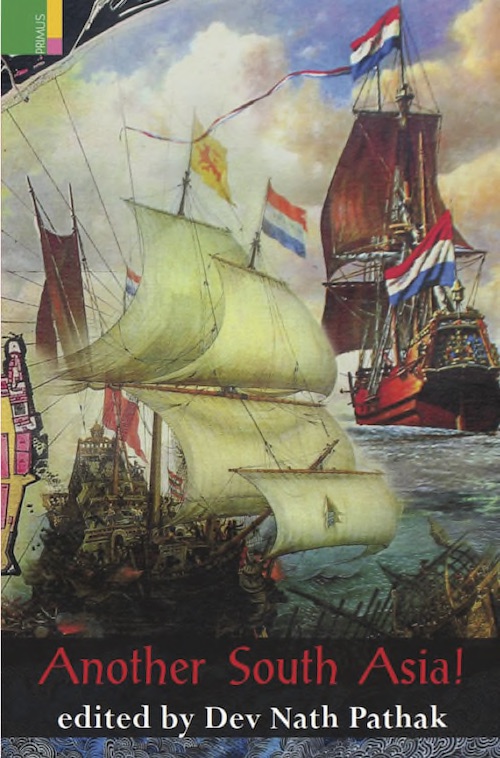
Culture Is Political & Politics Is Cultural In ‘Another South Asia’


Anushka Kahandagama
Culture is Political & Politics is Cultural in ‘Another South Asia’;Another South Asia! Pathak, Dev Nath. 2017. Delhi: Primus Books.
 It
was at my grandfather’s house where as a child I came to know about
Krishna. Krishna was a hunched, short fair middle-aged man who worked in
the neighbour’s estate. Most of the time Krishna and I interacted and
he shared fruits with me. My grandfather told me about how Krishna came
from India to Sri Lanka due to the oppression he encountered. This is
one of the earliest memories I have of crossing the boundaries of South
Asia. Then, of course there were stories about the LTTE (full form?)
leaders crossing borders of India and Sri Lanka in the dead of night.
The stories informed us that these border crossing Tigers would go to
watch a Tamil movie and have dinner in India and return to Sri Lanka by
the next morning. These stories might not be entirely true. As
a student of social anthropology I am not interested in digging out the
‘truth’ content. Truth is in the meanings that emerge from not so true
stories., The regional connections are marked in these stories. Much
later, after many years, I watched SAARC games as an enthusiastic South
Asian teenager. And as the destiny would have it, I ended up studying at
South Asian University located in the dusty Delhi in politically
volatile India. It is not such a long journey of my idea and experience
of South Asia. It entails the early stage equipped with exotic,
colourful and exciting images, later accompanied by tedious and
mechanical bureaucracy and administration, and very recently the
addition of cynicism- South Asia means everything bad. I think this may
be true of many of us, our memories and stories, today. In this wake,
the book Another South Asia unearths hidden and forgotten histories and
shared experiences in the region.
It
was at my grandfather’s house where as a child I came to know about
Krishna. Krishna was a hunched, short fair middle-aged man who worked in
the neighbour’s estate. Most of the time Krishna and I interacted and
he shared fruits with me. My grandfather told me about how Krishna came
from India to Sri Lanka due to the oppression he encountered. This is
one of the earliest memories I have of crossing the boundaries of South
Asia. Then, of course there were stories about the LTTE (full form?)
leaders crossing borders of India and Sri Lanka in the dead of night.
The stories informed us that these border crossing Tigers would go to
watch a Tamil movie and have dinner in India and return to Sri Lanka by
the next morning. These stories might not be entirely true. As
a student of social anthropology I am not interested in digging out the
‘truth’ content. Truth is in the meanings that emerge from not so true
stories., The regional connections are marked in these stories. Much
later, after many years, I watched SAARC games as an enthusiastic South
Asian teenager. And as the destiny would have it, I ended up studying at
South Asian University located in the dusty Delhi in politically
volatile India. It is not such a long journey of my idea and experience
of South Asia. It entails the early stage equipped with exotic,
colourful and exciting images, later accompanied by tedious and
mechanical bureaucracy and administration, and very recently the
addition of cynicism- South Asia means everything bad. I think this may
be true of many of us, our memories and stories, today. In this wake,
the book Another South Asia unearths hidden and forgotten histories and
shared experiences in the region.
The
book took me on a journey, which was partially new to me and unraveled a
world beyond the boundaries of South Asia. What is South Asia and what
is ‘Another South Asia?’ The word ‘South Asia’ came into being after the
Second World War. In the wake of the establishment of area studies in
the United States, the ‘Asian continent’ as a space of study came into
being. After the Second World War, it was found that there is not much
knowledge about the region to deal with it’s economic, political and
social issues. During the period of the 1940s – 1970’s, American State
Department identified the region as South Asia. However, the word does
not emerge within the region but imposed by various administrative
bodies’ exogenesis to the region. The strong administrative boundaries
created within the region have been naturalized creating a ‘modern myth’
through textbooks, legal documents, etc. The borders and boundaries
along the nation-states render the region lifeless bunch of territories.
The official idea of South Asia does not see that people share their
grand mythologies, civilization, cultures, and languages. They also
share the political ills and social evils, not only heroes and virtues.
These boundaries are sites of interactions with wanderers, devotees,
travelers and others. The
making of the region as an administrative entity has de-historicized
the region. The scholars who are blinded by the boundaries of
nation-states limit their studies and intellectual imagination to the
nation-states. The effort of the book Another South Asia problematizes
these administrative boundaries, cartographic borders, and bureaucratic
impediments. While editor of the book outlines the rationale to depart
from the disciplinary limitations, Sasanka Perera argues in this essay
that ‘a more dynamic sense of regionalism and regional consciousness
must necessarily emanate from sources exterior to SAARC such as artists,
writers, scholars and ordinary citizens’ (page 261). In the other
significant essays we take note of the examples of poetic, literature,
theater and practices of Sufis. The book brings together scholars from diverse background and conjures an idea of fluid region.
Read More
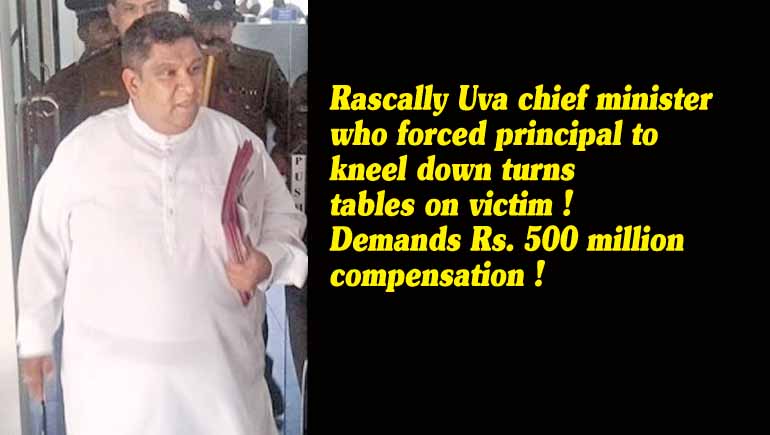
Rascally Uva chief minister who forced principal to kneel down turns tables on victim ! Demands Rs. 500 million compensation !
 (Lanka-e-News
- 27.Feb.2018, 2.14PM) The uncouth Uva province chief minister Chamara
Sampath Dassanayake the brute who is now out on bail in the case in
which he is charged with forcibly making R. Bavani the principal of
Badulla Tamil Balika Vidyalaya to kneel down before him has sought to
turn the tables on the victim, degrade the sacred laws and subvert the
course of justice by claiming a compensation of Rs. 500 million from the
principal.
(Lanka-e-News
- 27.Feb.2018, 2.14PM) The uncouth Uva province chief minister Chamara
Sampath Dassanayake the brute who is now out on bail in the case in
which he is charged with forcibly making R. Bavani the principal of
Badulla Tamil Balika Vidyalaya to kneel down before him has sought to
turn the tables on the victim, degrade the sacred laws and subvert the
course of justice by claiming a compensation of Rs. 500 million from the
principal.
It is to be noted that this rascally minister had sent a letter of
demand while there is a case against him in connection with his barbaric
and disgraceful conduct at the SL Human Rights Commission. Hence, in
these circumstances , the letter of demand sent by the culprit to the
victim in order to flaunt his political powers is tantamount to a threat
made to the principal . If a political bigwig is to abuse his powers to
make a public servant to kneel down before him , and even goes as far
as to threaten and intimidate the victim by sending a letter of demand
while the case against him is being heard, such circumstances can only
precipitate anarchy in the country with political scoundrels and
ruffians taking the law into their hands , while the victims continue to
suffer at every turn. This will further imply the laws are not strong
enough to punish the political villains and barbarians who are now
multiplying in the country because they know fully well of the impunity
they are enjoying .
It will serve well if the BASL too inquires into who is the lawless
lawyer who sent such a letter of demand , with a view to taking action
against him/her.
---------------------------
by (2018-02-27 08:43:03)
by (2018-02-27 08:43:03)
WORLD: Ignoring Crime Prevention is a Sri Lankan Policy


A reflection on the Report of the United Nations High Commissioner for Human Rights on Sri Lanka at the 37th Session of the Human Rights Council, 26 February–23 March 2018
by Basil Fernando-February 27, 2018
 The
idea of good governance in Sri Lanka seems to be - to make lot of good
promises and thereafter to ignore all of them. This is not only an
internal policy, but this seems also to be our international policy
particularly with regard to the United Nations Human Rights Council. Of
course, when you do these kinds of things it is not possible to prevent
it from being unnoticed. The Human Rights High Commissioner’s report on
Sri Lanka this year, clearly indicates the High Commissioner has seen
through both sides of that coin; that is, the ease with which Sri Lanka
has agreed to whatever requests that the Council has made to it and also
the ease with which all that had been agreed, has been ignored.
The
idea of good governance in Sri Lanka seems to be - to make lot of good
promises and thereafter to ignore all of them. This is not only an
internal policy, but this seems also to be our international policy
particularly with regard to the United Nations Human Rights Council. Of
course, when you do these kinds of things it is not possible to prevent
it from being unnoticed. The Human Rights High Commissioner’s report on
Sri Lanka this year, clearly indicates the High Commissioner has seen
through both sides of that coin; that is, the ease with which Sri Lanka
has agreed to whatever requests that the Council has made to it and also
the ease with which all that had been agreed, has been ignored.In fact, no Sri Lankan would, ever be surprised by this dual capacity. Anyone who knows about the dysfunctional nature of Sri Lanka’s legal system - particularly the criminal justice system - knows that these promises that are made to improve the human rights situation in Sri Lanka is simply unrealizable. The protection of human rights requires a functional legal system. Sri Lanka’s legal system is far below that requirement.
In 2017, 20th of September the Sectoral Oversight Committee on Legal Affairs (anti-corruption) and Media issued a Report “On Recommendations pertaining to the Expeditious and Efficient Administration of Criminal Justice” which was presented to the Parliament of Sri Lanka by the Chairman of the Committee Ajith Mannapperuma M.P. This report clearly pointed out that the state of the judicial system is shameful and outdated.
This Committee also pointed out that on the average a criminal trial into a serious crime takes at least 17 years to conclude. This is not about mega crimes such as mega corruption and other many heinous crimes, about which nothing has ever been done, and we can assume that in the near future nothing will be done.
The problem that the Committee was pointing out to, was what are usually called ordinary crimes such as murder, attempted murder, causing of grievous bodily harm, robbery, rape, sexual abuse of children and such other horrible things which in most countries today, would take around one year to finish - from the time of commencement of the investigations till the time of the final verdict. The Committee understood the core of the problem of the absence of criminal justice in Sri Lanka and expressed it very clearly. What the Committee said was of no surprise to any adult Sri Lankan. It is not only a lay person who knows this, but also the judges, the prosecutors, policemen, the prison officials, and above all the criminals in the country know this. For an average criminal it is a matter of joy to know that such delays is what would keep him out of a prison. But to the average citizen what it means is that if you or one of your family members becomes a victim of crime, it is rather a sad thing. However, the Democratic Socialist Republic of Sri Lanka would not think of the matter in the same way. It is a Republic in which the commitment for the eradication of crime, takes one of the least priorities.
Now let us go back to this Committee again. To the credit of the Committee, they have taken their task seriously and suggested to the Ministry of Justice that within six months from the 20th of September 2017 at least the following recommendations must be done to address the problem.
“….
6. Steps that should be taken to strengthen the mechanism
i. Steps to be taken by the Attorney General and to report by him to the Chief Justice, in order to make it imperative under Section 12 of the Judicature Act No 2 of 1978 for trial before a trial at bar - cases of corruption, declaration of assets, money laundering, fraud, criminal misappropriation, criminal breach of trust and making of fraudulent documents and other similar crimes - that exceeds the value of 5 Million Rupees.
ii. The Parliament should newly establish an anti-corruption High Court under Article 105 (1) (d). These High Courts should hear trials which are crimes under the existing law before three courts presided over by three High Court Judges for continuous day-to-day trials.
iii. Number of High Court Judges should be increased to 110 and in relation to that the Judicature Act No. 02 of 1978 should be amended.
iv. In order to create an environment for expediting pre-trials before the High Courts, by way of day-to-day trials, recorder judges should be appointed.
v. When a trial starts, under 263(1) the Criminal Procedure Code on crimes of murder, attempted murder, rape, and child abuse, and other similar crimes, it must be made compulsory to hold trials day-to-day and genuine steps must be taken to realise this.
vi. 10 new High Courts must be launched for High Courts which have been recognised as having a large backlog. That is Anuradhapura, Kandy, Gampaha and Ratnapura – there must be one more extra High Court each, a new High Court should be established at Matale and 04 more High Courts in the Colombo area.
vii. There is a new High Court at Anuradhapura for hearing of trials on child abuse. A High Court must be established in Colombo also for hearing of trials relating to child abuse in the similar manner.
To increase the effectiveness of the work of the Attorney General’s Department
…..We made the following observations regarding the Attorney General’s Department.
a. Delays in filing indictments and the files that have gathered in the Department remain without change.
b. The tendency for capable new attorneys to not make applications when vacancies for new positions in the Department are announced. The AG has submitted several proposals in order to improve the efficiency of the Department and to regain again the prestigious position it had. (This document is annexed to this report)
c. The following proposals are made by this Committee after considering the report of the Attorney General, the facts placed by the Secretary to the Ministry of Justice on behalf of the Ministry, and the facts placed on behalf of the Sri Lanka Bar Association. These recommendations should be taken as a response to the public criticisms regarding the administration of justice relating to crimes, relating to the AGs Department and the Government and as such these recommendations should be considered as having national significance and the Committee recommends that these be implemented without delay.
i. The salaries of all the officials of the Attorney General’s Department should be revised urgently and steps should be taken to retain the competent and experienced officers; job attraction which will enable the recruitment of competent officers should be created. Recommendations to this effect has been made to the Government earlier but hey have not been implemented. (The decision of the Committee was that the salary of a state counsel at the time of recruitment should be in terms of the circular No 5/2016 of State Administrative Services Department one step below the salary scale of a Magistrates as per circular JS/1.
ii. The approved number of positions for state counsels should be increased from 118 to 218 – 50 of the 100 new appointments should be made by January 2018 and the other 50 by 2018 May/June and 2019 January recruiting 25 persons each time.
iii. Further to making advertisements for recruitment of new state counsel, the Attorney General must inform the Deans of the Faculties of Law and the Principal of the Sri Lanka Law College that those who graduate with law degrees in the universities and pass the final year examinations in the Law College with an honours/merit pass, to be called upon for interviews for the recruitment as state counsel.
iv. For all High Courts where more than 50 indictments are still pending new state counsel should be appointed besides the state counsel who is already serving.
v. For all the offices of the Attorney General’s Department, throughout the island besides the serving office assistant another office assistant, stenographer and court clerk should be appointed.
vi. As the new building for the Attorney General’s Department is to be completed by April 2019, till the new building is completed, an appropriate building should be rented out in the Hulftsdorp area which could accommodate 100 officers and in such a building there should be space to comfortably accommodate for official purposes maximum of 02 state counsel in an office room.
vii. In order to provide more efficiently for the security all the officers of the Attorney General’s Department should be provided with an official car.
viii. For the purpose of greater efficiency of the Department’s administrative services, an Information Technology Unit must be established within the Attorney General’s Department.
ix. An officer of the Sri Lanka Administrative services should be made available to work under the supervision of the Senior State Counsel of the Attorney General’s Department.
x. Steps must be taken to provide for systematic and adequate post graduate studies for the officers of the Attorney General’s Department.
Further to the above measures, it is also recommended that attention of the Ministry of Justice should be drawn to the Attorney General’s Report dated 30.08.2017. It should specially be remembered that Attorney General’s Department is not just one more Government Department and the facilities and the environment necessary for it to carry out its special responsibilities should be the obligation of the State. We also like to point out that the Central Bank of Sri Lanka, the Parliament and similar institutions with special responsibilities have been provided with special allowances and provided with special facilities. We wish to state that raising the Attorney General’s Department to a special position as the above can easily be justified.
Seeking a solution to the scarcity of stenographers which is one of the reasons for the delays in courts and for continuous hearing of cases.
…..we make the following recommendations and also recommend that these solutions must be implemented within the coming six months.
i. In relation to for qualifications for recruitment instead of the present requirement of a credit pass in mathematics, replace with an ordinary pass.
ii. As stenographers could be regarded as skilled labourers their salaries must be raised to MT/2/2016 Salary scale.
iii. Raise the age limit for recruitment to 45 years. Create the possibility of recruiting unskilled labourers for stenographers’ positions contract basis of day –to day payments – and later when they get trained raise their positions to permanent basis giving priority of place for the recruits who were recruited earlier on contract basis.
iv. Recruiting retired stenographers on an urgent basis with encouragement of providing a small ( sulu dimanawak) allowance
v. Starting in a government’s technical college – study courses for stenographers.
Recommendations for making the work of the Commissions on Bribery and Corruption efficient.
After the inquiries by the Commission for Bribery and Corruption, in the past 23 years, the accused have been found guilty for the crime of “corruption” only on three occasions. It must be said that this is a sad reflection of the manner in which the Commission works at present and also about its powers. Absence of competent lawyers in the Commission has been recognised as a serious problem. Besides, no local legislation has been instituted in order to incorporate into the Sri Lankan Law, the provisions of the United Nations Convention on Corruption.
[Emphasis-ours]
[Excerpt from an unofficial translation of the original report in Sinhala]
Reclaiming the wealth that has been acquired through crimes
The law for reclaiming by the state the wealth that has been acquired through crimes should be considered a national priority and should be passed urgently. Further, the Ministry of Justice must accept as a responsibility to introduce a new law on the above mentioned matters and amendment of other regulations and put into effect on an urgent basis.
The Ministry of Justice should be responsible to place before the parliament within two weeks the assessment of allocations necessary for the implementation of the above mentioned recommendations.
This Committee will take steps to place before the Minister responsible for this subject the Minister of Justice, His Excellency the Prime Minster and His Excellency the President.
At the same time it is the responsibility of the Ministry of Justice to take all steps to implement all the recommendations completely within six months of placing of this report before the Parliament.
The Committee will fortnightly monitor and review the progress of the implementation of this report. …”
Low priority for crime prevention
Well, the due date by which all these things were expected to happen is the 20th of March 2018! Up till now, there is no sign of anything happening.
What kind of human rights protection could you expect from any government that ascribes such a low priority to eradicate the most serious threat to life and liberty and the honour of women and children?
Human Rights protection is not about a great pie in the skies. It is about very simple things; like protecting people from murder, robbery, theft, rape and child abuse, and of course from dangerous drugs.
Why are these elementary things, matters of least importance in the Republic of Sri Lanka? There may be many explanations, but there is one explanation which stands out. This is that a serious policy for eradication of crime is very dangerous to many people who occupy high positions and also to those who make their money, thanks to low priority given to crime elimination.
That is the reality of the Sri Lankan nation. People have got used to it. And “people prefer” to sacrifice their own lives and liberties so that criminals can thrive.
This perhaps is the reality that the High Commissioner for Human Rights should spend forty days in quiet meditation on, if he wants his words to carry some significance - as it should - since he is speaking on behalf of the highest human rights body in the world.
ASP TRAPPED IN BRIBERY NET


An Assistant Superintendent of Police (ASP) was arrested by the officers
of the Bribery Commission around 9.00 am yesterday, while obtaining a
bribe.
Speaking to the Daily News, the Commission to Investigate Allegations of
Bribery or Corruption Director, SSP Priyantha Chandrasiri said the
suspect ASP had demanded a bribe of Rs. 40,000 initially to allow the
operation of a brothel under the disguise of an ayurvedic massage
parlour in the Wennappuwa area. However, the amount was subsequently
negotiated to Rs. 30,000.
The ASP was nabbed by Bribery Commission officers when he was accepting the money last morning.
The arrested ASP was produced before the Negombo Magistrate yesterday.
Eastern Ghouta 'humanitarian pause' ended by fresh shelling
Monitors say bombing hit Douma and other towns, killing at least five people, as Russia claims rebels fired on evacuation route

Wounded Mohammed Malas, two, at a makeshift clinic in Eastern Ghouta on February 22, 2018 (AFP)


A five-hour truce in Syria's Eastern Ghouta was halted prematurely by
fresh shelling on Tuesday, with both sides blaming each other for new
attacks on the besieged enclave.
Sources in the Damascus suburb told Middle East Eye that the ceasefire
lasted for only half an hour, when pro-government forces struck targets
in Douma, the main town in Eastern Ghouta, and other towns including
Harasta, Jisreen and Housh al-Dawahra.
At least five people, including women and children have been killed, sources said, while "many others" were injured.
The United Nations said ongoing combat had made it impossible to bring in aid or rescue the wounded.
"Fighting continues this morning. That is what our reports from Eastern
Ghouta tell us," a spokesman for the UN humanitarian office, Jens
Laerke, told reporters in Geneva, adding that it was premature to
discuss any relief operations for desperate civilians given the
persisting clashes.
The Syrian Observatory for Human Rights separately reported air strikes
in two towns, while other sources on the ground reported strikes over
the towns of Hasa report that the Syrian military denied.
The reported strikes came only hours into a Russian-imposed
"humanitarian pause" in the Damascus suburbs, where more than 400 people
have been killed in intense bombing over the last week, which was
designed to allow civilians to leave the besieged area.
Humanitarian corridors
Syrian families in Eastern Ghouta have been afraid to use the
humanitarian corroridors which Russia had called on to allow a safe
route for wounded to be evacuated and civilians to escape.
"No one is willing to attempt to use the corridors or leave Eastern
Ghouta," a source in Douma told MEE. "How can they trust the very people
who killed their families."
The Russian military was reported by the Tass news agency of accusing
rebels in the enclave of firing mortar bombs on an evacuation route,
meaning not one civilian had been able to leave.
The Kremlin went on to say that the future of Syria's ceasefire will depend on the actions of fighters in Eastern Ghouta.
"It will depend on how the terrorist groups behave, whether they will
open fire, whether provocations from them will continue," Kremlin
spokesman Dmitry Peskov told journalists when asked whether the current
daily five-hour pause in fighting will increase.
Meanwhile, the main rebel groups in Syria's Eastern Ghouta said on
Tuesday they would be willing to expel militant fighters from the
enclave as soon as a UN ceasefire takes effect.
The main forces are militant groups - Jaish al-Islam, Faylaq al-Rahman
and Ahrar al-Sham - who on Tuesday addressed a letter to the United
Nations which was seen by AFP.
Moscow says the corridors are aimed at saving lives, but Assad’s
opponents say they are a cynical ploy to snuff out the last pockets of
rebellion.
In a statement on Tuesday, the Revolutionary Command Council in
Damascus, a rebel umbrella organisation said the truce was “a green
light for the regime and its allies to continue the genocide on unarmed
civilians in besieged Ghouta”.
“This reveals the reality of its [Russian and Syrian-allied forces]
intentions to carry out mass forced displacement under the pressure of a
scorched earth policy and demographic change.”

'A Russian crime'
The Russian defence ministry said on Monday the measures, decided in
agreement with Syrian forces, were intended to help civilians leave and
to evacuate the sick and wounded.
But the spokesman for Failaq al-Rahman, one of the main rebel groups in
the eastern Ghouta, accused Russia of presenting people with the choice
of forced displacement or being killed in bombardment and siege, and
called this a “Russian crime”.
Eastern Ghouta is the last major stronghold near Damascus for rebels
battling to topple President Bashar al-Assad, who has driven fighters
from numerous areas with military backing from Russia and Iran.
A UN Security Council resolution passed on Saturday had demanded a 30-day truce across Syria.
Fighting has escalated on several fronts in Syria this year. As Assad
has pressed the offensive against eastern Ghouta, Turkey has launched an
incursion against Kurdish fighters in the northwestern Afrin region.
Tensions have also flared between Iran and Israel, which is deeply
alarmed by Tehran’s expanding influence in Syria. Syrian air defences
shot down an Israeli F-16 earlier this month as it returned from a
bombing raid on Iran-backed positions in Syria.
The Syrian war, which is approaching its eighth year, has killed
hundreds of thousands of people and driven half of the country’s pre-war
population of 23 million people from their homes.
Further reporting by agencies
Here’s the latest sign Trump’s lies about Russia are failing
Trump
says the Justice Department is politically biased. Lawfare’s Quinta
Jurecic examines the investigation Trump calls "fake news."
 THE MORNING PLUM:
new CNN poll finds that 61 percent of Americans say the Russia affair is a serious matter that should be investigated. It finds that 55 percent say President Trump has tried to interfere in special counsel Robert S. Mueller III’s investigation. And it finds that 60 percent are not confident that Trump is taking steps to safeguard the nation against foreign sabotage of future elections.
A
Here’s why this poll matters so much at this particular moment. It comes right after two major events that (1) underscored the extraordinary measures that Trump and his allies have employed to deceive the nation about the Mueller probe; and (2) illustrated Trump’s profound abdication in refusing to act to prevent further Russian attacks on our democracy.
THE MORNING PLUM:new CNN poll finds that 61 percent of Americans say the Russia affair is a serious matter that should be investigated. It finds that 55 percent say President Trump has tried to interfere in special counsel Robert S. Mueller III’s investigation. And it finds that 60 percent are not confident that Trump is taking steps to safeguard the nation against foreign sabotage of future elections.
A
Here’s why this poll matters so much at this particular moment. It comes right after two major events that (1) underscored the extraordinary measures that Trump and his allies have employed to deceive the nation about the Mueller probe; and (2) illustrated Trump’s profound abdication in refusing to act to prevent further Russian attacks on our democracy.
First, Rep. Adam B. Schiff (D-Calif.) released his rebuttal to the memoauthored
by Intelligence Committee Chairman Devin Nunes (R-Calif.). Schiff’s
rebuttal revealed just how absurd the story line spun by Nunes really
is: It showed that to get a warrant to surveil Trump campaign adviser
Carter Page, the Justice Department relied only narrowly on the Democratic-funded research in the “Steele dossier,” and relied on “multiple sources.” It also showed that the investigation predated any info from Steele, that the Justice Department actually did reveal that British spy Christopher Steele had gathered data for political reasons, and that the data was corroborated by investigators from other sources.
Now, it’s always possible Schiff’s rebuttal is wrong on some of the facts. But there is nothing in Nunes’s memo that offers any cause for concluding that. And Nunes’s memo undercuts itself, by revealing both that the genesis of the probe predated Steele and that judges renewed the warrants, suggesting they thought the probe was bearing fruit. Trump has claimed that the Nunes memo vindicates his insistence that the probe is a “witch hunt.” But those two facts about the Nunes memo alone demolish that lie. The Schiff rebuttal is icing on that cake — it simply reinforces the degree to which the Nunes memo inadvertently undercuts Trump’s narrative.
Indeed, what the Schiff and Nunes affair really illustrates is just how far Trump’s allies and other Republicans — such as House Speaker Paul D. Ryan (Wis.), who blessed the Nunes memo strategy — are going in weaponizing and perverting the oversight process to protect Trump from any accountability. Meanwhile, the second big event — Mueller’s indictment of 13 Russian nationals — shows just how elaborate the alleged scheme to undermine our election really was, and by extension, what a great abdication it is for Trump to continue to claim Russian interference is a hoax and to continue to fail to do nothing in preparation for more to come.
The CNN poll suggests that the false alt-narrative spun by Trump and his allies — even to the degree that it’s merely intended to kick up a lot of fog to confuse people — just isn’t working on much of the American mainstream. Large majorities not only accept that the Russian sabotage happened, but also see it as a cause for serious concern that should be investigated and reject the notion that the probe is a “witch hunt” to hurt Trump. (Only 34 percent believe that.) Majorities also say Trump has interfered in that same investigation and that Trump isn’t taking future sabotage seriously enough. Even larger majorities say that such sabotage is generally a cause for concern (72 percent) and that disinformation aimed at U.S. voters is also cause for concern (70 percent).
The broader story Trump and his allies are trying to tell here is that the probe itself represents a “deep state” coup to overturn the election. In addition to the Nunes memo’s effort to portray the probe as the fruit of a poisoned tree (now debunked by Schiff) and Trump’s frequent suggestion that Russian sabotage never happened at all (undercut by the Mueller indictments), there has also been a drumbeat of claims that law enforcement allowed alleged Hillary Clinton wrongdoing to slide, showing that it is riddled with corruption. Trump again tweeted furiously about that Tuesday morning. But the plain fact remains that a large majority of Americans see the probe as legitimate and focused on matters of serious national interest.
There is a tendency among liberals to dismiss such findings by arguing that the alt-narrative is working on its intended target — Republicans — which shows that GOP lawmakers won’t hold Trump accountable if Mueller documents serious misconduct. It is true that the CNN poll finds that 71 percent of Republicans think the probe is a witch hunt. But even here you can see cracks in Trump’s coalition: Twenty-six percent of Republicans say Russian sabotage is a serious matter that should be investigated, and non-college-educated whites tilt slightly toward that position, 50 percent to 45 percent.
But that aside, it was always going to be hard to get Republican voters to take this seriously as long as Trump keeps telling them it’s a witch hunt. And the chances that GOP lawmakers will act even if serious misconduct is uncovered has always been a long shot. It’s likely that the only hope for any accountability is for Democrats to take back the House. And the CNN poll shows that large majorities of the voter groups that will likely make that possible all see this as a serious matter. That position is held by 67 percent of college-educated whites; 60 percent of people under 45; 71 percent of nonwhites; and 65 percent of women.
Whether or not that will actually help Democrats take back the lower chamber is another question, of course. But Trump and his allies are losing the battle over public opinion on the Russia probe, and we shouldn’t hesitate to say so.
* WHITE HOUSE REACHES OUT TO GOP ON GUNS: Bloomberg Politics reports that the White House is reaching out to congressional Republicans to gauge their support for various gun reforms, but isn’t getting much back:
* WILL REPUBLICANS ACT ON BACKGROUND CHECKS? The Post reports that in addition to the proposal mentioned above, which would improve data sharing on background checks, there’s another possibility:
* JOHN KELLY AND IVANKA TRUMP ARE AT ODDS: CNN reports that some inside the White House, including Chief of Staff John F. Kelly, are pretty ticked that Trump sent Ivanka Trump to South Korea:
* A SHOWDOWN OVER THE NATIONAL RIFLE ASSOCIATION IN GEORGIA: After Delta Air Lines nixed a discount fare program for the NRA, the Republican lieutenant governor threatened to kill a tax break deal for the company:
The GOP governor, who supports the tax break to encourage international flight routes from Georgia, is not commenting. What will conservatives say about this use of governmental power?
* THE NRA WHITEWASHES ITS HISTORY: NRA spokesperson Dana Loesch is pushing the idea that the NRA supports fixing the holes in the background check system. Salvador Rizzo reconstructs the history and shows the NRA fought background checks for years:
* THE FORCES OF DECENCY ARE RISING: Paul Krugman considers the rise of the alt-right as against the response to Trumpism and the Florida shooting from #MeToo and the Parkland kids, and argues the latter groups are ascendant:
Now, it’s always possible Schiff’s rebuttal is wrong on some of the facts. But there is nothing in Nunes’s memo that offers any cause for concluding that. And Nunes’s memo undercuts itself, by revealing both that the genesis of the probe predated Steele and that judges renewed the warrants, suggesting they thought the probe was bearing fruit. Trump has claimed that the Nunes memo vindicates his insistence that the probe is a “witch hunt.” But those two facts about the Nunes memo alone demolish that lie. The Schiff rebuttal is icing on that cake — it simply reinforces the degree to which the Nunes memo inadvertently undercuts Trump’s narrative.
Indeed, what the Schiff and Nunes affair really illustrates is just how far Trump’s allies and other Republicans — such as House Speaker Paul D. Ryan (Wis.), who blessed the Nunes memo strategy — are going in weaponizing and perverting the oversight process to protect Trump from any accountability. Meanwhile, the second big event — Mueller’s indictment of 13 Russian nationals — shows just how elaborate the alleged scheme to undermine our election really was, and by extension, what a great abdication it is for Trump to continue to claim Russian interference is a hoax and to continue to fail to do nothing in preparation for more to come.
The CNN poll suggests that the false alt-narrative spun by Trump and his allies — even to the degree that it’s merely intended to kick up a lot of fog to confuse people — just isn’t working on much of the American mainstream. Large majorities not only accept that the Russian sabotage happened, but also see it as a cause for serious concern that should be investigated and reject the notion that the probe is a “witch hunt” to hurt Trump. (Only 34 percent believe that.) Majorities also say Trump has interfered in that same investigation and that Trump isn’t taking future sabotage seriously enough. Even larger majorities say that such sabotage is generally a cause for concern (72 percent) and that disinformation aimed at U.S. voters is also cause for concern (70 percent).
The broader story Trump and his allies are trying to tell here is that the probe itself represents a “deep state” coup to overturn the election. In addition to the Nunes memo’s effort to portray the probe as the fruit of a poisoned tree (now debunked by Schiff) and Trump’s frequent suggestion that Russian sabotage never happened at all (undercut by the Mueller indictments), there has also been a drumbeat of claims that law enforcement allowed alleged Hillary Clinton wrongdoing to slide, showing that it is riddled with corruption. Trump again tweeted furiously about that Tuesday morning. But the plain fact remains that a large majority of Americans see the probe as legitimate and focused on matters of serious national interest.
There is a tendency among liberals to dismiss such findings by arguing that the alt-narrative is working on its intended target — Republicans — which shows that GOP lawmakers won’t hold Trump accountable if Mueller documents serious misconduct. It is true that the CNN poll finds that 71 percent of Republicans think the probe is a witch hunt. But even here you can see cracks in Trump’s coalition: Twenty-six percent of Republicans say Russian sabotage is a serious matter that should be investigated, and non-college-educated whites tilt slightly toward that position, 50 percent to 45 percent.
But that aside, it was always going to be hard to get Republican voters to take this seriously as long as Trump keeps telling them it’s a witch hunt. And the chances that GOP lawmakers will act even if serious misconduct is uncovered has always been a long shot. It’s likely that the only hope for any accountability is for Democrats to take back the House. And the CNN poll shows that large majorities of the voter groups that will likely make that possible all see this as a serious matter. That position is held by 67 percent of college-educated whites; 60 percent of people under 45; 71 percent of nonwhites; and 65 percent of women.
Whether or not that will actually help Democrats take back the lower chamber is another question, of course. But Trump and his allies are losing the battle over public opinion on the Russia probe, and we shouldn’t hesitate to say so.
* WHITE HOUSE REACHES OUT TO GOP ON GUNS: Bloomberg Politics reports that the White House is reaching out to congressional Republicans to gauge their support for various gun reforms, but isn’t getting much back:
One measure the president has spoken of approvingly in public — legislation that would close gaps in criminal records entered into the database for existing federal gun background checks — has already hit a bump. Republican Senator Mike Lee of Utah … blocked the chamber from considering the bill. … House Republicans also are deeply divided over whether to allow consideration of the background check legislation without a provision … requiring all states to honor concealed carry permits issued in other states.“Are deeply divided” is code for “won’t allow this to move forward, ever, no matter what.” The question is whether Trump will press Republicans to do it. Seems unlikely.
* WILL REPUBLICANS ACT ON BACKGROUND CHECKS? The Post reports that in addition to the proposal mentioned above, which would improve data sharing on background checks, there’s another possibility:
A bill aimed at beefing up background checks, first proposed in 2013 by Sens. Joe Manchin III (D-W.Va.) and Patrick J. Toomey (R-Pa.), could be revived, the two men said, but they maintained that Trump’s support was a prerequisite. “President Trump has to find a pathway that he feels comfortable with,” Manchin said.Nice to hear this proposal (which was filibustered by Republicans in 2013) being discussed again, but I fear we will soon learn Trump is not even remotely serious about acting even to improve background checks.
* JOHN KELLY AND IVANKA TRUMP ARE AT ODDS: CNN reports that some inside the White House, including Chief of Staff John F. Kelly, are pretty ticked that Trump sent Ivanka Trump to South Korea:
The decision to send her to South Korea did not sit well with some senior officials in the West Wing, two people familiar with the situation told CNN. The nuclear threat from North Korea and the tensions already boiling across the Korean Peninsula made any U.S. delegation far more than ceremonial. Kelly was not initially enthusiastic about her South Korea trip … largely because the visit to the Korean Peninsula was far more than a typical Olympic closing ceremony.But according to CNN, Kelly privately concluded that opposing her trip “would be a losing battle.” It’s great that President Trump is putting only “the best people” in charge, isn’t it?
* A SHOWDOWN OVER THE NATIONAL RIFLE ASSOCIATION IN GEORGIA: After Delta Air Lines nixed a discount fare program for the NRA, the Republican lieutenant governor threatened to kill a tax break deal for the company:

The GOP governor, who supports the tax break to encourage international flight routes from Georgia, is not commenting. What will conservatives say about this use of governmental power?
* THE NRA WHITEWASHES ITS HISTORY: NRA spokesperson Dana Loesch is pushing the idea that the NRA supports fixing the holes in the background check system. Salvador Rizzo reconstructs the history and shows the NRA fought background checks for years:
The NRA’s love-hate relationship with the [National Instant Criminal Background Check System] database is something to behold. The group once fought to strike down the law that created the database. Failing that, the NRA still managed to defang one of the law’s provisions. But now, the NRA and Loesch are concerned that the NICS is not getting all the records it needs. The irony is that the NICS might be getting those records — or getting more of them, at least — had the NRA not worked to undermine the Brady law in the early 1990s.But today’s concern about the holes in our background check system sure makes the NRA sound reasonable right now!
* THE FORCES OF DECENCY ARE RISING: Paul Krugman considers the rise of the alt-right as against the response to Trumpism and the Florida shooting from #MeToo and the Parkland kids, and argues the latter groups are ascendant:
The period 2016-17 clearly represented a sort of Alt-Right Spring … in which white supremacists and anti-Semites were emboldened. … I nevertheless find the surge of indignation now building in America hugely encouraging. … The #MeToo movement, the refusal to shrug off the Parkland massacre, the new political activism of outraged citizens (many of them women) all stem from a common perception … that far too much power rests in the hands of men who are simply bad people.
Krugman suggests the only hope for the “forces of decency” is taking the House, but much of this energy should also be getting channeled into regaining ground in the states, which is crucial.
* AND THIS IS HOW ONE REPUBLICAN CHANGED ON GUNS: Paul Kane has an
interesting report on how GOP Rep. Brian Mast of Florida, a veteran and
gun-carrier, changed his mind and now supports gun control:
Mast is a Bronze Star winner — the ultimate “good guy with a gun,” as gun-rights supporters like to say. But his handgun and concealed-weapon permit would have been no match for someone firing a military-style weapon from high above. “He could take me out, and my concealed-carry does me no good,” he recalled thinking that day. That’s when Mast started thinking, for the first time in his brief political career, about how federal gun laws should change.If only more Republicans would think seriously about this issue, instead of thinking in “good guy with a gun” cartoons.
Subscribe to:
Posts (Atom)