Peace for the World World ! Your War Our Lives

The Dalai Lama
A Brief Colonial History Of Ceylon(SriLanka)
Sri Lanka: One Island Two Nations
A Brief Colonial History Of Ceylon(SriLanka)
Sri Lanka: One Island Two Nations
(Full Story)
Back to 500BC.

Monday, April 30, 2018
A Leader Like No Other, A Party Like No Other
UNP Leader Ranil Wickremesinghe
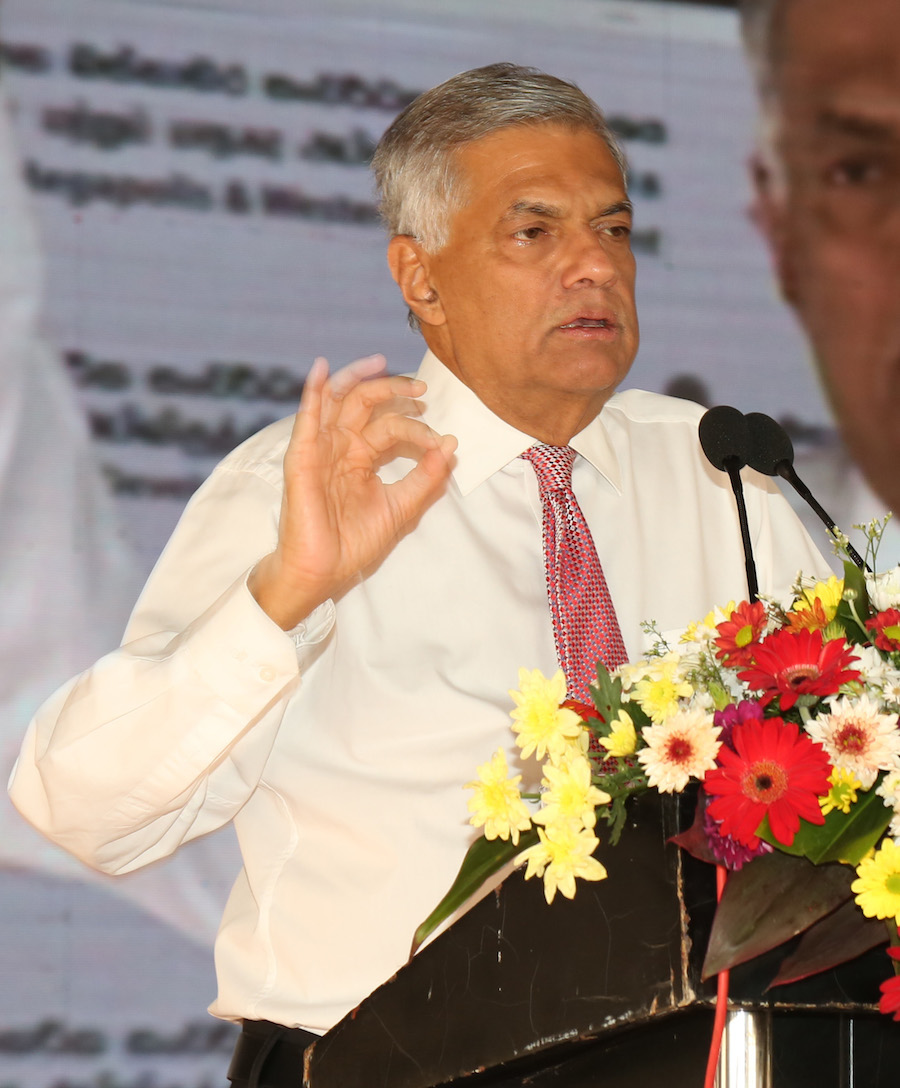
By Narada Seananayake –APRIL 29, 2018
“An obstinate man does not hold opinions. Opinions hold him” – Alexander Pope.
The UNP is in crisis.
The people know it. The party loyalists are tormented by it. The party leader is not aware of it. When
Lenin wrote his famous tract- ‘what is to be done?’ he began by
recognizing the problem. He wrote “Our party is in a state of formation.
There is the danger of diversion from the correct path. Ranil is not
Lenin. Ranil is a leader like no other leader, leading a party like no
other party.
For the UNP to decide on the way forward, it must first trace the path
that brought it to this point, period and phase. This essay is intended
to help that process.
Resolving the Riddle of Ranil 
Why does Ranil resist reforms in the party? Because they are not needed stupid!
Leaders lead. Followers follow. That is the effortless, painless world that Ranil Wickremesinghe the UNP leader inhabits.
He accepts no other arrangement. As
most psychologists would say, man is a creature of habit. His reactions
are automatic reflexes from the stimuli of his environment. Which is
why Warren Buffet remarked that “Chains of habit are too light to be
felt until they are too heavy to be broken”.
All his life, Ranil has lived in an environment of privilege. He has never knocked on doors. Doors have always remained open to him.
Ranil is convinced that he is the destined successor of J.R. Jayewardene. JRJ
made him a cabinet minister in his first term. And that was before he
turned thirty. That was destiny. A destiny that he will not share today,
with others in his party.
Since then his task has been a battle to match his destiny to the vagaries
of politics. Quite early in his political journey, he wisely concluded
that he does not possess that annoying attribute – the common touch, the
ability to be ordinary among ordinary people. That was essential to
retain his rural base in Biyagama his first constituency, won in the
1977 landslide. Why bother changing habits or renouncing birthrights
when more convenient options are available?
He deftly switched his base to metropolitan Colombo. That is what JR did
when he moved from Kelaniya to Colombo South. Adequate funds and
machine politics are efficient substitutes for public approval.
Ranil is not the archetypical grassroots leader. He is the
quintessential string puller leader. There is no way he will oblige the
UNP backbenchers in their demand to reform the party. Reform means
change. The very anatomy of change is determined not by one’s
surroundings but by one’s inherent mind set. When change and reform are
mooted, his instinct commands him to dig deep and stay put. That is what
he has done now.
The modern information age has no place for leaders such as Ranil Wickremesinghe. In this age, followers don’t follow leaders. Followers have the resources to make or break leaders.
So, if Ranil thinks that he has won the first round, he is in for not one surprise but plenty.
Read More

CID: A Navy chief helped wanted man flee in FAC

 A
high-profile CID investigation into the alleged abduction and
disappearance of 11 Tamil youth, by the Navy, during the previous
administration, mostly in 2008, has taken a dramatic turn with former
Navy Commander and the incumbent Chief of Defence Staff (CDS) Ravi
Wijegunaratne being accused of having helped an officer, wanted in
connection with the probe, flee the country.
A
high-profile CID investigation into the alleged abduction and
disappearance of 11 Tamil youth, by the Navy, during the previous
administration, mostly in 2008, has taken a dramatic turn with former
Navy Commander and the incumbent Chief of Defence Staff (CDS) Ravi
Wijegunaratne being accused of having helped an officer, wanted in
connection with the probe, flee the country.
The majority of abductions were allegedly carried out in Colombo and its suburbs.
The on-gong CID probe has come under the scrutiny of the Geneva-based United Nations Human Rights Council (UNHRC).
The CID identified the wanted person, who had escaped allegedly with the
help of the then Vice Admiral Wijegunaratne, as Lt. Commander Chandana
Prasad Hettiarachchi. At the time of Hettiarachchi’s alleged
disappearance in late March 2017, he had been attached to the Navy
welfare section in Colombo.
The CID recently brought to the notice of the Fort Magistrate the
circumstances which had led to Hettiarachchi’s disappearance, in spite
of two specific requests, made in March 2017, to hand him over to the
CID.
The CID has alleged that high ranking officers prevented the police from
questioning the suspect. The Navy has been accused of facilitating the
alleged disappearance of the former intelligence officer to mislead the
investigators.
The Island raised the issue with Admiral Wijegunaratne, after CID
Director SSP Shani Abeysekera had accused him of having facilitated
Hettiarachchi’s escape. The serious allegation was made in
Wijegunaratne’s presence, at a meeting, also attended by Ministers
Ranjith Madduma Bandara, Rajitha Senaratne, D. M. Swaminathan, Ajith P.
Perera, Navy Commander Sirimevan Ranasinghe, President’s Counsel J. C.
Weliamuna and senior officials of the CID and the FCID.
SSP Abeysekera alleged that Wijegunaratne had provided Rs. 500,000 to
Hettiarachchi and moved him out of Sri Lankan waters, in a Fast Attack
Craft (FAC). Wijegunaratne said that he would quit if allegations
against him could be proved.
Admiral Wijegunaratne declined to discuss the issue with us further.
However, the highest ranking serving officer told The Island, "Navy
Commanders don’t get involved in human smuggling."
Having failed to locate Hettiarachchi, the police recently sought public
assistance to trace him. Hettiarachchi is among five suspects,
including three Navy personnel, facing indictments over the
assassination of TNA Jaffna District MP, Nadarajah Raviraj and his
police bodyguard, Sergeant Lakshman Lokuwella, acquitted by the Colombo
High Court, in Dec. 2016.
The police have identified Hettiarachchi as ‘Navy Sampath’, though he had not previously known by that alias.
The Island sought Navy headquarters’ response to the CID allegations,
especially the alleged deployment of a fast attack craft to move
Hettiarachchi out of the Sri Lankan waters. The Navy headquarters
yesterday assured that a statement would be made shortly on the issue.
Of those, arrested, so far, in connection with the alleged 11
disappearances, six Navy personnel, including Commodore D. K. P.
Dassanayake and Commander R. P. S. Ranasinghe received bail from the
Colombo High Court, this year.
In addition to them, Lt. Commander Sampath Munasinghe, Security Chief of
wartime Navy Commander Vice Admiral Wasantha Karannagoda, too, was
arrested in connection with the disappearance case and given bail.
The alleged disappearances came to light, in early 2009, soon after the
successful conclusion of the war. Karannagoda initiated an inquiry after
receiving representations from a close relative of one of the missing
persons, through the intervention of one-time navy spokesman J. J.
Ranasinghe, incumbent Vice Chancellor of the Kotelawela Defence
University (KDU).
Lt. Commander Munasinghe quit the Navy several weeks after Karannagoda
had complained to police of the recovery of some national identity cards
and other items belonging to the missing persons, from his chief
security officer’s locker.
The CID initiated a fresh investigation after the change of government in January 2015.
The CID recorded statements, from over 50 officers, including former
Navy Commanders, Admiral Karannagoda and Admiral Travis Sinniah.
Sinniah succeeded Wijegunaratne, in August 2017. Sirimewan Ranasinghe replaced Sinniah in Oct 2017.
Lt. Commander K. C. Welagedara, who was the second-in-command of
Trincomalee-based Commander R. P. S. Ranasinghe, one of those arrested
in connection with the disappearances was questioned by the CID in 2013.
Police spokesman SP Ruwan Gunasekera told the media that Dassanayake had
supervised Ranasinghe and Hettiarachchi allegedly responsible for the
abductions at issue.
Gunasekera said those Navy personnel, under investigation, had carried out the abductions to extort money.
Proposed amendments to Bribery Act before House
Powers to deal with bribery and corruption in private sector


Proposed amendments to the Bribery Act which will also include powers to
deal with bribery and corruption in the private sector will be brought
before Parliament shortly, Bribery Commission Director General Sarath
Jayamanne PC said.
The new proposals also include powers to file legal action directly in
High Court, Jayamanne said during a workshop held for Parliamentary
Journalists Association members at Pegasus Reef Hotel in Wattala
yesterday. The Workshop had been organised with the assistance of the
‘Internews’ organization.
Jayamanne went said that only four convictions have been recorded during
the past 23 years in corruption cases due to snags in the system of
prosecution.
“However, convictions were brought in 57 Bribery cases last year, the highest recorded in a single year,” Jayamanne said.
He said according to proposed amendments, the Commission will have the
power to consult the Attorney General for advice in any legal matter
when needed.
“Also a minimum of a Rs.100,000 fine has been proposed to the
Declaration of Assets and Liabilities Act for Non declaration of Assets
and Liabilities. The current penalty for such an offence is Rs.1,000,”
he added..
The Commissioner further said that the amendments would be made to the
Bribery Act, Bribery Commission Act and the Property Evaluation Act.
“The Cabinet has approved the amendments and the Legal Draftsman’s
Department is doing the paperwork which will be submitted to Parliament
for approval.
“The amendments would be made to an extent that the cases could be
directly filed in the High Courts. Cases could only be filed in the
Magistrate’s court under the current Act,” Jayamanne said.
“The Bribery Act was implemented in 1957 and amendments were made in
1994. However, many practical issues have arisen due to some
complications in the amendment which has been made in a hurry,” the
Commissioner remarked.
“There are many errors in this system. The cases go on for a long time
due to the process of appealing and the inexperience of the persons
handling these cases. The Commission to Investigate Bribery or
Corruption (CIABOC) has only 200 inquiry officials to cater to the 210
lakh population of the country while Hong Kong has 1200 inquiry
officials for its 60 lakh population,” the Bribery Commission Director
General said.
Build society where lives could be shaped & maintained according to Lord Buddha’s teaching

 April 29, 2018
Full text of the message:
A society where lives could be shaped and maintained according to Lord Buddha’s teaching should be created
Wesak Poya Day, is a day that is important not only to Buddhists in Sri Lanka but Buddhists all over the world as they accept it as the day in which Lord Buddha’s Birth, Enlightenment, Nirvana took place, and is commemorated, venerated and honoured as it is linked to the three important occurrences of Lord Buddha’s life.
Lord Buddha’s teachings that help the society to progress include cooperation, working for reconciliation and righteousness. Undoubtedly, most of the virtuous qualities that exist in the Sri Lankan society have been nurtured by His teachings. Sri Lanka was known as ‘Dharmadweepa during the period these teachings and policies were followed and protected by the rulers and the masses.
However, at present in Sri Lanka, despite the day begins and ends with Buddha’s teachings, there is no reduction to the number of crimes. Lord Buddha’s teaching vividly shows that the number of criminal activities escalates and virtuousness and morality degenerate when the country and the people are economically ruined.
The rulers who fictitiously show they protect Lord Buddha’s teaching and follow counsel of the Buddhist clergy, deceive masses and instead of taking steps to develop the economy so that the standard of life of the masses could be raised, pave the way for crime, robbery and immorality. As long as these rulers, who lack foresight, rule the country Sri Lanka would never become a ‘Dharmadweepa’.
In such a situation the duty and the responsibility of all Sri Lankan Buddhists is to distance themselves from all dissoluteness so that the economic, cultural and moral degeneration could be ended. Also, we wish Sri Lankan Buddhists would, on this Wesak Day, resolve to eliminate all obstructions that have been placed against building an environment that would genuinely help in maintaining lives of our people according to Lord Buddha’s teaching and to create a society that would cherish such transformation.
Buddha introduced mental culture to humanity

2018-04-30

 “What should be directly known is directly known
What should be developed has been developed
What should be abandoned has been abandoned
Therefore, Brahmin, I am a Buddha”
(Sela Sutta – Sutta Nipata)
Two hundred and sixty decades ago, the above mentioned unprecedented and unheard of words profoundly resounded and tremendously resonated in our human society. The Master and an extraordinary human being who indefatigably accomplished his incomparable spiritual aspiration firmly assured and resolutely confirmed true nature and the impeccable personality of the Buddha.
As the aspirant of the Buddha; the Bodhisatta, who enthusiastically sought the ultimate truth, an incomparable noble search was implemented and executed with indefatigable endeavour and indefinable determination till he reached the beacon of the conclusion of the aspiration of his spiritual purpose, the full enlightenment.
Inconceivable challenges and ineffable difficulties were enormous and excessively inundated in his life but he patiently overcame and assiduously conquered them with courage and perseverance. With his unique dedication and paramount persistence he conquered the battle of defilements and impurities; ultimately by treading the Noble Eightfold Path or Path of Purification he attained his spiritual accomplishment, the bliss of Nibbana.
“Through many a birth in Samsara, have I wandered in vain, seeking the builder of his house of life. Repeated and continual birth is indeed suffering!
O house-builder, you are seen!
You will not build this house again. For all your rafters broken and your ridge-pole shattered.
My mind has reached the unconditioned! I have attained the destruction of cravings.”
(Gouthama Buddha)
This is his foremost statement and profound confirmation soon after he accomplished his Full Enlightenment.
Though we live in a digitally-cultured global society, modern science and nano-technology have failed to make peace of the human mind in our human society. All these boasting achievements and developments have created competitive commercial culture and numerous discordances in our human society today. Profit-based multinational weapon manufacturing companies and multitudes of consumer products business sectors have directed innocent people into a quagmire of mental conflicts and struggles.
Nano technology and Digital Revolution along with proliferation of digital devices have created highly perplexing entanglements in our human society today.
26 centuries ago, the Blessed One explicitly emphasised thus:
“A tangle inside, a tangle outside,
This generation is entangled in a tangle”
(Samyutta Nikaya)
In his statement, the Blessed One firmly stated that the tangle was the network of craving.
We have encountered innumerable individuals who are infatuated with accumulation of wealth and intoxicated with pursuing treasures. Unfortunately most of them are mentally stressful and sometimes depressed. Some of them have no peace at all. Their marriage lives are in chaos and disorder. Their children are disobedient and insubordinate. Some parents complain about their poor performance of academic work and unruly behaviour. Now increasing of single parent digits are highly escalated. Some partners are terrified and tortured. The prime reason is that most people are mentally bewildered and topsy-turvy. Humane qualities are drastically degraded.
They think that the money, wealth, profit, treasures, status, power, amusement and so on are the life. They have no capacity and ability to understand the importance of humane inner qualities.
Once Gouthama Buddha said thus:
“One who, while himself seeking happiness, oppresses with violence other beings who also desire happiness, will not attain happiness hereafter.”
Today, emotional disturbances and mental traumas are overflowing.
Unfortunately some members in our human family come to an end with catastrophic conclusion due to their inconceivable agonies. Mental distress, frustration, stress, anxiety, grief, misery, sorrow, despair, depression are widely known and prominent maladies along with numerous afflictions which we daily experience and encounter around the globe today.
The significance of the Buddha Dhamma, the teaching of the Buddha is opening the gateway to find and scrutinize the underlying tendencies of the mind and removing the cloud of ignorance which tremendously covers the human mind. The great Master, the Buddha has prescribed many techniques to apply and train ourselves to win the battle of hidden tendencies. This is why the Buddha Dhamma is widely accepted and globally appreciated in our human society today.
Some may firmly believe that aggressively working and fighting to preserve and protect their nationality and culture is what the Goutama Buddha asked and encouraged us to practise, but none was included in his discourses at all. If someone can understand the fundamental teaching of the Buddha, they would be able to recognise who the Buddha is, and what the Buddha said.
Once, when his disciples assembled, the Buddha precisely emphasised thus;
“Bhikkhus, there are these four means of sustaining a favourable relationship.
What four? Giving, endearing speech, beneficent conduct, and impartiality. These are four means of sustaining a favourable relationship.”
Unfortunately, many people have completely forgotten the authentic approach to find the true peace and innermost happiness that the great Master, Gouthama Buddha compassionately asked to achieve. There are numerous unacceptable and disgraceful activities that are visible in the vicinity of the island of the Dhamma and political movements are gravely apparent and undeniable in our society today. These provocative pursuits will constantly lead and create a very violent and hostile environment in our peaceful society.
People speak and express their personal views about their own so called cultures. Some of them are in a battle field to make their own superior to another. Even some religious groups struggle to place the superior one’s own in some other part in the world today.
Unfortunately, they never focus on their own mentality and inward condition. After a long period of time, by achieving his ultimate spiritual aspiration the Blessed One declared that the best was the mental culture. Mentally cultured people never suffer from defilement and they are not shaken by any vicissitude of life.
Once the Goutama Buddha was asked by an earth-bound deity (deva) who dwelt in the forest, each day he would see monks who inhabited the forest sitting in meditation after their meal. As they sat their minds would become unified and serene, and the serenity of their minds would become manifest in their complexions. Puzzled that they could have such serene faces while living under these austere conditions, the deva came to the Blessed One to inquire into the cause.
“Those who dwell deep in the forest,
Peaceful, leading the holy life,
Eating but a single meal a day:
Why is their complexion so serene?”
“They do not sorrow over the past,
Nor do they hanker for the future,
They maintain themselves with what is present,
Hence their complexion is so serene.”
(Samyutta Nikaya)
Unfortunately, the deplorable and distressing fact is that individual branded credos and dogmas are proliferated and multiplied in the name of the Buddha Dhamma.
No authority in the community of the Buddhist monks or responsible
government to take any decisive and conclusive action to protect and
preserve true doctrine and discipline (Dhamma –Vinaya).
The quality and standard of the monk-hood has been drastically changed. Many monks have embraced and engaged in party politics. The life style, the way of life, behaviour as a disciple of the Buddha, deportment of monkhood, duties and responsibilities as a monk is completely disappeared and absent in certain individuals.
Unacceptable behaviour and disgraceful acts of so called monks lead drastically changed people’s respectful attitudes and deep rooted devotion. The way they speak and express their antagonistic ideas and inimical views is completely dangerous and catastrophic. Our future generation will be in vulnerable situation and true spiritual practice will dramatically disappear.
The Buddha declared that “Vinayo Naama Sasanassa Aayu” Discipline is the lifespan of the dispensation of the Buddha. Numerous well-disciplined and well trained monks have guided our Buddhist community with outstanding examples but now it is in topsy-turvy.
The current propensity and inconceivable proclivity in the Sinhala Buddhist community around the globe is indescribable. Listening to multitudes of sermons and taking part in meditation programmes are widely spread and fast growing cult of personality.
Antagonism and animosity is the burning issue in the globe today. World recognized organizations indefatigably work hard to implement and execute numerous programmes to resolve and to find the solid and long-lasting solution to this smouldering matter of contention.
Until we accept the inner failure and start with fresh thoughts of loving kindness and compassion, no one can reach the destination of unity and harmony.
Craving for political power is the virus in our country today. They horrendously and unwisely provoke innocent people towards violence, conflicts and discord. So called unwise leaders implant disharmony and hostility in the hearts of many people.
If the Buddhists cannot be harmonious and united, how will they be in harmony and in unison with other nationalities and races and what they preach others to do so?
Be wise to set aside disparity, diversity and differences. We should wholeheartedly appreciate and accept the similarities and conformities of others with compassion and understanding.
“He who is friendly
amidst the hostile,
Peaceful amidst the violent,
And unattached amidst the attached
Him do I call a Holy man”
(Gouthama Buddha)

Repressive tactics have been used against some Palestine solidarity campaigners in Germany.
ActiveStills Annette Groth- 19 April 2018
When attempts are made to prevent discussions from taking place, the
allegation most often used is that organizers or participants are
anti-Semites. This allegation is even applied to Jews who defend
Palestinian rights. According to pro-Israel advocates, such Jews are “self-hating.”
The obstacles have been especially steep in Munich.
Ilan Pappe, an Israeli historian best known for his research into the 1948 ethnic cleansing of Palestine, was refused permission
to speak at a Munich teaching center during 2009. The episode can be
viewed as the first in a series of attempts made during the past decade
to prevent people who criticize the official Israeli narrative from
reaching a Bavarian audience.
Abraham Melzer, a well-known German-Jewish author and journalist, was the target of one such attempt.
In September 2016, Melzer was invited to speak at the One World House, a
cultural center. A few days before the event was scheduled to take
place, Munich’s city council intervened to forbid it.
The reason cited for the ban was that material promoting the event
questioned Israel’s legitimacy. According to the council, the material
crossed the line from criticism of Israel into anti-Semitism.
Charlotte Knobloch, former chair of the Central Council of Jews in Germany and a vocal pro-Israel advocate, smeared Melzer around that time, claiming he was “notorious for his anti-Semitic statements.”
Melzer sued Knobloch over the slur. He was initially successful.
In November 2016, a Bavarian court ordered Knobloch not to repeat her
accusation. Yet Knobloch appealed against that ruling. She won her
appeal in January this year, leaving her free to smear Melzer once
again.
The efforts to muzzle Palestine solidarity activists received a boost in December last year, when Munich’s city council decided to
ban events in publicly owned buildings if they promoted the Palestinian
boycott, divestment and sanctions (BDS) call. Made in 2005, that call demands respect for international law and equality between Israeli Jews and Palestinians.
The council’s motion also asserted Munich’s “solidarity with Israel” and
that Israel had an “unrestricted right to existence and self-defense.”
A similar decision has been taken by the municipal authority in Frankfurt.
Repression of refugees
The assault on free speech about Palestine has also been occurring at the federal level.
In January this year, Germany’s parliament, the Bundestag, approved measures
with the stated goal of combating anti-Semitism “resolutely.” Yet a
closer look at the measures indicates that a key target is the BDS
movement.
The Bundestag motion recommended, for example, that the judiciary should
examine to what extent a boycott of Israel is a “criminal offense.” It
even suggested that such calls may amount to “sedition.”
The motion was adopted at a time when talks on establishing a new German
government – following a general election in September last – were
still underway. All bar one of the main political parties supported the
motion. The exception was the left-wing Die Linke, which abstained.
The motion was drawn up following protests against the announcement by
President Donald Trump that the US was recognizing Jerusalem as Israel’s
capital.
During one protest in Berlin, an Israeli flag was burned. The German press exaggerated the significance of that incident.
Although only one homemade flag was burned, newspapers and broadcasters
gave the impression that there had been a large-scale destruction of
Israeli symbols and the chanting of anti-Semitic slogans. Some Berlin
newspapers printed corrections when it emerged that their reporting was
inaccurate.
The Bundestag motion relies on a dubious definition of anti-Semitism, approved by
a 31-country grouping called the International Holocaust Remembrance
Alliance. That definition and an accompanying memorandum suggest that
decrying Israel’s racism is tantamount to a hatred of Jews.
The effects of such conflation could be far-reaching. The Bundestag
motion urges Germany’s 16 states to take action – including deportations
– against foreign residents if they “propagate anti-Semitic hatred.”
Given that the motion treats BDS activities as criminal, it may pave the
way for repression against refugees who express support for Palestinian
rights.
Crackdown on dissent
The Bundestag’s motion could have chilling consequences for free speech.
It forms part of a wider crackdown on dissent within Germany.
One worrying trend is that courts have been assessing charges of
“psychological support” against people arrested at the time of the G-20
summit in Hamburg last July. An Italian who took part in protests
against that grouping of world leaders was held in jail for
a number of months, even though it was clear that he had not rioted.
Yet because he was present at a riot scene, he was accused of
“psychological support” for violence.
“Psychological support” is not yet a recognized crime. But some politicians are pushing for it to become one.
Most German politicians are reluctant to speak out against the Israeli
government’s policies and human rights violations, lest they be accused
of anti-Semitism. That explains why the political parties are generally
acquiescing in a huge attack on civil liberties.
Die Linke has made a major mistake by not loudly criticizing the close military cooperation between
Germany and Israel. The peace movement and other progressive
associations such as trade unions have also failed to protest adequately
against this cooperation.
It is particularly disturbing that some of Die Linke’s elected
representatives have not contested strongly the military cooperation
with Israel. Die Linke is against Germany’s planned purchase of Israeli drones, but has been soft-spoken in its opposition.
Bombs have been dropped from
military drones during Israel’s three major offensives against Gaza
since December 2008. Over the past few weeks, Israel has sprayed tear gas – a toxic weapon – from drones as it massacred Palestinians taking part in the Great March of Return.
This action has highlighted how drones are one of Israel’s weapons
against unarmed demonstrators. If the current crackdown on dissent
continues in Germany, it is not inconceivable that drones bought from
Israel will be turned against German demonstrators.
Annette Groth was a member of the German Parliament and spokesperson
on human rights for Die Linke, a left-wing party, from 2009 to 2017.
I'm Syrian, and I will not give up hope for justice
Syrians
have seen their lives destroyed as the international community stood by
and watched, but they still cling to the hope that one day justice will
be served


 Thursday 26 April 2018
Several years ago, I remember asking a friend who worked in research why
he didn’t choose to focus on Iraq, given that he was from there and
would probably have more nuanced insights than others. His response was
that he couldn’t - it struck too close to his heart for a day-to-day
job.
I didn't fully understand that at the time, archiving his response as an
afterthought that I didn't know existed until I began working in
research myself. The pain of monitoring events in Syria, zooming into
the gruesome with little time to focus on the hopeful, has weighed my
heart down, and perhaps even rendered me unproductive, as I desperately
seek hopeful angles or topics from which I am the most emotionally
removed, in order to avoid breaking down every other day.
A duty to speak out
How does a Syrian approach a piece on Syria? I've spent the last 48
hours writing and deleting, trying every approach I know to tackle my
own reflections about Syria today. I wrote questions, arguments and
rebuttals; at one point, I wrote a personal narrative, until imposter
syndrome reared its head and convinced me to discard it - because who am
I to speak in the name of those back home?
I rebutted this point in my head, assuring myself that I had just as
much right - a duty, in fact - to convey the voices of those I still
know in Syria, and to express my own opinion as a Syrian. This, I
realised, was the core of my problem: expressing my opinion as a
Syrian.
I remember the day my father received news that three members of his family, all over 55, were killed with axes for no reason
So what does it mean to be Syrian? What does it mean to have lived
through the past seven years, experiencing the development of breaking
news, from "live shots fired at protesters", to "one person killed by a
sniper", to full on-massacres - until breaking news no longer existed as
a concept?
What does it mean to have survived in silence to avoid imprisonment,
never being able to build trust with neighbours to discuss issues
pertaining to your very survival, for fear of being disappeared forever
as a political dissident? What does it mean to have lived through the
horror and barbarity of the shabiha,
to have received news of your own family being killed with butcher
knives and axes, and then to have to convince the rest of the world that
this level of monstrosity actually exists?
Merciless slaughter
I remember the day my father received news that three members of his
family, all over 55, were killed with axes for no reason. Their
neighbourhood was raided by Bashar al-Assad’s shabiha in
Homs, and they were slaughtered mercilessly. For someone who has
escaped death, and seen it in all its forms threatening his existence at
so many points in his life, words failed my father as he sat there,
reading the news over and over in disbelief.
Nor will I ever forget the time I asked him whether he knew a name I had
come across in a list of martyrs in 2012. His face lit up as I uttered
the name to him: “Yes, that’s my cousin – he and I used to always be
together in our childhood. Did he get in touch with you?”
 Syrians
run for cover following Syrian government air strikes on the Eastern
Ghouta rebel-held enclave of Douma, on the outskirts of the capital
Damascus, on 20 March 2018 (AFP)
Syrians
run for cover following Syrian government air strikes on the Eastern
Ghouta rebel-held enclave of Douma, on the outskirts of the capital
Damascus, on 20 March 2018 (AFP)
His face fell as the realisation dawned that the news probably wasn’t
what he had hoped for. I showed him a video of his dead cousin on the
streets of Homs, with a packet of bread next to him. A bakery was
targeted just as he was buying food to feed his family.
So what does it mean to meet your family members over YouTube, through
videos of their dead bodies? What does it mean to have tried every
single peaceful method of shedding light on the crimes of the Assad
regime for seven years and been ignored repeatedly? What does it mean to
have a voice that isn’t heard?
Pawns in a game
What was missing most from the conversations on the air strikes last
week were Syrians. I was approached numerous times by people and
organisations who wanted me to express my Syrian opinion, but what got
to me the most was the way in which I was approached.
It's difficult to articulate in words just how disheartening it is to
know that you won't be taken seriously because you’re already viewed as
either a victim or an opinionated activist, or to be hosted beside a
self-proclaimed “Middle East expert” who will speak with a seemingly
more reasonable and objective voice, given their lack of emotional
attachment to the situation.
READ MORE ►
So allow me to answer the question, what does it mean to be Syrian?
To be Syrian is to know that the world isn’t black and white, that the
US never intended to serve us, and that the air strikes weren’t going to
have much of an impact on the Assad regime.
To be Syrian is to know what it means to be abandoned, and to understand
that state interests will always trump those of actual Syrians.
To be Syrian is to know just how much has been destroyed over the past
seven years; to have seen Assad act with impunity, as nobody stood up to
him, beyond empty rhetoric.
To be Syrian was to revolt, protest and demonstrate peacefully until the revolution was forced to take up arms.
To be Syrian is to know what it means to be played with, to know how it
feels to be a reluctant pawn in a game, and to force oneself to
sometimes play by its rules to reach a temporary safe haven.
Understanding the struggle
To be Syrian is to know that there will be many practical jokes in this
process, all played on us. But to be Syrian is also to be a realist, and
to go along with them, because we know what justice means.
Above all, to be Syrian is to be a human being who deserves the right to a life
And justice will be served. Because to be Syrian is to hope. To be
Syrian is to see death, and to still have hope that one day, justice
will be served. To be Syrian is to merge experience, expertise and
opinion – to offer all three for a discounted price, because we are
desperate to stem the tide of uninsightful, unintelligent, non-Syrian
voices.
Above all, to be Syrian is to be a human being who deserves the right to a life.
And if that needs deliberation and debating among the leaders of this
world, to be Syrian is to try very hard not to wish for death to come
upon them, too, to enable them to better understand the struggle of
being Syrian.
- Razan Saffour is
a British Syrian, currently working as a researcher at the TRT World
Research Centre. She has completed a masters in history at SOAS,
University of London and is active on Syrian matters.
The views expressed in this article
belong to the author and do not necessarily reflect the editorial policy
of Middle East Eye.
Photo: A Syrian man holds a child as
buses carrying Jaish al-Islam fighters and their families arrive from
their former rebel bastion of Douma at a checkpoint in northern Aleppo
province, on 13 April 2018 (AFP)
At the White House correspondents’ dinner, the buzz was reduced to a snore — until Michelle Wolf showed up
Here's what you missed from comedian Michelle Wolf's routine at the 2018 White House correspondents' dinner.

There were no sitcom actors. No Olympians or supermodels or Real Housewives, either. Even some of the usual high-profile media names were missing, too. And for the second consecutive year, so was the president.
The White House Correspondents’ Association dinner on Saturday attracted
about 3,000 journalists, random plus-ones and curious hangers on, but
the usual buzz around the event was reduced to something more like a
snore.
The annual social rite of spring in Washington was less the
government-meets-Hollywood-meets-the-press glitzfest of yore and more
like a dressed-up Kiwanis Club dinner, albeit one televised live by
CNN, MSNBC and C-SPAN.
This may have been President Trump’s intent when he turned down an invitation to
the dinner, making him 0 for 2 since his inauguration last year. Trump —
who distilled his signature hostility toward the news media by branding
them “the enemy of the people” — arranged to be out of town while the
journalists and their guests partied.
As he did last year, Trump staged a campaign-style rally, this year in
Michigan, timing it to begin just as the salad was being served in the
Washington Hilton ballroom. Many of the people at the Hilton read that
as more than a coincidence. At one point in the speech, Trump
eviscerated the media for being “very, very dishonest people.”
Fifteen presidents have attended the correspondents’ dinner since it
began in 1921, which has made the event a hot ticket long before the
likes of Bradley Cooper and Scarlett Johansson began showing up. The
presidents-in-the-house streak ran to 36 consecutive years until Trump
pooped out on the party last year. The last time Trump attended, in
2011, he sat stoically as the evening’s entertainer, Seth Meyers,
dropped comic bombs on him. The prospect of it happening again seems to
have deterred him from returning.
Trump did make one gesture toward press-administration glasnost,
encouraging current and former members of his administration to attend
(the White House announced last year that no staff employees would
attend in “solidarity” with the president’s snub). And so Kellyanne
Conway, Sean Spicer and Reince Priebus showed up. Omarosa
Manigault-Newman came, too (accompanied by a fellow who tended to the
train of her gown). Press secretary Sarah Huckabee Sanders occupied a
seat at the head table at the invitation of the White House
Correspondents’ Association.
The celebrity cadre was small and not quite A-list: comic and Trump
controversialist Kathy Griffin, Comedy Central host Jordan Klepper,
Baltimore Orioles legend Brooks Robinson, Stormy Daniels attorney and
ubiquitous TV presence Michael Avenatti.
The political contingent was modest as well. Among the pols in
attendance were former Virginia governor Terry McAuliffe (D), former New
Jersey governor Chris Christie (R), Ohio Gov. John Kasich (R) and Rep.
Adam B. Schiff (D-Calif.).
Tech luminaries? Titans of business? TV network chiefs? Not so many.
It was possible, one guest quipped, that Trump had done something he doesn’t usually do: He made an event more normal.
The sedate and earnest nature of the event was disrupted by comedian
Michelle Wolf, the evening’s entertainer, who predictably went after
Trump in a routine that swerved from raunchy to downright nasty. She
began by saying, “Like a porn star says when she’s about to have sex
with a Trump, let’s get this over with.”
Wolf vowed to get under Trump’s skin by questioning his wealth, issuing a
call and response with the audience (“How broke is he?”). Her punchline
included such quips as, “He’s so broke . . . he has to fly failed
business class” and “he looked for foreign oil in Don Jr.’s hair.”
She was particularly harsh on the women associated with Trump. At one
point, she compared Ivanka Trump to a diaper pail, and said Kellyanne
Conway has “the perfect last name” because “all she does is lie.”
Several cracks about Sarah Huckabee Sanders landed poorly, such as her
alleged confusion over how to refer to Sanders’s full name: “Is it Sarah
Sanders? Is it Sarah Huckabee Sanders? . . . What’s ‘Uncle Tom’ but for
white women who disappoint other white women? Oh, I know: ‘Aunt
Coulter.’ ”
Groans and cold silence followed.
In place of celebrity glitz, the correspondents’ group has tried to
rebrand its party as a celebration of the First Amendment, a fundraiser
for journalism scholarships and an awards ceremony. Winners of White
House reporting awards this year included: the New York Times’ Maggie
Haberman, whom Trump disparaged in a tweet last week; a CNN team
consisting of Jake Tapper, Evan Perez, Jim Sciutto and Carl Bernstein;
Washington Post reporter Josh Dawsey, recognized for his work at
Politico; and a team from Reuters.
And maybe that’s how it should be, Tapper indicated during a pre-dinner cocktail party.
“This might be a precedent that the president is setting that is good,”
he said. “We in the media have constantly for years been accused of
being too cozy with power — during the Bush years, during the Obama
years. Maybe no U.S. president should ever feel comfortable in a room
full of White House reporters. I know that’s not why he’s taking a
stand, but maybe it’s a good thing.”
The WHCA’s current president, Bloomberg News’ White House reporter Margaret Talev, called the president’s absence “unfortunate.”
But she added, “Our tradition of inviting U.S. presidents, vice
presidents and their staffs exists not because of the individual
president but because of the office. Those who accept the invitation are
signaling that they support the constitutional principles at stake and
the role of the press and free speech in our republic.”
News organizations seemed to get that, quickly snapping up all of the available tables within the first week they were on sale.
That meant that more than the usual number of actual journalists got to
attend, lending the affair a kind of industry reunion vibe.
“Maybe ultimately this should be more about the First Amendment, and
about recognizing good journalism and about recognizing student
journalists,” Tapper said. “Maybe this is not as glamorous and fun, but
ultimately maybe this is what this event should be more like.”
Subscribe to:
Posts (Atom)