Peace for the World World ! Your War Our Lives

The Dalai Lama
A Brief Colonial History Of Ceylon(SriLanka)
Sri Lanka: One Island Two Nations
A Brief Colonial History Of Ceylon(SriLanka)
Sri Lanka: One Island Two Nations
(Full Story)
Back to 500BC.

Thursday, July 18, 2019
Rainbow coalition intact with defeat of no-faith motion

By HARIM PEIRIS-July 14, 2019, 7:28 pm

The No-Confidence motion (NCM) against the government, presented by the
JVP was defeated in Parliament a few days back, by one hundred and
nineteen (119) votes to ninety-two (92) or by a majority of twenty-seven
(27) votes. Voting in favor of the motion were three of the main
opposition parties, the SLPP and the SLFP sitting in Parliament as the
UPFA and the JVP. Opposing the same and having a comfortable margin
above the threshold of one hundred and thirteen (113) members required
for a simple majority of the House, was the UNP and the TNA.
The politics of whether the government should stand or fall provides
some useful insights into the political alliances and coalitions that
currently exist, and are an indicator of the balance of political and
social forces, for the much-anticipated year end presidential election.
Firstly, the hard core of the rainbow coalition which ended Rajapaksa
rule in 2015 was the UNF together with its allies of the Muslim parties
and the Tamil National Alliance. They were supported independently by
the JVP. The UPFA at the January 2015 election was solidly behind
Mahinda Rajapaksa, but the politics of Rajapaksa verses the rest, meant
that the rest or a rainbow coalition defeated the deeply entrenched and
seemingly invincible Rajapaksa political machine. The breakup of the
UPFA post the presidential election, into the Rajapaksa SLPP and the
Sirisena SLFP is again coalescing politically, though the talks to do so
institutionally are still progressing very slowly.
For both Opposition Leader Mahinda Rajapaksa who cannot contest another
presidential election due to being term barred, and President
Maithripala Sirisena, who is extremely unlikely to receive presidential
election nomination from either the UNP or the SLPP, a general election
consequent to a successful no confidence motion against the government
is to their advantage. Mahinda Rajapaksa can lead his party in a general
election in which he is eligible for candidature, and President
Sirisena can conduct such a campaign for his party, with all the
trappings of his office and state power. Even for the JVP, a general
election before a presidential election would be more favorable, since
as a third force in national politics, it is not seriously in the game
of the two horse presidential race. So, the votes in Parliament for the
NCM demonstrated just that; as UPFA and JVP supported the NCM, while the
UNP and the TNA opposed the same, leading to a resounding defeat for
the NCM. The politics of the NCM, last week, demonstrated that at least
in parliament the remnant of the rainbow coalition was holding, in much
the same way it held together late last year, to defeat the
constitutional coup premiership of Mahinda Rajapaksa.
Implications for the presidential election
The presidential election politics of 2015 was a rather simple formula,
the Rajapaksas vs the rest. The rest, a rainbow coalition prevailed
against all odds. The 2019 presidential election will in a sense be a
re-run of that same election, but with different actors. Instead of
Mahinda, another Rajapaksa will be candidate, most likely Gota; and
instead of Maithripala Sirisena, another consensus candidate would be
required who is a unifier of a disparate coalition, while simultaneously
being attractive to a more diverse constituency, including at least
about two fifths of the Sinhala constituency. The reality of the 2015
election is that Maithripala Sirisena did not win the popular vote
outside the North and East, losing the other seven provinces combined by
three hundred thousand votes, but winning big in the North and East
with a combined majority of seven hundred and fifty thousand votes,
leading to his national victory margin of almost half a million votes.
The big difference this time around, is that the UNP and its UNF
partners have been in Government for the past five years and are likely
seen, at least by the floating voter and definitely by those in the
North and East, to have not fully delivered on their expectations.
Expectations created in no small part by the coalition’s own rhetoric of
good governance and sweeping reforms. The real issue is would many
voters switch back to the Rajapaksa candidate as a repudiation of the
one term of UNP rule, and would people vote along ethno-religious
identity blocks or base their votes on governance track record and
policies? In all likelihood, votes are garnered on a combination of
these factors. But for a Rajapaksa candidate to win, he (or indeed she)
would have to do better and improve on Mahinda Rajapaksa’s own electoral
performance among Sinhala Buddhist voters in 2015 and his appeal to
them.
Even as things stand now, the rhetoric and messaging of Gotabaya’s Eliya
and Viyath Maga organizations and their fellow travelers is certainly
more strident and nationalistic, than Mahinda Rajapaksa ever was or has
been. The real issue is whether the votes that slipped away from the
Rajapaksa’s in 2015, essentially all minorities and the more liberal
minded, urban, sub-urban and youthful first time Sinhala voters, can be
won back with ever higher doses of nationalism and stridency or a move
back to a more moderate center? Neither in November - December last year
nor six months later, have the Rajapaksa’s secured or demonstrated any
new political allies, they didn’t have in January 2015. Whether they
have done so with the voting public at large, we will know through the
next presidential election, due before the year end.

A leap forward in long due MMDA reforms - EDITORIAL

 17 July 2019
Muslim political and religious leaders must be commended and encouraged for agreeing finally after ten long years of deliberations on the reformation of the Muslim Marriages and Divorce Act (MMDA) in spite of the agreed reforms being far short of national standards. UPFA MP Faiszer Mustapha has told media that the Secretary to the Ministry of Justice has been tasked with formulating a draft proposal on the crucial amendments to the MMDA, which are to be tabled before Parliament.
He had stated that an agreement had been reached at a meeting of Muslim MPs and ministers held on Friday to accelerate reforms on the MMDA, to which the Ministry Secretary is tasked with formulating a proposal. According to him several amendments to the Act, including raising the minimum age of marriage for both bride and groom to 18, allowing the bride to sign the Register of Marriage as her consent, upgrading the required qualification of a Quazi (the judge of a Muslim matrimonial court) to Attorney-at-Law and permitting women as Quazis.
These and several other issues have been under discussion within the Muslim community for decades and within a committee headed by retired Supreme Court Judge Justice Saleem Marsoof appointed in 2009 by the then Justice Minister Milinda Moragoda, without arriving at an agreement due to adamant behaviour of certain backward but influential groups among Muslims. The groups that championed many changes in the Muslim marriages and divorce law in par with national legal system and gender equality allege that Islam did not hinder the promulgation of these changes despite certain people having stuck to the old law.
For instance, they point out that although Islam does not specify a minimum age limit for marriage for men or women, neither has it prevented the Muslims of a particular country to fix a minimum age, according to the modern-day social requirements. Yet, some people wanted to stick to the age limit of 12 years, vaguely stipulated in the MMDA of 1951, whereas their faith has not spelled out a minimum age, leave alone the age limit of 12 years.
It is not clear as to why the Muslim politicians have agreed to bring in changes only to a section of clauses of the MMDA under discussion for the past ten years when changes had been proposed by pro-change groups including Muslim women’s groups on various other matters as well. Those matters include unconditional polygamy, unilateral divorce by husbands and unequal divorce procedures for women and men and requirement of women to obtain permission from male guardian called “Vali” to marry. In fact, these issues except for the one on “Vali” had been less contentious than those on minimum age limit and the women Quazis that have been now agreed upon.
In spite of the fact that the new development on the issue being encouraging, the long delay has portrayed the entire Muslim community in a bad light. And it is more so as these agreements have been arrived at, at a time when anti-Muslim groups have taken these issues in their hands in order to portray the Muslim community as a pre-mediaeval tribe as well as to show them not following the law of the land. The current move, irrespective of its progressiveness, might be seen, due to its long delay, not as a voluntary exercise but as an outcome of the fear psychosis prevalent among the Muslims these days, due to the current anti-Muslim propaganda unleashed by certain politically motivated groups.
One has to agree with the Muslims that the Muslim Personal Law, including the MMDA is not a law independent of the law of the land as some people claim. For instance, the Judicial Service Commission (JSC) is responsible for the appointment, transfer and termination of Quazis while the judgments of Quazi courts can be challenged in the Court of Appeal. Yet, laws pertaining to various communities in a country must always be modernized in a manner that they would assimilate with national laws, as far as possible and thereby facilitate social integration, without compromising the basic tenets of their religions or traditions
“One Country – One Law”
We are for “One Country – One Law”

 by Zulkifli Nazim-2019-07-18
The hot subject under discussion today - The Muslim Marriages and Divorces Act.
We were monitoring the discussions, press releases and conspicuous loud
comments from certain Muslims, who have no knowledge of the subject. We
have also seen a few politicians and some so-called preachers, who too
are lacking knowledge in the fundamentals and nescient of the prevailing
chaos and bedlam, trying to voice their emotions and sentiments and
trying to create upheaval, disturbance and disorder.
It is an established fact that No woman will agree to share her lawful husband with another woman.
The Tunisian Government, an Islamic State, has banned polygamy and they
initiated this in the year 2012. Many other countries are in the process
of following suit.
Here is an excerpt of what the Tunisian ladies feel about polygamy:
Quote: (Regarding the most welcome ban) - "I do not think that women in
Tunisia will give up this gain easily, because the Tunisian woman is a
jealous one and will never be satisfied that her husband has a second
woman in his life other than her," Aisha Youssef commented.
Rim Azzabi considered that polygamy would undermine family stability and
create unnecessary social tragedies. "Marriage is a relationship of
friendship, convergence and integrated partnership, and responsibility
between women and men," she said.
Her husband Jamel Bahri agreed with her, saying, "For me, I cannot marry
a second, even if I can afford it. One is enough, the number is not
important. What is important is peace of mind and the good rearing of
the offspring. This is my happiness." Unquote (Source – Maghrebia –
September 10, 2012.)
Morocco has reformulated a New Islamic Family Law.
The men in the Muslim Community, as well as men from other communities,
have abused this Muslim Marriages and Divorces Laws for decades and it
is time to put a stop to it now. Even while having a legal wife, they
embrace Islam and get married to a second wife - Even those who are not
Muslims, if they have an idea of getting married a second time under
this so-called “law” they embrace Islam and marry a second time – this
we have seen happen a bit too often and in this country, this has become
a joke and a farce.
Based on all this, we think it is high time that we too legislate proper
laws declaring the second marriage a “bigamy” and must be criminally
prosecuted when a legal marriage exists and is in force.
The Muslims are allowed religious freedom under our constitution, with
regard to their rituals and those concerned with sacred matters,
religion and the mosque.
Any other social interactions – like marriage, and other interactions
with human society and its members, must be subject to the laws of this
country.
We are for “One Country – One Law”
An Open Letter To Sri Lankan Muslims


Soraya M. Deen
 The recent spate of hate crimes and hate speech against Muslims in
Sri Lanka is alarming. These acts of hate have targeted the entire
community, devastated individuals, and above all ripped our countries
process of reconciliation and co-existence, whilst threatening to
undermine the most basic tenets of our democracy.
The recent spate of hate crimes and hate speech against Muslims in
Sri Lanka is alarming. These acts of hate have targeted the entire
community, devastated individuals, and above all ripped our countries
process of reconciliation and co-existence, whilst threatening to
undermine the most basic tenets of our democracy.
Mutating Muslim hate
One of the greatest and gravest tasks facing the Sri Lankan Muslim
community today is to educate the public on the differences between
hating a Muslim for an awful crime committed is not the same as hating
people just because they are Muslims. Issue based hatred is not the same
as blanket hatred towards a community irrespective of what they do or
not do.
All Muslims have a crucial role to play in addressing this problem of
mutating Muslim hate head on, whilst promoting a real and honest
dialogue free of political correctness on the true nature of radical
Islamists Jihadism.
The Bodhu Bala Sena Bodu Bala Sena, the Sinhalese Buddhist nationalist organization headed by Venerable Galagoda Atte Gnanasara has
openly called for the discrimination and annihilation of Muslims and
establishing a Buddhist only government and nation. The hate speech spewed by this group has escalated. As reprisal for the Eater Sunday bombings that
killed more than 250 people Anti-Muslim violence with mobs
vandalizing mosques, homes and businesses is on the rise, bringing the
Sri Lankan Muslim communities to its knees.
The recent rally of the BBS in
the city of Kandy, for the second time prompted worried Muslim traders
to shut their establishments and a majority of Muslims chose to stay
confined to their homes that day. Does the mere mention of the Bodu Bala
Sena and the fiery monk Gnanasara send ripples of fear and uncertainty
in you? Do you chose to close shop and stay home because law enforcement
has failed you?
Hate is acceptable in Sri Lanka
Many politicians cry foul and condemn hate. They say hate is bad. But
they fail to genuinely address hate and the root causes of it. This is
not an oversight or an accident. It is because the most powerful forces,
are those that are violating the rules. They have incredible power and
influence. Not the ruling party, nor the opposition nor the other
leaders will stand up to condemn that hate. There is no debate, there
will never be. Let’s face that reality. Let’s know that it will only get
worse.
It’s time for you to identify by name who these people are who are
spreading and promoting the hate. Those who are staying idle. Your
ability to build a coalition of people comprising other Sri Lankans from
the Sinhala, Tamil, Muslim and Christian communities will be critical
to how successful you will be in agitating for action.
Build power, don’t learn to be helpless
I asked my relatives in Kandy, what they did when Gnanasara Thero was speaking just a mile away from them in Kandy on July 7th? They said, “Nothing, we can’t do anything now.”
I inquired, “Do you now 100 people in Kandy?” to which my cousin she replied, “Yes, of course.”
I asked her, “Why couldn’t a 100 of you have gathered, hired some
private security, maybe informed the local police chief and shown up at
the rally?” I continued in true Sinhala fashion, “You guys will wait
quiet, in your beautiful homes, reading the Quran until Gnanasara and
his monk brigade washed his hands on your heads.” (Oluwata atha
hodanakang)
We seek to remain powerless, helpless and innocent. It is expedient
because it puts us in no danger. Yes, you can get killed for speaking
up. Yes you will be attacked and ridiculed if you say the wrong thing.
Yes there are a myriad of reasons why we chose to remain silent.
But your silence today is a weakness. We cannot look at hatred and
bigotry in a vacuum anymore. The escalation and the impact these crimes
have on our daily lives are reminders that any type of hate and bias
ultimately hurt us all. We don’t have to go too far, just read our
recent history.
Power is the ability to act. The ability to assert oneself to exercise
influence. Innocence on the other hand is the failure to understand and
acknowledge the reality of this power.
The people missing to make this happen are the Muslims. Work on your
ability to get more people on board. People who will be passionate about
the issues that impact you. People who are passionate about social
justice. People who are committed to the process of peace and
reconciliation. Mobilize, hundreds and thousands of them.. Muslims.
Tamils, Sinhalese, Christians, those aboard, those visiting, those
foreigners – everyone. Begin the process of organizing people for
action.
Live in community – You can’t do this alone. Listen, more than you chose
to talk. Who are the people of influence in your community? What
talents, gifts and abilities do they have? Focus on how you can leverage
these gifts? Find out more about your community. What issues promote
anger, frustration and concern? What values are being violated? What do
you all have in common? Build consensus and solidarity around the
issues that you hope to address.
Build power. Seek power and influence in the public arena. Understand
how decisions are made and get engaged in the process. Position
yourself as a force to be considered.
People need a plan, a purpose, a movement. Give them the tools to act.
Too many people today are married to their smart phones and computers.
Activism for some is confined to posting or forwarding a video or email
via social media. We must commit to serious action.
As Gandhi would say, “The difference between what we do and what we are
capable of doing would suffice to solve most of the world’s
problems.”
Hold our leaders accountable
Have you ever heard our political leaders say, “Lets join together to
solve these national issues?” They will not. That is because their focus
and goal is to get power for themselves.
Political leaders have failed and continue to fail in protecting the
safety and rights of the Muslim population. Dr. King once said, “It is
not the violence it is the silence that is deafening.”
It is this silence that is today an existential threat for Muslims. Some
of our political leaders have become facilitators of this hatred. Some
active and vocal, whilst some others passive and prodding.
Because of their failure to address this issue there is today an
escalation, a provocation and a sense of normalcy in the hatred towards
Muslims. Be very specific about who said what and who did not respond to
the hate. Individually name the hater and the one who promotes it. Be
specific and general. Hold them accountable, ask them what they hope to
do about it. Write letters to the newspaper, hold a rally or march,
organize a community awareness campaign, be active on social media, call
your ministers and other community leaders, build solid partnerships
with individuals and organizations who work on social justice issues. If
you can’t run walk, if you can’t walk crawl, if you can’t crawl sit,
for goodness sake do something.
Now is the time for you and the community and all of Sri Lanka to come
together to prevent these incidents of hatred being legitimized by the
silence of our elected leaders and from taking place in the first
instance. Holding our leaders accountable is critical for us to prevent
and prohibit such acts in the future.
The more you retreat, the more the haters will advance.
Look for the leaders who stand with you and support your aspirations. In
a recent post the Minister of National Integration, Official Languages,
Social Progress & Hindu Religious Affairs, Mr. Mano Ganesan stated,
“The changes should come from within. Nobody outside Muslim community
shall try pushing it. We will provide support through discussions. I am
confident that soon Muslim moderates will take up the responsibility and
provide leadership. Let us stand up as Sri Lankans.”
Read More
SRI LANKA:HOSPITAL DIRECTOR WEERA BANDARA FABRICATED EVIDENCE TO MISLED COURT IN THE CASE OF DR. SHAFI

 12/07/2019
PLOT THICKENS: Hospital director, dentist Weera Bandara, fabricated evidence and misled court to save Kurunegala DIG Kithsiri Jayalath who sparked the sterilisation scare by planting a story in the Divaina newspaper against Dr. Shafi. Only 11 cases relevant: Here they are.
Total of 615 complaints received by police. 468 of them after media reports that Dr. Shafi carried out illegal sterilisations(LRT). Finally, only 11 of them have been categorised as “sterilisation,” but only 3 can be considered as such. Others fabricated by Weera Bandara
Case 1: Nadeeka Karunatissa: C-section done by Dr. Shafi on Feb 18. Bed Head Ticket (BHT) entry by Dr. Hansini Munasinghe says LRT done, but patient says did not consent. Another doctor,. Sagarika Priyadharshini had falsified entries.
Case 2: Shamali Geethamala Karunatilaka: Gives consent with husband’s approval for LRT after 3rd baby. Complications after last delivery. Hospital director falsely lists this as an illegal sterilisation. Deliberate misleading of court.
Case 3: Nirosha Lakmali: After delivering her 3rd baby through a C-section, Dr. Shafi asked if she wanted to be sterilised. Said no. Wants to know if she can have another child. Hospital director lists this conversation as an illegal LRT to mislead court.
Case 4: K. W. Vajiralatha: Dr. Shafi offered LRT surgery 10 years ago, but she refused. Now at 51, she wants to know if she has been sterilised. Hospital director lists this too as an LRT, but does not provide hospital records.
Case 5: Dilrukshi Shiromi Fonseka: Refused offer of an LRT after 2nd C-section delivery. Suffered complications and later treated at a private hospital. This is also reported as an illegal sterilisation.
Case 6: Priyadharshani Ratnayake: Says a doctor told her that an LRT had been performed after a still birth on July 3, 2011. Case merits further investigations.
Case 7: Priyanka Dilrukshi Ekanayake: Suffered prolapse of the womb after the 3 rd C-section. She does not complain of any sterilisation. Only wants to know if the surgery had been done properly. Not relevant to the charge against Dr. Shafi.
Case 8: R. M. Kumari: Complaints of incontinence after delivering her 4th child through natural child birth. Not relevant to the subject matter and a blatant attempt to mislead court and inflate allegations against Dr. Shafi.
Case 9: D. M. Muthumanike: Claims LRT done on April 8, 2008 after excessive bleeding during 2nd C-section delivery. Hospital records, director’s report and patient’s statements contradict each other. Need AG’s advice to proceed.
Case 10: Chamika Nadeeshani Somasiri: Refused an LRT after second delivery through C-section. Needs to know if she has been subjected to LRT. Qualifies for a HSG test.
Case 11: Prashanthi de Silva: Had complicated C-section delivery. Child with hole-in-the-heart. Womb removed to save mother, but Weera Bandara included this to mislead court and investigators. Hospital summary replete with duplication, fabrications.
Compiled using Tweets by M A Ratna@maratnasiri
I wish Sajith Premadasa had taken up a challenging ministry to showcase his prowess

Sajith Premadasa
Expectations, father and son
 Thursday, 18 July 2019
Sajith Premadasa has put his hands up for leadership in the party and for nomination by the United National Party in the forthcoming presidential elections. I wish Sajith had tested himself, and had given the public a chance to test, his distinctive capabilities and resourcefulness as a leader in governance.
He has, indeed, proved to be an effective speaker resonating his illustrious dad. But that is just one qualifying factor. In the complex and most challenging situation the island now confronts, very much more is expected of a leadership aspirant. The biological fact of being the son of the father is hardly relevant to the Lankan public’s political perceptions today. Neighbouring India has unequivocally rejected this ‘right of inheritance’ notion.
Senior Premadasa
 At
the end of the day, one has to lean on the cliché that the proof of the
pudding is in the eating. Ranasinghe Premadasa demonstrated his
effectiveness in many ways before he was able to pierce through a party
that was then known to be feudalistic. That was the senior Premadasa’s
great moment. He was Colombo City Councillor, Colombo’s Mayor, the
Minister in charge of Local Government and Housing and Prime Minister.
Ranasinghe Premadasa accomplished himself well and truly and created a
strong impression of efficiency, response to challenges, discipline and
hard work.
At
the end of the day, one has to lean on the cliché that the proof of the
pudding is in the eating. Ranasinghe Premadasa demonstrated his
effectiveness in many ways before he was able to pierce through a party
that was then known to be feudalistic. That was the senior Premadasa’s
great moment. He was Colombo City Councillor, Colombo’s Mayor, the
Minister in charge of Local Government and Housing and Prime Minister.
Ranasinghe Premadasa accomplished himself well and truly and created a
strong impression of efficiency, response to challenges, discipline and
hard work.While on his political journey up, senior Premadasa showed another good quality, namely, loyalty to his party and party leader. He once said that one has to learn to be a follower before becoming a leader. That was what Ranasinghe Premadasa had been.
To most of us who had the fortune to be in some proximity to Ranasinghe Premadasa, we witnessed a man with enormous drive, self-confidence, and ambition to reach the top. His peer recognition was unambiguous except for the ‘elite leaders,’ like Lalith Athulathmudali, who always seemed to me to be sceptical and even scornful of Premadasa. It was this drive that built Premadasa’s resilience and his determination to overcome all obstacles.
Weakness of the inheritance factor
President Ranasinghe Premadasa was killed even before the LTTE bomb and that was when accusations went viral that he was behind the killing of prominent persons. I, frankly, do not know the sources of these rumours and how they ignited a fire of public disgust that eventually made thousands of persons cheer and light crackers when the leader was bombed to death. There was something not quite right. Fact or fiction, the position is that the man was publicly condemned.
A significant lesson for Sajith here is that in the course of election rhetoric the opposing candidate can caricature and fictionalise the murder allegations. This sullies Sajith’s reliance on the ‘right’ of inheritance.
Taking challenges
Sajith never showed, then and now, the same positive drive and ticker toward leadership of the Grand Old Party. He seems to me as having been more reliant on the legacy factor. He happily took the subject of Housing and moved to the periphery of the island to work quietly.
The key insight required of a leader in governance is a practical understanding of economic and social policy. The Housing portfolio constitutes charity work. In terms of opportunity cost, the cost of diverting public funds to housing like this is considerable. This is not to deny that there is no need for special housing projects for really vulnerable families, disabled persons, etc. That is a State charity that must be done; yet it is charity, and the mind of the relevant minister doesn’t have to operate in challenging labyrinths and pathwaysWhat are the challenges and perennial obstacles that surface in housing? Marginal. The minister depends on national budgetary allocations and spends the money he has got by giving a contractor to do the job. It is a question of taking from the national purse and distributing among selectees. Something extra Sajith could have done is to undertake a housing census to identify the more deserving of public charity like this. Here, the Minister has faulted. The public are not aware of the criteria for selection. It seems to be ad hoc and piecemeal. Another area that cries for attention, but is hard for the mind, are the changes required to the legal framework in housing. Current laws inhibit private sector housing investment.
Sajith, once, did challenge Ranil Wickremesinghe for leadership of the party. But, here too, he had nothing to show other than being the son of the father. His father virtually demonstrated his ability in taking challenges and then put up his hands up.
Validity of the Housing Project
Sajith Premadasa’s belief that he can solve the housing problem this way, by diverting the poor resources of the National Treasury, are easily subject to challenge by economists. It is bad economic policy to begin with. The Minister will not make even a dent on the national housing problem this way. No country in the world has solved housing needs this way. The real path is to boost per capita income, and secure a legal and financial environment where banks can engage in safe and swift mortgage transactions with customers for mutual benefit. An economy ridden with poverty cannot fix housing shortages. Sajith Premadasa’s talk of promising houses and bits of land to all and sundry is, therefore, nonsense and deceitful.
Economic growth is crucial. This needs an overhaul of the economy in many structural ways, to encourage exports and Foreign Direct Investment and to develop entrepreneurship. To be fair, the current Government is on this line of attack and I wish Sajith had joined one of these Government endeavours and worked in a big way. In Australia, the Treasurer’s job (Finance Ministry) is deemed next in line to premiership. That experience is so challenging and self-learning very much suited to the goal of apprenticing for leadership.
The key insight required of a leader in governance is a practical understanding of economic and social policy. The Housing portfolio constitutes charity work. In terms of opportunity cost, the cost of diverting public funds to housing like this is considerable. This is not to deny that there is no need for special housing projects for really vulnerable families, disabled persons, etc. That is a State charity that must be done; yet it is charity, and the mind of the relevant minister doesn’t have to operate in challenging labyrinths and pathways.
(The writer can be reached via sjturaus@optusnet.com.au.)
Long Overdue: Breaking down the minimum age of marriage in Sri Lanka
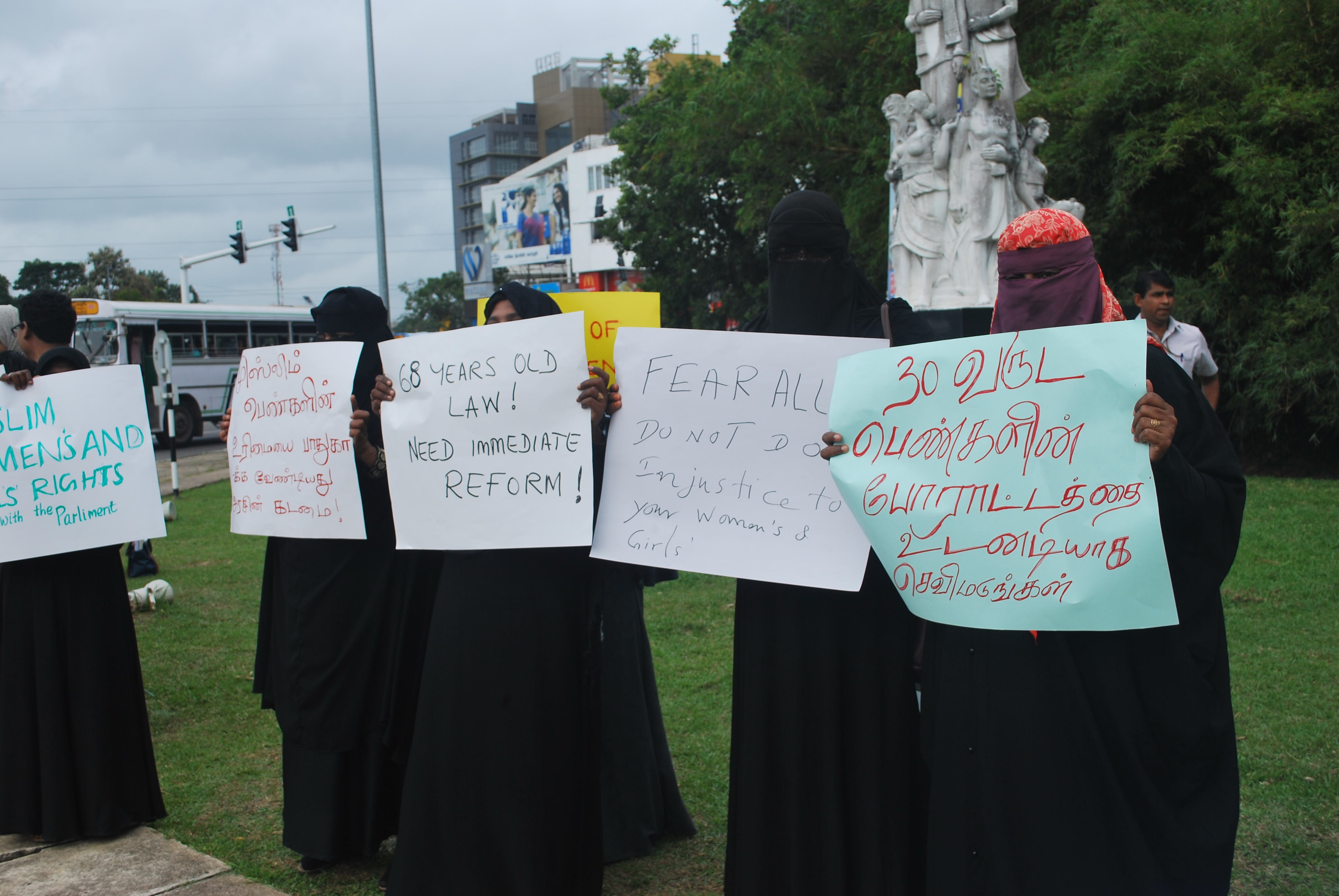
Featured image by Hafsa Razi
 SABRA ZAHID AND HYSHYAMA HAMIN-
 One of the most contested issues in the debate around reform of the Muslim Marriage and Divorce Act (MMDA) has been with regard to increasing the minimum age of marriage for Muslims. While legal reforms in 1995 increased the minimum age of marriage to 18 years for all citizens except Muslims, the MMDA does not stipulate an age of marriage. Contrary to popular belief, the minimum age at which a Muslim girl or boy can get married under the MMDA is not 12 years; as per Section 23 of the Act, a girl below 12 can be given in marriage with the authorisation of a Quazi judge. Hence, the minimum age of marriage for Sri Lankan Muslims is technically zero.
Of the problematic provisions of the MMDA currently being discussed, setting a minimum age has been met with so much resistance especially from conservative elements of the Muslim community. There are two points of contention here from within the Muslim community- one, whether or not the MMDA should set a minimum age of marriage given the absence of Islamic jurisprudence and consensus among scholars on the matter and two, if the minimum age of marriage should be raised, which age should it be raised to?
Opposition to raising minimum age
Those who are not in favor of the MMDA stipulating a minimum age of marriage give reasons mostly based on religious interpretations (and misinterpretations) of religious text and Hadith (practices of the Prophet Muhammed). In the past, the All Ceylon Jamaiyyatul Ulama (ACJU) made an appalling submission to Muslim politicians, stating that according to multiple verses in the Quran, there was “no restriction for age of marriage”. It also stated that according to their reading of hadith, “a father giving in marriage his daughter before puberty is possible”. The document also cited statistics that in Ampara district between 2011 and 2016 – 870 marriage involving 13-18 year olds had taken place, including eight 13-years olds and 36 14-year olds. While the document indicated that this number is low, it is actually very strong evidence against those who say that only one or two cases occur around the country. This figure also does not reflect the non-registered marriages, which according to community-level activists is highly prevalent.
Furthermore, the 2018 report of the 2009 Committee Appointed to Suggest Amendments to the MMDA [1] contains statistics of registered marriages with brides below 18 years for many districts around the country. This data shows the occurrence of marriages of girls as young as 12 even in districts like Colombo in 2014. The majority of marriages of minor girls are between 16-17 years of age, effectively proving that raising the minimum age of marriage to 18 years with an exception for 16 years will not resolve the issue of legal child marriages among Muslims.
Muslim lobby groups like the Muslim Personal Law Reform Action Group (MPLRAG) previously released a position paper advocating for no exceptions to the minimum age of marriage. They presented cases of lived realities and evidence of Islamic legal tradition that supports raising the minimum age to 18 years.
Lived realities of Sri Lankan Muslim girls
From field interviews conducted by researchers, women across many communities, counselors and volunteers who work closely with victim-survivors of child marriage, young mothers and women and girls affected by the Quazi court system have even articulated a much older age – 21 years. This is based on their experiences of how much this issue affects women and girls in their everyday lives and the benefits of having a legal protection against forced marriage, especially when consent of women and girls is not a mandatory prerequisite under the MMDA.
There are yet others who believe that the age of marriage should be set to 18 years, but a legal loophole should be in place, whereby under “special circumstances” a girl between 16 and 18 years can be given in marriage with parental permission and/or authorization of a Quazi judge. Special circumstances such individuals are referring to is mainly if the girl gets pregnant, or if the guardian of the girl is unable to take care of her and so on. These opinions are no doubt based on concern for the girls who maybe affected by these circumstances, but as evidenced by impacts of such legal loopholes around the world, such a provision if considered can have adverse consequences for 15 – 17 year old Muslim girls. Especially given that these are the ages whereby Muslim girls most likely drop out of completing Ordinary and Advanced Level exams, an educational milestone in determining their future progress. Bangladesh just recently permitted child marriage under special circumstances, amidst heavy controversy that it legitimises rape and forced marriages. In fact the first case under special provisions, was of a 25 year old man and a minor girl who got pregnant with his baby when she was 13 years old.
As evidenced by many cases around Sri Lanka of young Muslim brides abandoned, divorced or forced into polygamous relationships after being married as minors – child marriage with or without legal loopholes will not protect the rights of children, no matter how it is articulated otherwise.
A brief history of the minimum age of marriage
In light of such divergent viewpoints on a single issue (from many issues plaguing the MMDA debate) it is important to understand why Sri Lanka chose to increase minimum age of marriage to 18 years under the general law in 1995.
Prior to 1995, the General Marriage Registration Ordinance of 1907 and the Kandyan Marriage and Divorce Act 1952 permitted marriages below 18 years of age. In 1995, both these laws were amended and the legal age of marriage was raised to 18 years [2]. Despite the existence of a predated clause (Section 22 of GMRO), which indicated persons who must give consent for minors under 18 years to marry, subsequent case law clarified this legal anomaly. In Gunaratnam v. Registrar-General (2002) the Court of Appeal held, “Since the prohibited age of marriages has been raised to 18 years of age, the absolute bar to marriage must necessarily override the parental authority to give consent to the marriage of a party. It was not relevant whether parents agreed or did not agree to the marriage of their children, only persons who had completed 18 years of age could enter into a valid marriage.” Therefore the minimum age of marriage in Sri Lanka for all citizens except Muslims stands at 18 years, without exceptions.
Consequently, in 1995 the Penal Code was also amended raising the age of sexual consent from 12 years (previously) to 16 years given that this was the age at which individuals had the freedom to make decisions on education (de Silva 2009). Hence since 1995, under Section 363 of the Penal Code, sexual intercourse with a girl below the age of 16 is a criminal offence, however this provision exempts married Muslim girls between 12 and 16 years of age.
It is important to note here that after the 1995 amendments, there was a significant drop in under-18 marriages in the non-Muslim community.
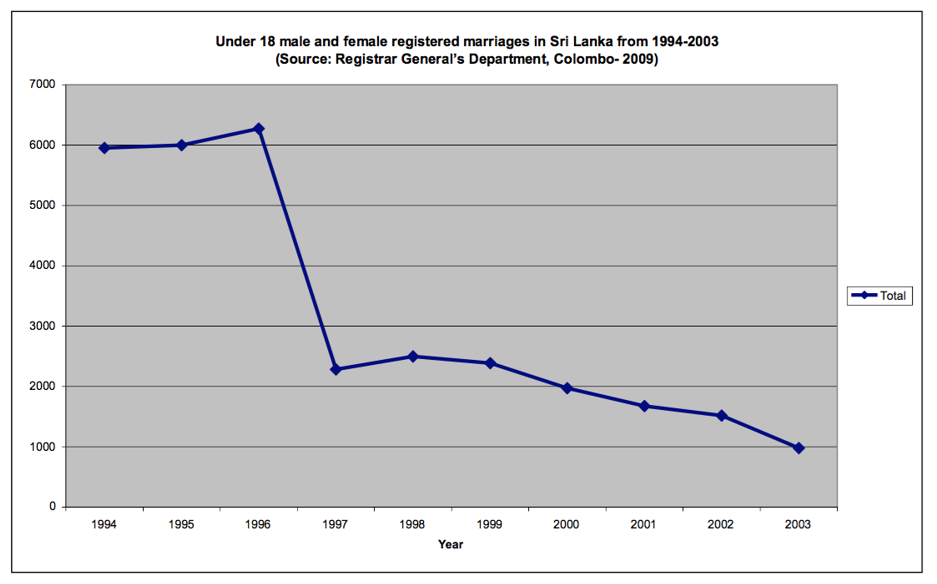
Noted from Amarasiri de Silva’s research [3] for UNICEF conducted in 2009, the decline was seen among all ethnic groups except Muslims. Data from the Registrar General’s Department further indicated there was actually a percentage increase of Muslim females in under-18 marriages between 1994 and 2003. Recent data on this trend must be obtained with urgency.
According to the research study by Amarasiri de Silva the reason for this increase to 18 years at the time was “on the ground that children younger than 18 were biologically and socially immature to get into wedlock and bear children, and detrimental effects may create problems in children born to such young women”. Progressively, in Sri Lanka the age of majority was set as 18 through an amendment to the Age of Majority Ordinance as far back in 1989 even before Sri Lanka ratified the Child Rights Charter in 1991.
There are other obvious reasons as to why nations such as Sri Lanka feel the need to set standard minimum ages in keeping with modern times. These legal safeguards afford the opportunities for children to complete compulsory education at least up to the secondary level, which to a certain extent would ensure a degree of maturity essential for the responsibilities and consequences of life and marriage. There is also ample research [4] documenting the undeniable impact of child marriage on the rights to education, health, and employment. Early marriages naturally makes girls and women vulnerable to violence and abuse, with limited avenues for recourse due to various reasons ranging from community pressure, dependency, lack of finances and further risk. Early marriage also prevents women and girl’s participation in all spheres of life.
State non-action despite clear evidence of child marriages
There is compelling evidence from women’s organisations working at the community level to indicate that the practice of child marriage is in fact more common than it is admitted to be.
According to the ‘Unequal Citizens’ study [5], marriages arranged by guardians are occurring between 14 and 17 years of age in districts like Puttalam and Batticaloa. Records on Muslim marriage registration in Kattankudy indicate that in 2015 – 22% of all registered marriages were with a bride below 18 years of age. This is a considerable increase from 2014 where the figure was recorded at 14%. The practice is also evident in Colombo due to religious and cultural considerations as opposed to poverty and safety concerns as its basis.
The study also points out that according to a Quazi from Colombo East, there are many instances of early marriages happening in areas like Mattakkuliya and Maradana. The Quazi for the minority Muslim community in Colombo also mentioned that girls of the community mostly get married between 15 and 17 years of age because according to him ‘the value of the girl decreases after she is 17’, clear indication of a prevalent patriarchal perception in favor of early marriage.
It is understood that marriages (legal or otherwise) happen due to a number socio-economic and cultural reasons and is prevalent in other communities as well, such as through early co-habitation and pressures of poverty and insecurity. Communities from districts that were affected by the conflict also show an increased number of early co-habitation due to these pressures. But the key difference is that in the Muslim community, it is legal and State has not taken any action in this regard, whereas in other communities the State agencies, social workers and civil society actors are actively working to eliminate the practice in the interest of the children and rightly so.
While the battle is fought within the Muslim community – between affected women supported by community groups, activists as well as a large number of women and men seeking reform, and the conservatives – the State continues to absent itself from these conversations. Up until July 2019, not a single Muslim and very few non-Muslim politicians have come forward publicly on the matter. Nor have agencies like the National Child Protection Authority (NCPA) or the Human Rights Commission (HRC) made any acknowledgement of or desire for action despite it being a child rights and human rights issue. On July 12, MP Faiszer Mustapha announced that Muslim MP’s had unanimously decided on raising the minimum age of marriage to 18 years, among a few other amendments. While a positive sign, until and unless this rhetoric results in comprehensive law reform, they remain empty words.
Standard minimum age of marriage for all citizens
It cannot be stated enough that what is sought in terms of reforms of the MMDA, including raising minimum age of marriage to 18, are basic rights enjoyed by other communities in Sri Lanka. The State is responsible for depriving these rights at the whims of the religious and political leadership of this country. In the current context, it is unlikely that all the stakeholders in the Muslim community in Sri Lanka would agree and reach consensus on matter of minimum age. Therefore State intervention is obligated and long overdue.
Child marriage within the Muslim community needs to be addressed by removing the legal cover that MMDA accords, without exceptions. It is the only way to ensure the minimum age is not decided arbitrarily by Muslim men based on their interpretations and misinterpretations.
It is important for the Sri Lankan state and leaders to recognize and protect the rights of all citizens to enjoy his/her culture, traditions and freedom of religion. Likewise, it is the responsibility of the State to ensure that child rights are not compromised in the name of culture and religion.
Sri Lanka is a party to the Convention on Rights of the Child (CRC) and Convention for Elimination of All forms of Discrimination Against Women (CEDAW), among other international human rights instruments, and is thus required to adhere to global benchmarks on child rights and women’s rights. The CRC recognizes anyone under the age of 18 as children and explicitly states in Article 2 that no child can be treated unfairly on any basis including religion, ethnicity or gender. Article 24 (3) of the CRC refers to the obligation of a State Party to “take effective and appropriate measures to abolish traditional practices prejudicial to health.”
If it is the State that sets the provision that all citizens need to be a certain age to be able to make an informed decision to vote, then the very same logic should apply to the minimum age of marriage, which has impactful consequences on the individuals in question, and the country as a whole. If the State determines that adolescents and children marrying before 18 years is detrimental to their health, education and wellbeing then it should apply to all children in the country irrespective of which ethnic or religious group they belong to. Sri Lankan Muslim girls are not born with a ‘special’ reproductive system that makes them ready for marriage at an earlier age.
There is an obvious difference in the treatment of Muslim children by the State itself, which continues to be indifferent to their plight despite being brought to notice by affected women as well as community-based organisations for decades. It is unacceptable that the State itself fails to realise that Muslim girls and boys too are citizens of this country, deserving of equality and fundamental rights as their counterparts. This discrimination against Muslim children of Sri Lanka must end once and for all.
[1} Report of 2009 Committee Appointed to Suggest Amendments to the Muslim Marriage and Divorce Act – Vol-1-A https://www.moj.gov.lk/web/index.php?option=com_content&view=article&id=114&Itemid=230&lang=en
[2] H.Amarasuriya, S. Goonesekera (2013). Emerging Concerns and Cases on Child Marriage in Sri Lanka, UNICEF Sri Lanka
[3] De Silva, Amarasiri (PhD), 2009. Desk Review and Basic Field Data on Child Marriages, Statutory Rape and Underage Sex. UNICEF Sri Lanka
[4] Girls Not Brides www.girlsnotbrides.org
[5] Cegu Isadeen. H, Hamin, H (2016). ‘Unequal Citizens: Muslim women’s struggle for Justice and Equality in Sri Lanka’ https://mplreforms.com/unequal-citizens-study/
Dog Will Not Bite Dog In Sri Lanka
 On the 8th of January 2009, Lasantha Wickrematunge,
the intrepid Editor of The Sunday Leader was murdered in a well planned
attack within a high security zone. Before the ink could dry on the
reams of newsprint written on that murder, a copycat style attack was
carried out on Upali Tennekoon,
the Editor of Rivira newspaper. It was on the 23rd of January 2009 the
attackers waylaid his vehicle when Upali Tennekoon and his wife were
driving towards Colombo. Tennekoon left Sri Lanka for awhile only to
return to an identification parade where he identified Army Intelligence
officer Udulagama as one of the assailants. Udulagama was also
identified by Dias for abducting him. Dias was Lasantha Wickrematunge’s
driver.
On the 8th of January 2009, Lasantha Wickrematunge,
the intrepid Editor of The Sunday Leader was murdered in a well planned
attack within a high security zone. Before the ink could dry on the
reams of newsprint written on that murder, a copycat style attack was
carried out on Upali Tennekoon,
the Editor of Rivira newspaper. It was on the 23rd of January 2009 the
attackers waylaid his vehicle when Upali Tennekoon and his wife were
driving towards Colombo. Tennekoon left Sri Lanka for awhile only to
return to an identification parade where he identified Army Intelligence
officer Udulagama as one of the assailants. Udulagama was also
identified by Dias for abducting him. Dias was Lasantha Wickrematunge’s
driver.
Lasantha
Upali Tennekoon was the Editor of Rivira newspaper which at the time was
owned by two Rajapaksa acolytes, namely Nilanka Rajapaksha and Prasanna
Wickramasuriya. Wickramasuriya is the brother of former Sri Lankan
Ambassador to the US Jaliya Wickremasuriya and a cousin of former
President Mahinda Rajapaksa.It was widely believed that Upali Tennekoon
was attacked to misdirect people that even Rajapaksa friendly newspaper
editors were being attacked. The intent was not to kill the Rivira
editor. The murder of Lasantha, attack on Upali and the abduction of Keith Noyahr (
2008 ), were handed over to Gotabaya’s bunny DIG Chandra Wakista of the
Terrorism Investigation Division (TID). Intent was clear. Show it as an
LTTE job.
The Criminal Investigations Department took over the investigations into
these crimes after the defeat of Mahiinda Rajapaksa and the real story
unfurled backed by credible evidence. A rogue unit at the Tripoli Market
run by Gotabaya Rajapaksa together
with former Army Intel Chief Kapila Hendawitharne, Gen Amal
Karunasekera and Major Bulathwatte were suspected to be the prime movers
of these crimes. Evidence in Keith Noyahr’s case reported to Court by
CID indicate this fact. The Tripoli Unit is widely known to have carried
out Lasantha murder, Keith Noyahr abduction and torture as well as
Upali Tennekoon assault.
Initially eight suspects from the very Tripoli Camp were arrested,
finger printed and remanded. They were later enlarged on bail. Finger
prints found on the late Editor Lasantha Wickrematunge’s car on the day
of the murder, prints on the vehicle of Upali Tennekoon were sent to the
expert Examiner of finger print division of the Police. Though no
matches were found to the prints on Lasantha’s vehicle a print on Upali
Tennekoon’s vehicle found a match with that of Corporal Lalith Rajapaksa
an Army Intelligence Officer who at the time of these crimes was
assigned to the Tripoli Unit. Corporal Lalith Rajapaksa was posted to
the Sri Lanka Consulate in Frankfurt, Germany on the instructions of
Gotabaya Rajapaksa in 2013 and returned only in 2017. As expected he has
denied knowledge as to how his print came to be on Upali Tennekoon’s
vehical. Finger prints are unique and no two persons prints match.

Upali
Colombo Telegraph reliably understands from a retired CID Official, that
Corporal Rajapaksa was retained in Frankfurt despite the Rajapaksa
Government being defeated in 2015, at the insistence of now resigned
Chief of Intelligence former DIG CID Sisira Mendis.
Colombo Telegraph also learns from the same source that the finger
prints were taken at the time of initial arrest but the match with
Corporal Lalith Rajapaksa has been reported to Court after a long lapse
of time. The Attorney General Dappula Livera’s advise to the CID to
arrest Corporal Rajapaksa though late was welcome news.
The Yahapalanaya Government has been in office for well nigh four years.
The evidence into these crimes have been reported to Court and
therefore has been on public record. Newspapers and electronic media
have time and again reported from these records. There has been a
perceived delay by the Yahapalanaya Government to bring the criminals
involved in these cases to court. In Sri lanka, dog does not bite dog.
Read More
Countering violent extremism in Sri Lanka: A primer

- Forward strategies and policies of preventing future terror attacks are lost in fierce political debates,
- Attacks of 21 April signified the approaches of extremists via selection of soft targets
15 July 2019
Nearly three months since the Easter attacks in Sri Lanka, the forward
strategies and policies of preventing future terror attacks are lost in
fierce political debates, elections buildup and conspiracy theories
which are further fracturing the most important compound that keeps a
society away from extremism; social cohesion. 
The lawmakers are debating new prevention of terrorism legislation, political voices are drowned by populist rhetoric, and national security seems to be a primer for debate yet miserably distant from any concrete policy articulations. In short, the attacks of 21 April signified the trademark approaches of extremists globally via the selection of soft targets.
Apart from the challenge of how to securitize soft targets comes the challenge of identifying and preventing so-called lone wolf type attacks that are carried out by terrorists with no real strategic guidance from a terror leadership. These terror strategies represent groupings that are ideologically driven, hence defeating ideas has become a major challenge for established security apparatus in their counter-terror policies.
The lawmakers are debating new prevention of terrorism legislation, political voices are drowned by populist rhetoric, and national security seems to be a primer for debate yet miserably distant from any concrete policy articulations. In short, the attacks of 21 April signified the trademark approaches of extremists globally via the selection of soft targets.
Apart from the challenge of how to securitize soft targets comes the challenge of identifying and preventing so-called lone wolf type attacks that are carried out by terrorists with no real strategic guidance from a terror leadership. These terror strategies represent groupings that are ideologically driven, hence defeating ideas has become a major challenge for established security apparatus in their counter-terror policies.
Dealing with terrorism
The important lesson for Sri Lanka is to understand these dual features
when framing a response to emerging terror and extremists’ threats in
the future. Counter-Terrorism globally took the shape of a hard response
to terrorism, using coercive methods and a culture of confidence in
offensives from anti-terror legislation to militarizing law enforcements
and military offensives. This is how Sri Lanka defeated the LTTE, the
Russians defeated Chechen rebels and Americans dismantled Al Qaeda.
Islamic State-related and even radical far-right extremists have adopted new forms of violent extremism that are mostly driven by communication strategies harnessing the power of ideas and the pull of ideological positionings, such as religious extremism of racial superiority complex. Thus the fight to defeat such organizations that have carried out the most number of terror attacks in the world cannot be totally dependent on hard countermeasures. Identified as lone wolf type attacks and mostly the perpetrators are not foreign elements. Thus the category of home-grown terrorism is used to identify them. Most of these radicalized, extremists have adopted to carry out attacks on soft targets.
Islamic State-related and even radical far-right extremists have adopted new forms of violent extremism that are mostly driven by communication strategies harnessing the power of ideas and the pull of ideological positionings, such as religious extremism of racial superiority complex. Thus the fight to defeat such organizations that have carried out the most number of terror attacks in the world cannot be totally dependent on hard countermeasures. Identified as lone wolf type attacks and mostly the perpetrators are not foreign elements. Thus the category of home-grown terrorism is used to identify them. Most of these radicalized, extremists have adopted to carry out attacks on soft targets.
The strategic importance of Soft Targets.
Terrorists, extremists of the full political spectrum, religious,
far-right to narco-terrorists have selected soft targets as their
preferred mode of unleashing violence. Soft targets include shopping
malls, theatres, markets, night clubs, schools and hotels. In the
context of Islamic State-related attacks, hotels were always preferred
sites of attacks, prior to Sri Lanka, if one analyses the attacks across
Indonesia, Egypt, Mali and Jordan Hotels were frequently targeted
resulting in mass casualties.
Hotels remain symbolically and tactically the indispensable structure of tourism and state of global connectivity of a nation. Hotels can never be promoted as garrisons thus there is always a limit to how much protection can be added to a hotel structure. Thus, they will remain perpetual targets of terrorists for years to come. With a burgeoning tourist industry and an aspiration to remain the most favoured travel destination in the world, Sri Lanka cannot rely on fortification of hotels or militarization of tourist attractions.
Hotels remain symbolically and tactically the indispensable structure of tourism and state of global connectivity of a nation. Hotels can never be promoted as garrisons thus there is always a limit to how much protection can be added to a hotel structure. Thus, they will remain perpetual targets of terrorists for years to come. With a burgeoning tourist industry and an aspiration to remain the most favoured travel destination in the world, Sri Lanka cannot rely on fortification of hotels or militarization of tourist attractions.
The need for Preventive and Countering Violent Extremism (PCEV)
Countering of Violent Extremism (CVE) has become a contested but
much-needed framework of analysis in the backdrop of increasing
radicalization, extremism, home-grown terrorism and most important
attacks that are targeting free and open societies in the world. Sri
Lanka experienced an Utopian moment of a decade of peace and openness
that even many Western societies were envious of since the end of the
war on LTTE terrorism in 2009. The high point of this Utopian moment was
the travel guidebook, lonely planet naming of Sri Lanka as the world’s
best travel destination.
Free and open societies, especially democracies which are going through political failures of both leadership and institutional decay are prime targets of extremist ideologies and infiltration. These infiltrations are facilitated through migrant workers, religious leaders and even foreign fighters who circulate globally. The last five years had witnessed the emergence of terror movements ideologically driven and with global reach and adaptability.
Islamic State fought in open battle theatres in Syria and Iraq while in other global destinations it spearheaded a massive communication and recruitment drive leading to radicalization to promote homegrown terror.
In July 2015 President Obama in an address at the Pentagon, observed:
“To prevent deadly terrorist attacks, we cannot solely rely on counterterrorism strategies. We must start further upstream challenging extremists’ narratives and ideologies and addressing the conditions that create a favourable environment for radicalization and recruitment” he made this observation given the last decade, most terror attacks in Western and democratic States were carried out by radicalized extremists and these accounted for nearly 70 percent of all known terror attacks since 2006.
Thus, the policy imperative has been to frame ways in which social cohesion as the main objective which can lead to the building of resilient societies. This approach makes Countering of Violent Extremism (CVE) distinct from traditional heavily securitized counter-terrorism approaches which feature the use of force through a combination of combat and operations the institution of extra-judicial law enforcement procedures. It yet remains a fairly new approach even the US Department of Homeland security started investing on CVE measures as recent as in 2016.
Free and open societies, especially democracies which are going through political failures of both leadership and institutional decay are prime targets of extremist ideologies and infiltration. These infiltrations are facilitated through migrant workers, religious leaders and even foreign fighters who circulate globally. The last five years had witnessed the emergence of
terror movements ideologically driven and with global reach and adaptability. Islamic State fought in open battle theatres in Syria and Iraq while in other global destinations it spearheaded a massive communication and recruitment drive leading to radicalization to promote homegrown terror.
In July 2015 President Obama in an address at the Pentagon, observed:
“To prevent deadly terrorist attacks, we cannot solely rely on counterterrorism strategies. We must start further upstream challenging extremists’ narratives and ideologies and addressing the conditions that create a favourable environment for radicalization and recruitment” he made this observation given the last decade, most terror attacks in Western and democratic States were carried out by radicalized extremists and these accounted for nearly 70 percent of all known terror attacks since 2006.
Thus, the policy imperative has been to frame ways in which social cohesion as the main objective which can lead to the building of resilient societies. This approach makes Countering of Violent Extremism (CVE) distinct from traditional heavily securitized counter-terrorism approaches which feature the use of force through a combination of combat and operations the institution of extra-judicial law enforcement procedures. It yet remains a fairly new approach even the US Department of Homeland security started investing on CVE measures as recent as in 2016.
How to make lone wolves be known wolves
While CVE remains in part rhetoric, and in part a subfield in
counter-terrorism its proponents see the importance of the approach as
more holistic as its core strength is the societal focus that
encompasses traditional iterations of de-radicalization and violence
de-escalation such as community policing and even forms of
reconciliation.
Sri Lanka with all its political idiosyncrasies remain a democratic polity and therefore it sees no other political alternative in the future, thus weak democracies can lead to state failures, contrary to some Western analysts who attempt of frame Sri Lanka as a fragile and weak State yet the recent trends of ethnic and religious tensions can further escalate the national security crisis of responding to violent extremism.
Thus while the State is seeking remedies from legislation and law enforcement upgrades which are necessary but not sufficient as neither law enforcement nor legislation are a fix to ideologically powered violence thus it needs more sophisticated policy solutions which have to be integrated into the security discourse and the security communities in this country.
While we seek justice and retribution for the Easter Sunday attacks, we also need to understand that it may not be a one-off lone wolf attack, as our intelligence services respond and are actively developing improving information sharing, and analysis it is becoming evident that the lone wolves are actually known wolves. The responsibility of the state is preventing the wolf packs from expanding which cannot be done without policies that address countering ideological narratives and other social and economic conditions that lead to radicalization. This article is an attempt to explore multiple dimensions of countering violent extremism approaches in Sri Lanka and the global and local conditions which shape and generate such tendencies and how best to mitigate them.
Sri Lanka with all its political idiosyncrasies remain a democratic polity and therefore it sees no other political alternative in the future, thus weak democracies can lead to state failures, contrary to some Western analysts who attempt of frame Sri Lanka as a fragile and weak State yet the recent trends of ethnic and religious tensions can further escalate the national security crisis of responding to violent extremism.
Thus while the State is seeking remedies from legislation and law enforcement upgrades which are necessary but not sufficient as neither law enforcement nor legislation are a fix to ideologically powered violence thus it needs more sophisticated policy solutions which have to be integrated into the security discourse and the security communities in this country.
While we seek justice and retribution for the Easter Sunday attacks, we also need to understand that it may not be a one-off lone wolf attack, as our intelligence services respond and are actively developing improving information sharing, and analysis it is becoming evident that the lone wolves are actually known wolves. The responsibility of the state is preventing the wolf packs from expanding which cannot be done without policies that address countering ideological narratives and other social and economic conditions that lead to radicalization. This article is an attempt to explore multiple dimensions of countering violent extremism approaches in Sri Lanka and the global and local conditions which shape and generate such tendencies and how best to mitigate them.
Subscribe to:
Posts (Atom)