Peace for the World World ! Your War Our Lives

The Dalai Lama
A Brief Colonial History Of Ceylon(SriLanka)
Sri Lanka: One Island Two Nations
A Brief Colonial History Of Ceylon(SriLanka)
Sri Lanka: One Island Two Nations
(Full Story)
Back to 500BC.

Tuesday, March 31, 2020
Weathering the COVID-19 storm, moving from ‘survival of the fittest’ to ‘survival of the quickest’

In the coming weeks, Sri Lanka will no doubt come up with further policies, which we will soon read about, marvel at, admire and might even criticise disproportionately. However, the choice left to every individual contributing towards a national economy is clear – it is to be aware, appreciate the scale of impact, be patient and to support domestic, national and global efforts – Pic by Shehan Gunasekara
Exploring the critical need for an ‘all-hands-on-deck’ approach to steer the economy and challenge traditional norms of doing business, as the world looks to leaders to weather the economic implications of COVID-19
 The brewing of a storm
 Monday, 30 March 2020
In the most unexpected manner, cases of COVID-19 first emerged at the back of 2019, when a mysterious illness was reported in Wuhan, China. A week later, it was confirmed that a new virus was spreading.
Within days, the world came to know of a virus, a disease that can spread rapidly and kill thousands. As the number of fatalities was rising rapidly China became the epicenter of global concerns. By now, it has been upgraded from an endemic to an epidemic and then to a pandemic, an infectious decease that could spread worldwide.
This called for countries to resort to extreme measures such as unprecedented social lockdowns and nationwide curfews. Suddenly social distancing became imperative. Economic activity took a back seat and safeguarding the health and wellbeing of nations became the top priority of their leaders.
Overnight the world was put on alert by an unseen enemy, and the responses displayed an uncanny resemblance to warfare with a general quiet sentiment of a silver screen like Armageddon no one could escape from. People had their movements, travel and daily life restricted; foreign tourists and visitors were banned from entering the country; medical staff prepared for a surge in cases; those who suspected an infection required to undergo a health check and self-quarantine for 14 days. Everyone stopped in their tracks.
No one is fooled, all this is temporary. The world will find a way to eradicate, if not curtail COVID-19, just like we did with SARS and Ebola in the recent past. Once effective measures are in place to deal with health-related concerns and public wellbeing, we will have to look to means of economic stimulus to steer the global economy out of the current storm.
With that optimistic view and with every reason to believe in the on-going extreme measures world over to ‘flatten the curve’, every leader will now be required to strategise business survival post impact and prosper beyond it.
It is imperative that every citizen and corporate, government entity and entrepreneur support the steering of the global economy to restoration. The leveller here is a common global consensus that a cohesive and coordinated effort is the winning formula, along with the need for an orchestra of leaders to perform together in one accord. Sweeping measures to combat COVID-19
There have already been laudable measures combatting impact of COVID-19 in every nation including an all-of-society, all-of-government approach. During early March, World Health Organisation (WHO) Chief Tedros Adhanom Ghebreyesus praised Singapore’s “all-government approach” in his opening remarks at a press briefing at the WHO headquarters in Geneva, Switzerland. He urged countries around the world to “not give up” in the fight against the disease.
Dr. Tedros said:”Singapore is a good example of an all-of-government approach and that Prime Minister Lee Hsien Loong’s regular videos are helping to explain the risks and reassure people.”
There were reports of a man, who breached a 14-day quarantine order, who lost his Singapore Permanent Resident status and been barred from re-entering Singapore by the Immigration and Checkpoints Authority. Similar reports were globally recorded and Sri Lanka took measures against those who withheld information or resisted complete disclosure of circumstances that may have led to contamination.
Firm action on social lock down and immediate quarantine saw a falling rate of new infections in China and it became a case study on how to bring COVID-19 under control.
National economies may perform significantly better if leaders and decision makers have backgrounds in economics
Every valorous leader in every stratum of society, will be challenged to draw from best practice, global policy, national strategy and common-sense wisdom during this time yet again fortifying the bon mot that necessity is, indeed, the mother of invention.
No matter how unprecedented the present global economic climate maybe, one cannot help but look through the archives of time to draw from best practice and innovation that restored the global economy in the past.
Precedent in this regard is found in a recent reveal, in December 2019 by the World Economic Forum (the research is published online in the Journal of Monetary Economics). The study encompassing 146 countries from 1950 to 2014 found that leaders with an economics background helped their countries perform better. One would think it applies to corporates with equal fervour.
In the said article, researchers pored over the educational and professional backgrounds of 1,681 leaders, including several United States Presidents, and considered economic data of 146 countries from 1950 to 2014.
“When I look at cases within the U.S., such as Ronald Reagan and Bill Clinton, who both studied economics, the story is consistent with what I find in the broader sample,” says Craig Brown, a visiting Assistant Professor of Finance at Purdue University’s Krannert School of Management who focuses on the intersection of finance and politics.
Other examples from across the globe include Singapore, a country that is well known for its economic success, that benefited from the effective leadership of Lee Kuan Yew; and Thabo Mbeki, who presided over the greatest economic expansion in South Africa since the country’s experience with full democratic elections in 1994. Brown found that growth was sustained, on average, during the years following an economist’s tenure.
Innovation as the need of the hour: Lead or be left behind
There is no saying how business models can augment themselves to what cannot even come under the traditional and familiar definition of a force majeure situation, as we look to experts in disaster management for direction.
Be that as it may, on a national front we admire brethren of the soil stepping forward - be it corporates and/or the Government taking the lead to champion innovation. From door-to-door delivery of essential goods; encouraging online platforms to steam ahead, banking on high levels of mobile penetration and strict maintaining social distancing. Work from home practices are the new modus as traffic builds on the super highways of the World Wide Web; online platforms assisting location independent work have kicked in. Social media is buzzing with methods and means of productively using idle time, book stores exploding open subscriptions and music streamed online being available at no charge. All of which transform the norm of survival of the fittest to survival of the quickest.
The critical need of the hour is nothing short of innovation and the willingness and ability to evolve. It will be evident before long that companies shackled with traditional ways of doing business that didn’t ride the wave of the fourth industrial revolution will regret at leisure their inability to be critically responsive. Those entities that planned for a rainy day will delve into their files and unearth all shades of Business Continuity Plans and BCP Tools to ensure that business retains, as much as possible, even a silhouette of normalcy.
Not ignoring that there will still be critical bailouts that are imperative, which is the business of those we have elected to govern, the battalion of naysayers will be polishing their begging bowls and relying on bailout and relief measures, banking on grants and rescue schemes.
How COVID-19 caused macroeconomists to flip the script
In a recent article the World Economic Forum explains that macroeconomists initially saw the pandemic as a negative demand shock that would need to be countered by expansionary fiscal and monetary policies to support aggregate spending. Soon enough, many of them realised that this shock is different. Unlike the 2008 global financial crisis, which led to a collapse in demand, the COVID-19 pandemic is first and foremost a supply shock. That changes everything.
If output is collapsing because people do not want to or cannot spend, adding spending power may help. But if cinemas, universities, schools, sports venues, hotels, and airlines are shut down to stop the spread of the virus, giving money to people will not reignite those industries: they are not lacking in demand. They are shut down as part of the public health policies implemented to flatten the curve. If firms are not producing because their workers are locked down, boosting demand will not magically make goods appear.
As a consequence, macroeconomists are now focusing on how to make social distancing and lockdowns tolerable and limit the damage that the supply shock will generate. In the US and the United Kingdom, governments are planning large fiscal packages to expand health-care provision, protect payrolls, provide additional unemployment insurance, delay tax payments, avert unnecessary bankruptcies, shore up the financial system, and help firms and households survive the storm.
But one frequently unstated assumption of this approach is that governments will be able to mobilise the necessary resources, essentially by borrowing more, if needed, from their own central banks, as they implement quantitative easing. Economists refer to governments’ ability to borrow as fiscal space. In short, the flatter you want the contagion curve to be, the more you will need to lock down your country – and the more fiscal space you will require to mitigate the deeper recession that will result.
Developing countries with precarious access to finance, may run into an inflationary spike, the experts warn.
“As horrific as this sounds, the situation in the advanced economies is likely to be much more benign than what developing countries are facing, not only in terms of the disease burden, but also in terms of the economic devastation they will face” – The World Economic Forum.
Country specific strategies according to the wold economic forum
Just as Sri Lanka, most developing countries rely for foreign income on a combination of commodity exports, tourism, and remittances: all are expected to collapse, leaving economies short of dollars and governments short of tax revenues. At the same time, access to international financial markets has been cut off as investors rush to the safety of government-issued assets. In other words, just when developing countries need to manage the pandemic, most have seen their fiscal space evaporate and face large funding gaps.
The standard prescription for revenue collapses and external financing problems is a combination of austerity (to bring spending in line with income), devaluation (to make scarce foreign exchange dearer), and international financial assistance to smooth the adjustment. But this would leave countries with no resources to fight the virus and no means to protect the economy from the damaging effects of lockdown measures. Moreover, the standard prescription is more inefficient if all countries try it at once, owing to negative spillovers on their neighbours.
To give countries the financial capacity to flatten the curve requires a level of financial support that will not be feasible with existing approaches and with international organisations’ current balance sheets. To help manage the pandemic, therefore, it is critical to recirculate the money that is fleeing the developing countries back to them. To do that, the G7 and the G20 should consider several measures.
The following strategies have been recommended as critical responses;
First, the US Federal Reserve announced swap lines with the central banks of Australia, Brazil, Denmark, Korea, Mexico, Norway, New Zealand, Singapore, and Sweden. This mechanism should be extended to many more countries. If fear of default is an impediment, these funds could be intermediated by the International Monetary Fund, which should redesign its existing Rapid Financing Instrument to meet current needs.
Second, it is said that as central banks implement quantitative easing, they should purchase emerging-market bonds, especially the less risky ones, in order to free up more space for international financial institutions to focus on the more difficult cases.
Third, dollarised or euroised economies that do not have their own currency and hence a lender of last resort, such as Panama, El Salvador, and Ecuador, should be offered special financial facilities so that their central banks can backstop their banking systems.
Lastly, developed countries should not impede or prohibit exports of tests, pharmaceuticals, and medical devices.
Global examples of innovation in policy creation: Response from the United Kingdom with a job retention scheme
As an exercise in theory one looks to the United Kingdom, merely an example of policy innovation. On an announcement made public on 20 March, The Chancellor of the Exchequer stated the Government’s package of support for the self-employed.
In summary, the British Government has said it will pay self-employed individuals who have found themselves without work due to the COVID-19 pandemic, a taxable grant of 80% of average monthly profit (calculated over the last three years) up to £2,500 per month. The scheme is said to be in place for three months, backdated to 1 March 2020. The British Government states this may be extended if necessary.
Payments under the scheme, as set out, will be accessible from the beginning of June, so individuals will receive their three months’ in one lump sum payment whereby Her Majesty’s Revenue and Customs (HMRC): the UK Government department that is responsible for calculating and collecting taxes, will contact eligible individuals directly. Applicants then fill out a form and receive payment from HMRC directly to their bank accounts.
Eligibility of those permitted to avail themselves of the said relief are the self-employed with trading profits up to GBP 50,000 per annum with the majority of income through self-employment and a must have a tax return for 2019 to be able to apply (aimed at ensuring people cannot suddenly claim they are self-employed to access the scheme). Further, July tax return payments are being deferred until January 2021.
Although the scheme does not address immediate cash flow issues, which many self-employed are facing, the public is encouraged to look to multiple sources available such as universal credit (with an advance payment) and business interruption loans.
Sri Lanka’s country specific policy locking into gear
World over there will be policy creators who find themselves cocooned in isolation and yet performing functions of national, regional and global importance. Sri Lanka too will have her own set of policies to respond to the present challenging economic environment as a panacea, as it were, to ease the sting of the aftermath of the unprecedented impact of a global pandemic. What is common however, is the depth of knowledge, appreciation, understanding of the critical steps to be taken and the wherewithal to implement same through state and private mechanisms.
Here at home the stock market and the tourism sector are at the forefront, facing the economic fallout of the spread of COVID-19. Despite closure last week, the stock market crashed, yet again, as millions of daily-income earners continued drawing from the bottoms of barrels while the effects of the impact have only just begun to surface.
The Government has responded proactively to the crisis by offering a relief package to the five sectors most affected. Respectively: tourism, apparel, foreign employment, information technology and small and medium enterprises. Moreover, the government decided to lift taxes on masks and disinfectants and to impose a fuel import tax to build a fund that will be used to repay the debt of the Ceylon Petroleum Corporation and Ceylon Electricity Board.
The Central Bank of Sri Lanka, on the other hand, interrupted the import of vehicles and non-essential goods to ease pressure on the exchange rate, suspended the purchase of Sri Lanka International Sovereign Bonds, limited the issuing of foreign currency notes as travel allowance, and last but not least, cut the interest rate corridor by 25 BP. The Inland Revenue Department announced a grace period until 30 April for the payment of Value Added Tax (VAT).
Additionally, in the fight against the negative impacts of COVID-19, is the Asian Development Bank and the World Bank announcing a financing package of $ 6.5 and 14 billion respectively, to assist companies and countries in their efforts to prevent, detect and respond to the rapid spread of the pandemic.
Call to action
In the coming weeks, Sri Lanka will no doubt come up with further policies, which we will soon read about, marvel at, admire and might even criticise disproportionately. However, the choice left to every individual contributing towards a national economy is clear – it is to be aware, appreciate the scale of impact, be patient and to support domestic, national and global efforts.
From a health and social perspective, the instructions are simple, whereas the implications of noncompliance: global. As has been reiterated time and again, the message cannot be overstated: stay at home; only go outside for food or health reasons; stay two metres (six feet) away from other people; wash your hands often; and have the presence of mind, at all times, that you can spread the virus even if you do not present symptoms.
The common sense pleas are even louder – be considerate; avoid panic purchasing and hysteria; practice gratitude; look inward; enjoy time at home with family; look after the elderly; share the limited resources; be kind and ‘love thy neighbour as thyself’ and whatever else that governs our temporary existence on earth.
Be assured – the worlds of disaster response, academic communities, public-health experts, policy creators and macroeconomists have started collaborative talks. Economically, the call to action is even clearer – it is to endure every effort to hold your post/s and safeguard your business as you would from an unseen enemy looking to obliterate it. As they say in battle – each man for himself, God, for us all.
(The author is an Attorney-at-Law; holds a Bachelor of Laws awarded by the University of London, and is a graduate of the Charted Institute of Marketing – UK.)

Too much religion is making it hard to fight the pandemic

Chart from Twitter @paulkrugman
At times of
personal and collective tragedy, people find solace in religion; some
seek divine blessings, others ponder the impermanence of the life, many
others do both.
Invocation of religion could be just symbolic for more earthly folks, but it could also be cathartic to some others.
31 March 2020
 Now,
a God-defying pandemic is redefining the relationship between religion
and the masses – and the disease itself while intensive social
distancing measures are distancing worshipers from temples, churches and
mosques. And, before such restrictions came into effect, religion
seemed to have done much to spread the virus.
Now,
a God-defying pandemic is redefining the relationship between religion
and the masses – and the disease itself while intensive social
distancing measures are distancing worshipers from temples, churches and
mosques. And, before such restrictions came into effect, religion
seemed to have done much to spread the virus. The
Shincheonji Church of Jesus, a secretive Christian cult known for
highly regimented religious practices and brainwashed followers was the
ground zero of South Korea’s coronavirus outbreak. Its leader, an
octogenarian conman promised to take a selected group of 144, 000
members with him to heaven. He is now facing criminal charges
The
Shincheonji Church of Jesus, a secretive Christian cult known for
highly regimented religious practices and brainwashed followers was the
ground zero of South Korea’s coronavirus outbreak. Its leader, an
octogenarian conman promised to take a selected group of 144, 000
members with him to heaven. He is now facing criminal charges
In Malaysia, more than half of reported cases of coronavirus are linked
to a global Islamic event attended by more than 20,000 devotees. Brunei
and Singapore have traced some local cases to the event.
In Bangladesh, a mass prayer meeting held in Dhaka amidst the global
coronavirus outbreak has caused alarm in a country, where the health
system is ill-equipped to cater to its teeming masses even at normal
times.
In America, some evangelical preachers and orthodox rabbis have defied
calls to suspend mass congregations while in Tanzania, its president
John Magufuli has asked the countrymen to go to church, to find ‘true
salvation’.
Sri Lanka’s response to the corona outbreak has been a lot more proactive than in most countries, especially considering the lower number of reported cases then and now
Divine intervention might be less demanding than most mitigation
measures currently in place. But there is no proof it is forthcoming.
Still, tricky snake oil salesmen are at work to hoodwink the
overzealous.
Last week in Colombo, ‘Pirith pen’ (Blessed water) was sprinkled by a
helicopter ostensibly to bless the country in an initiative financed by a
group of businessmen. While the symbolism is evident, the provision of
drinking water to drought-stricken villagers would have generated more
earthly benefits.
If every other Tom, Dick and Harry follow suit and choose to seek divine intervention (and also to make some political capital), health officials would have a strong case to worry about potential contamination and the spread of the virus by air.
If every other Tom, Dick and Harry follow suit and choose to seek divine intervention (and also to make some political capital), health officials would have a strong case to worry about potential contamination and the spread of the virus by air.
Elsewhere, Aranodaya Mawatha at Obeysekerapura in Rajagiriya was sealed
off after four adults and two children who participated in a religious
service were found to exhibit symptoms of Covid-19. The infected are
part of the two busloads of devotees who went on a pilgrimage to attend a
service in Suriyawewa, led by a local pastor on March 15.
Another service at a Church in Jaffna by a Swiss pastor, who was later found positive to the coronavirus infection on his return, has caused concerns. Several individuals who had close interaction with him have been placed in quarantine, and other participants have been advised to undergo a period of self-isolation.
Last week, police raided a mosque in Horowpathana that conducted Friday prayers, defying the curfew. Eighteen attendees out of the 80-odd congregation were arrested while the rest fled the scene.
Another service at a Church in Jaffna by a Swiss pastor, who was later found positive to the coronavirus infection on his return, has caused concerns. Several individuals who had close interaction with him have been placed in quarantine, and other participants have been advised to undergo a period of self-isolation.
Last week, police raided a mosque in Horowpathana that conducted Friday prayers, defying the curfew. Eighteen attendees out of the 80-odd congregation were arrested while the rest fled the scene.
In another incident, health officials are closely monitoring the
participants of another gathering at the Red Mosque in Colombo, after a
father and son duo attended a prayer they were found positive to the
coronavirus infection.
Strict curfews and social distancing measures have largely helped
curtailing the spread of the virus. Earlier, in the absence of adequate
action, the high priest of Siripada refused to suspend pilgrimages while
the Kachchathivu feast was held in the presence of Tamil Nadu and Sri
Lankan devotees.
(Among the recent Covid-19 cases are four Sri Lankans who returned from Chennai)
Most run-ins with the social distancing measures by the religious
zealots happened before the countywide curfew was announced. However,
the full scope of their repercussions would come to the surface much
later. GMOA says Sri Lanka’s corona cases would peak on April 7 or
thereabouts.
Sri Lanka’s response to the corona outbreak has been a lot more
proactive than in most countries, especially considering the lower
number of reported cases then and now. The first local case, a tour
guide who travelled with an Italian tour group, was found on March 12.
By noon yesterday, there were a total of 120 cases, and one death.
The number of infections passed 100 on March 25. In most countries where
the epidemic recorded an exponential growth, it took barely two to
three days for that number to double whereas in Sri Lanka, the number
hovers at 120, five days after. In contrast, first 50 cases in Sri
Lanka doubled in 6 days (from March 19 to 25).
A study by the Imperial College, London earlier found that the infection was doubling every five days since late January.
The low number of cases in Sri Lanka might be due to the pro-active
mitigation and suppression measures that were adopted before the virus
reached the threshold of the community spread.
However, the limited number testing also prevents the health officials
from having an idea of the full scope of the virus spread, though the
on-going curfew should limit the exposure even where there are silent
carriers.
More dangerous though is the reckless behaviour of high-risk individuals
who are contributing to the spread. In one incident, a village in
Ataugama, Bandaragama was sealed off after a Sri Lankan who returned
from the Middle East was found Covid-19 positive. To make matters worse,
he had paid visits to almost all the houses in the village.
Also two villages in Kadayankulam, Puttalam and another in Akrurana,
Kandy were sealed off yesterday after health authorities found two
more COVID-19 patients.
Individuals who are hiding their travel histories and admit themselves
to hospital and then being found positive to the virus have forced
health officials to send doctors and nurses into self-isolation at least
on two occasions.
As the world fights the pandemic, individual idiosyncrasies including
religion are making it hard for science to beat the virus.
Follow @RangaJayasuriya on Twitter
National effort to overcome coronavirus challenge

By Jehan Perera-March 30, 2020, 12:00 pm
 The
unprecedented 24-hour curfew is stretching to its second successive
week. This first week is ending after more than a week of semi-lockdown,
where work from home was encouraged. The government appears to be
taking no chances to ensure that it will rid the country of the threat
of coronavirus infection. About 7,000 curfew violators have been
arrested. The hardships to the general population are significant with
appeals coming from around the country that those who are daily wage
earners and living on the margins have no reserves either of cash or
food to fall back on.
The
unprecedented 24-hour curfew is stretching to its second successive
week. This first week is ending after more than a week of semi-lockdown,
where work from home was encouraged. The government appears to be
taking no chances to ensure that it will rid the country of the threat
of coronavirus infection. About 7,000 curfew violators have been
arrested. The hardships to the general population are significant with
appeals coming from around the country that those who are daily wage
earners and living on the margins have no reserves either of cash or
food to fall back on. Highlighting the extent of the crisis former Minister of Economic
Reforms, Dr Harsha de Silva has written, “Out of the 8 million people
employed in Sri Lanka, only 3 million get a monthly paycheck. 1.7
million people rely on daily wages and 2.5 million people are
self-employed. They are struggling to survive with the Covid-19 curfew
and no savings to help them in this dire situation. Absolute poverty
line is Rs. 5,000 a week for a family of four. We need cash transfers
between Rs 8 billion- 20 billion per week urgently.”
Highlighting the extent of the crisis former Minister of Economic
Reforms, Dr Harsha de Silva has written, “Out of the 8 million people
employed in Sri Lanka, only 3 million get a monthly paycheck. 1.7
million people rely on daily wages and 2.5 million people are
self-employed. They are struggling to survive with the Covid-19 curfew
and no savings to help them in this dire situation. Absolute poverty
line is Rs. 5,000 a week for a family of four. We need cash transfers
between Rs 8 billion- 20 billion per week urgently.”
During the relaxation of the curfew last week for eight hours, the
government saw that half measures can be self-defeating especially in
the big cities. The moment the curfew was relaxed, tens of thousands of
people poured out on to the streets. They did so to purchase the
groceries, medicine and other basic necessities to face the coming round
of curfew days. But as a result the condition of physical distancing
that is required to prevent the spread of the Covid-19 was breached.
When hundreds of people have to stand in line for hours that stretched
to five and six to get into a supermarket, they invariably began to
jostle with each other.
With the passage of time the system of direct delivery of essential
foodstuffs and medicines has improved significantly. The government has
been efficient in ensuring that traders to do not take undue advantage
of the prevailing market scarcities following upon the movement
restrictions. Those who obtain curfew passes to engage in direct
door-to-door sales have to subscribe to police regulations. The police
have discouraged the uncontrolled sale of vegetables and fruit and have
compelled the traders to put their produce into standard bags to be sold
at uniform prices. While this restricts variety, it enables families to
obtain the essentials for their meals at reasonable prices.
CIVIL SOCIETY
In addition to mobilizing the private sector, the government has also
reached out to social service organisations to ensure that those who are
marginalized and vulnerable, and might be missed, are also supported
during these days of lockdown and curfew. A Presidential Task Force has
been set up to identify the vulnerable groups that need to be
specifically looked after. These are children’s homes, elders’ homes,
rehabilitation centres, probation centres, safe-houses for women and
centres for people with disabilities. In a time of crisis, these are the
groups that could fall between the cracks.
While many of these institutions run with state support they also depend
on the people living in nearby communities to support them on a
charitable basis. In Sri Lanka, where sharing is a part of the
traditional culture, and almsgivings in memory of the dear departed are a
key feature of social life, a significant proportion of costs of meals
can be met through donations under normal circumstances. In addition,
people of goodwill often make generous donations to such institutions to
mark birthdays, the beginning of a new job and other special
occurrences. However, with the lockdown these donations are less
forthcoming.
It is in this context that the Presidential Task Force has proposed to
convene a consortium of civil society representatives to coordinate a
humanitarian response where social service organisations will coordinate
with the government’s divisional secretariats and other government
officials. The purpose is to respond to the emergency health, nutrition
and medical needs of the people in those vulnerable sectors. Civil
society organisations whose mandate is educational and training-oriented
have been trying to switch their work on the ground to delivering
humanitarian aid utilizing the networks of partner organisations and
grassroots groups they have been engaging with.
RETHINK LIFE
The coronavirus crisis is providing civil society organisations with the
need to engage positively with the government to assist the people.
Civil society has been defined to occupy the space that is not covered
by the government and the private sector. The examples of space that
needs to be filled would be the institutions that the Presidential Task
Force has identified as needing special assistance in this time of
crisis. Although the government has its own children’s homes, elders’
homes and other homes for vulnerable sections of the population, there
are more people who need to be assisted than the government can cope
with.
But along with its role in supporting the state, civil society also acts
as a monitor and critic of the use of state power. The recent
presidential pardon given to an army officer convicted by the courts of
killing eight civilians including a child as young as five in the north
of the country during a time of ceasefire has come as a shock. It has
also been subjected to severe criticism by civil society organisations
that focus on human rights issues. It is unfortunate that this
controversial decision should have been made at a time when the
coronavirus pandemic, devastating as it is, has presented an opportunity
for the country to rally together against a common enemy that does not
distinguish between religion, ethnicity or social class. The
opportunity and need to work together must not be lost.
The post-Covid-19 world will be a very different one that will compel us
to rethink notions of the common good, social welfare and the role of
the state in protecting and nurturing all its citizens. The lesson of
the coronavirus is that none of us can be secure if all of us are not
secure. The government, the private sector, civil society and the
polity as a whole would do well to consider this time to be one in which
to forge bonds across religion, ethnicity and class divides. In these
times of terrific stress and fear worldwide where thousands are falling
prey daily to this deadly disease, there is a need to generate hope for
the future and Sri Lanka can play its part.
After Corona & Curfew: A Soft Landing, ‘Herd Immunity’ & An Easter Memorial


Dr. Darini Rajasingham-Senanayake
Them belly full but we hungry
A hungry mob is an angry mob
A rain a-fall but the dirt, it tough
A pot a-cook but the food no ‘nough
A hungry mob is an angry mob
A rain a-fall but the dirt, it tough
A pot a-cook but the food no ‘nough
–Bob Marley and the Wailers
The Government of Sri Lanka has yet to respond effectively, rationally,
and in a manner that balances the physical and mental well-being of
citizens, their livelihoods, and the economy, as well as, democratic
rights such as to information, with available in-country data on Covid-19.
An indefinite and economically crippling curfew, now in its 8th day,
has been imposed on the entire country and citizenry, indiscriminately,
with little information provided and less logic, if the data and
numbers of Covid 19 cases in the island nation are an indication.
In a country of 22 million, there have been 109 cases with many
recoveries and NO deaths – so far – due to the superb efforts of
frontline health workers. Many of the Covid 19 cases in Sri Lanka were
tourists and those returned from abroad. Yet unlike in badly Covid 19
hit UK or the US where despite the crisis, food and grocery stores were
open and people encouraged and able to go out for daily exercise, Sri
Lankan citizens are under continuous curfew.
The softer notion of “social distance” is less used. Those who venture
out for food or exercise – which may also boost their immune systems to
withstand the virus- risk arrest and/ or their vehicles being
confiscated in Sri Lanka. Super markets and corner shops where people
may buy food have been shut indefinitely, with many unsure where their
next meal may come from. Only the State Pharmacies, Osu Salas, are open
at this time, although transmission of the Covid 19 virus appears
relatively low and the illness appears to mutate to relatively mild in
hot and humid Sri Lanka, similar to data from other tropical regions of
the world. Those who may have colds and coughs meanwhile fear stigma
While, information is scarce in Sri Lanka as the press and media are not
considered essential services unlike in India, state and private
television channels regularly run interviews with military and police
officers or the Government Medical Officers Association (GMOA). The
latter keep warning that only a total shut down of the country could
prevent the spread of the infection. The GMOA ‘experts’ speak of the
need to obey the indefinite lock-down and some claim that 500 people may
be infected to justify prolonged and indefinite curfews.
Economic Impact of Indefinite Curfew
The economy and citizens’ livelihoods are hurting on all sides at this
time, as in many other parts of the world. Country-wide curfew in Sri
Lanka has shut down both economic production and consumption. The
Cinnamon Grand Hotel, one of Colombo’s oldest five star hotels which
survived last year’s Easter Sunday suicide attacks is now shuttered
after decades – a result of the blow dealt by the lockdowns. Workers,
young and old, are out of work and wages, without funds to purchase food
and other essentials. Many free trade zone workers who are young and
hence less vulnerable to the virus which mainly targets the elderly
population, have nevertheless lost their livelihoods and are being
‘assisted’ to migrate back to their villages by the Sri Lanka Army and
their employers.
While the government claims that food is available and being delivered
to homes at reduced prices, calls for food provision deliveries are
unanswered. Simultaneously, daily wage, service and gig economy workers
and those in small and medium enterprise (SMEs), are out of jobs and
income because of the curfew. They lack the cash to buy food and other
essentials – even if available.
Meanwhile, jobless and wage-less “curfew violators” who go out looking
for food are deemed anti-national and selfish, and threatened with
arrest despite the fact that more people die due to normal flu, dengue,
poverty and malnutrition related illness in the country. On Friday March
27, 1,1670 curfew violators were arrested within 24 hours bringing the
total to 5185 after the regime arbitrarily revoked a brief lifting of 4
days long non-stop curfew, according to Ada Derana SMS messages. What
about the right to food?
In the absence of tourists and local clientele several luxury hotels
have been offered as makeshift hospitals if needed. However, plans are
on-going to convert buildings occupied by the Voice of America (VOA)
station into a Covid 19 hospital, despite the fact that there have been
few new Covid cases, and full recoveries, and there are plenty of
hospital beds and if needed five-star makeshift space available. Sri
Lanka has designated 18 hospitals to accept COVID-19 patients, but most
of the confirmed patients are treated at the main infectious disease
hospital in Colombo.
The democratic rights or the people, such as the, right to information
has been likewise stifled with doctored messages. While the
qualifications of the Minister of Health for the job are not obvious at
this time, one GMOA expert praised her for willingness to listen to the
GMOA and boasted on television about Sri Lanka’s brilliant Covid 19
response while speaking with schadenfreude about the numbers of dead and
struggle of healthcare workers in hard hit Italy and Spain.
An exit strategy from Curfew: Herd Immunity
The country needs an exit strategy from endless curfew, especially as
there is increased evidence that the virus mutates to mild in hot and
humid climates as in Sri Lanka and may tropical parts of Africa and
Asia. Endless curfews and confining people in doors for extended periods
of time impact on physical fitness and mental well-being. There has
been an increase in reported cases of domestic violence due to the
stress of being confined at this time.
Dr. Michael O. Favorov immunologist at the Centers for Disease Control and Prevention in
Atlanta, USA, has stated clearly that lock downs delay but cannot
prevent spread of Corona 19. The long term solution is either for
immunization by vaccine or for the flu to run its course through 50-60
percent of the population, enabling development of anti-bodies to the
virus and what is termed ‘herd immunity’.
Given that there is no vaccine for Covid 19 at this time anywhere in the
world and nor envisaged for a while and treatment is symptomatic, ‘herd
immunity’ has been the long term strategy of countries like the United
Kingdom (UK), where even the Prime Minister and Prince Charles have got
symptoms, indicating likelihood that many more have got the Covid 19 and
been either asymptomatic or very mild.
Researchers at the University of Melbourne, who have mapped the immune
responses from one of country’s first coronavirus patients, the bulk of
those infected experience only mild symptoms, it is severe or critical
in 6% of patients. The virus mortality rate is about 3.4%, the WHO has
estimated. While monitoring the situation for new cases the end point
would be working to develop herd immunity while self-isolation for those
with underlying health issues and the elderly is needed.
Herd immunity means that once 60-70 percent of the population have got
the Corvid 19 flu and develop the anti-bodies, the rest of the
population and vulnerable people like elders who have been protected
would be safe from getting the virus and this particular flu epidemic
would be over in Sri Lanka. It is known that the virus does poorly in
warm climates. Indeed, it may be better to get the mild stand of the
COVID 19 in this hot season in Sri Lanka and acquire herd immunity and
for South Asian populations to develop anti-bodies at this time, rather
than later when the temperature drops in the monsoon season when rains
also bring other diseases like Dengue.
Being a Middle Income Country (MIC), with significant tax payer funds
invested in the education and health systems, Sri Lanka has one of the
best health care systems in the South Asian region, with many
outstanding doctors and health professionals. There are even are robots
to assist at the infectious disease hospital (IDH). The health system
may be tested but able to meet the Covid 19 virus challenge without
causing further economic and social stress if and when the inevitable
second wave of infection comes.
Read More
State ownership of commercial enterprises in the time of pandemic

The unrealistic price levels that were set for tinned fish and dhal will naturally lead to rationing, short or no supply, and black markets. Rationing and selling at a loss are both easier to do with a State-owned retailer. One could say that is the raison-d’etre of State-Owned entities. Unlike private firms which must recover costs, State-owned retailers can sell at a loss for as long as they are told. Treasury will cover their losses – Pic by Shehan Gunasekara
Tuesday, 31 March 2020 The latest claim is that we need State-owned retail shops because that’s the only way the people can be fed. Before that it was that we needed public-money haemorrhaging SriLankan Airlines because that’s the only way we could haul back students from China. Even the most well-meaning people fall back on State ownership at the slightest excuse.
Giving Sathosa and Lak Sathosa a monopoly on food delivery during curfew is wrong in multiple ways. First, they will not have the capacity to supply 5.4 million households, however dedicated or efficient. If the market has been supplied by multiple retailers in normal times, it is unrealistic to expect one supplier with a small market share to be able to serve all, just because there is a curfew.
 Second,
people must have money in hand in order to buy groceries, even in
standard packs determined by a Government functionary. If the private
retailers are shut out of business, it follows that the people working
for them and the people working for their suppliers will be out of work
and therefore out of money. Even if Sathosa were capable of bringing the
standard food pack to 5.3 million doors, the whole thing will come to
naught if the buyer has no money to buy it with. If one has no income,
one cannot consume.
Second,
people must have money in hand in order to buy groceries, even in
standard packs determined by a Government functionary. If the private
retailers are shut out of business, it follows that the people working
for them and the people working for their suppliers will be out of work
and therefore out of money. Even if Sathosa were capable of bringing the
standard food pack to 5.3 million doors, the whole thing will come to
naught if the buyer has no money to buy it with. If one has no income,
one cannot consume.Third, the idea that people can be compelled to consume what the Government decides is wrong. That was how things were done in 1970-’77. But this is now. One hopes we have moved on.
The easy alternative to the Sathosa silliness is to let the big supermarket chains also operate, but under supervision. They have the wherewithal to keep the supply chains running and even to innovate with e commerce (notwithstanding the crashed Keells website). They did yeoman service during the peak buying periods around the curfew.
Being allowed to buy from the familiar stores will keep the chattering classes quiet. Being few, the big chains are easy to regulate, at least in terms of unauthorised movements during curfew hours. The JVP did it in 1989, why can’t the 90,000 strong Police do it now?
Ideally, the Government will not stop with the easy alternative. The small-scale retailers must be kept alive. They serve a vital function close to the consumer. Each small kade supports multiple livelihoods. But it must be admitted that they are hard to regulate.
Why regulate?
The entire purpose of the curfew, which is causing massive losses to the country and households, is negated if people move around easily, do not keep the necessary distance from each other, etc. It appears that people were using prescriptions as curfew passes to socialise and not to buy medicines. This could have been controlled by means less draconian than shutting down all supermarkets and pharmacies other than the State-owned ones. Actual curfew passes come to mind.
Another reason may be the need to enforce price control. The unrealistic price levels that were set for tinned fish and dhal will naturally lead to rationing, short or no supply, and black markets. Rationing and selling at a loss are both easier to do with a State-owned retailer. One could say that is the raison-d’etre of State-Owned entities. Unlike private firms which must recover costs, State-owned retailers can sell at a loss for as long as they are told. Treasury will cover their losses.
One thing State-ownership does not eliminate is black markets. As was seen in the 1970-’77 period, scarce items can and will be siphoned off and sold at a premium or given to powerholders as favours. Dhal off the books may have already started.
Price control is unnecessary in a competitive market. Some form of workable competition can be maintained by allowing multiple suppliers to open during breaks in the curfew or to deliver. Even if prices are set, they should be set above costs rather than at arbitrary levels.
The real reason for State ownership
The formative years of most of the key decision makers in Government today were the 1960s and 1970s. People who do not keep on learning fall back on whatever they absorbed in their formative years. I cannot say it better than John Maynard Keynes:
“The ideas of economists and political philosophers, both when they are right and when they are wrong, are more powerful than is commonly understood. Indeed the world is ruled by little else. Practical men, who believe themselves to be quite exempt from any intellectual influences, are usually the slaves of some defunct economist. Madmen in authority, who hear voices in the air, are distilling their frenzy from some academic scribbler of a few years back. I am sure that the power of vested interests is vastly exaggerated compared with the gradual encroachment of ideas….
“There are not many who are influenced by new theories after they are twenty-five or thirty years of age, so that the ideas which civil servants and politicians and even agitators apply to current events are not likely to be the newest. But, soon or late, it is ideas, not vested interests, which are dangerous for good or evil.”
Falling between the cracks in Jerusalem
 Israeli
forces, wearing protective face masks, check ID cards of Palestinians
in front of the Damascus gate in Jerusalem’s occupied Old City, which is
on lockdown in an effort to control the spread of coronavirus. APA images
Israeli
forces, wearing protective face masks, check ID cards of Palestinians
in front of the Damascus gate in Jerusalem’s occupied Old City, which is
on lockdown in an effort to control the spread of coronavirus. APA images -30 March 2020
In this part of our ailing world, like everywhere else, Palestinians count theirs and Israelis theirs, as the number of those infected with the new coronavirus, which causes the respiratory illness COVID-19, continues to rise.
But it is not at all clear whose statistics I would boost should I be unlucky enough to contract the virus.
Why? I am a Palestinian of uncertain status living in occupied East Jerusalem.
Like everyone else on this planet right now, I am trying to ride out this wave as safely as possible for myself and my family.
And yet, while I follow all the recommendations of the World Health Organization, the Centers for Disease Control and governments (both Israeli and Palestinian) to wash hands, physically isolate and work from home, my situation is uniquely precarious.
I do all this from my little home in the Old City of Jerusalem, tucked cosily away in the heart of the Muslim Quarter. And while I may sometimes feel as if I were the only one in my situation, I am surely not. There are tens of thousands of people just like me.
Here is our problem: Without permits from the Israeli authorities to stay in Jerusalem – where we have families, or property, or work, or where we are from – we have no health insurance and are at risk of being “returned” to the West Bank.
Now, I hold both Palestinian and American citizenship. However, for the purpose of this article, I will disregard my red, white and blue identity given it offers me absolutely no protection against the whims of Israeli military rule.
I have lived for over two decades in this Old City home with my husband and two children, but have no legal residency rights. For the first 11 years, I was living here “illegally” in Jerusalem because of the lag in Israel’s processing of family reunification applications for Palestinians in Jerusalem.
Permits and population control
For the past 10 years, the Israeli interior ministry did issue me such a permit – annually renewed and contingent upon a plethora of papers proving my place of residency – just so I can live in my house without fear of being arrested or deported.Kafkaesque bureaucracy aside, in those 10 years, I had started to get comfortable with my status in Jerusalem. I was not a citizen of Israel, not even a permanent resident of the city like my husband and kids, but at least I was something of a legal tenant, if you will.
I could ride the bus (though not drive anything), cross checkpoints and actually sleep in my own bed without worrying about a knock at the door from an Israeli officer who would inform me I was being deported to the West Bank for “illegally” living in the city.
Recently however, I have been unwittingly caught in limbo. That is, I have not been refused a family reunification permit per se, but neither has it been renewed, ostensibly pending Israeli police – and now court – approval.
What that means in real terms is that my permit allowing me to travel within Jerusalem and to and from the West Bank has not been issued. What’s more, and more worrying under the circumstances, my Israeli health insurance has been revoked.
Hence, the precariousness of my current situation.
Let’s say I contract the novel coronavirus and become gravely ill with COVID-19. As the occupying authority in Jerusalem, Israel is in control of medical services in the city. So, if I were to go to an Israeli hospital, I would have to show my ID card and – if I did not want to pay through the nose – my health insurance card.
Let me just add: Israel has one of the best health systems in the world. I’m not going to lie, I enjoyed the sense of security during those few years I had insurance.
Well, not anymore, and it couldn’t have come at a worse time. Since my ID is issued in the West Bank, this effectively excludes me from any rights in Jerusalem.
Not only would I risk being turned away at an Israeli hospital, I would open a can of administrative/punitive worms with the Israeli authorities – which have not been shy of continuing their oppressive measures against Palestinians during this pandemic – as to why I have not moved back to the West Bank, even though my case is still pending.
Why not move to the West Bank? Well for one, I have no medical insurance there. But, much more importantly, my family isn’t there. Once in the West Bank I would not be allowed to see them. What if one of them contracted the virus and was hospitalized? How would I be able to reach them?
Fear and contagion
So, adopting a “best of two evils” philosophy, I’ve opted to sit it out in Jerusalem, in the confines of my home and in the hope that all my rigorous hand washing, sanitizing and social distancing will pay off in the end and I and my family will come out the other side relatively unscathed.When I do venture out, it is only to buy groceries and I always take my “legal resident” husband with me for backup just in case we get stopped and questioned. These days Israeli police are patrolling the streets more than ever, on the lookout for feverish citizens or wayward individuals who defy their quarantine.
Mine is an unsettling existence. I’ve fallen between the cracks of a discriminatory and segregationist system. But I am hardly an anomaly. Being a Palestinian resident in Jerusalem – “legal” or “illegal” – already relegates one to second-class status, including in the provision of health care.
In this new pandemic world we live in, Palestinian Jerusalemites still have to deal with police and army raids, arrests and harassment in addition to the concern of a coronavirus outbreak in their community.
Just the other night, Israeli police stormed our neighborhood, arrested a young man from his house and sprayed us all with pepper spray.
The residents of the neighborhood rushed to the man’s rescue, scuffling with the police, pushing, shoving and yelling. These types of raids are traumatic enough in normal times much less now when there is the threat of a lethal virus looming over us.
Needless to say, there was no physical distancing that night, what with the young man’s family, friends and neighbors all trying to rescue him from the clutches of ungloved, unmasked Israeli police, brandishing pepper spray, guns and nightsticks in our equally unmasked faces.
Thus my latest worry is that one or more of the people pushed up against one another that night from either side of the political divide is carrying the virus (whether they know it or not) and that an unknown number of us has contracted it as a result.
I covered my mouth and nose, both from the sting of the pepper spray and from any invisible virus-laden particles that might have been hovering in the atmosphere. Only the coming several days will tell if that was enough.
J. Ahmad lives in Jerusalem. She is writing under a pseudonym.
Renowned British surgeon says Gaza 2018 protest injuries still untreated
Terence English talks to MEE about coronavirus, Israeli neglect and the failures of UK policy in Gaza
A man carries a protester injured by Israeli forces during demonstrations in Gaza on 14 May (AFP)
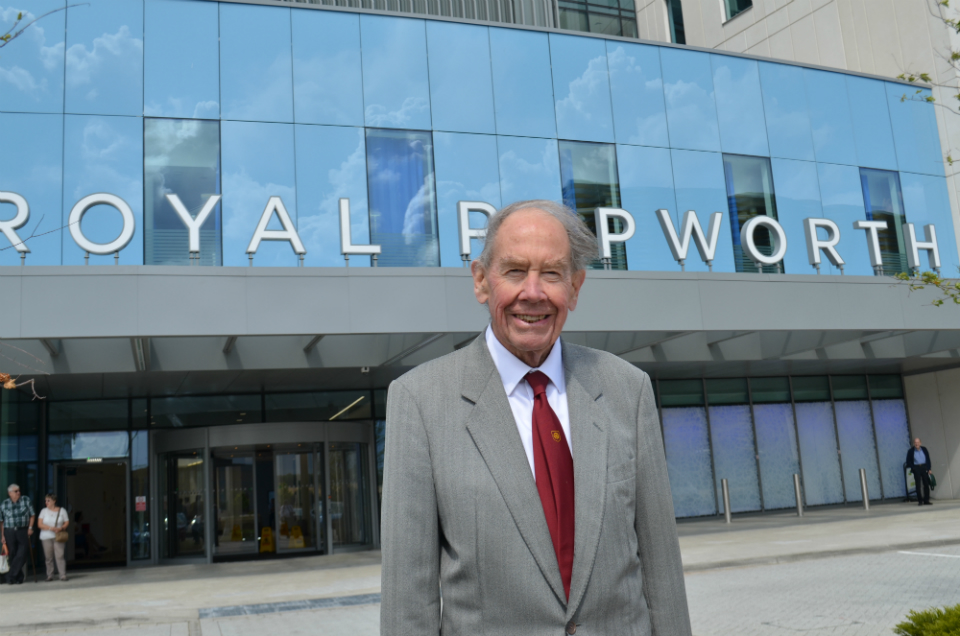
Terence English is a celebrated British surgeon. In 1979 he performed the first successful heart transplant in the UK.
 Peter Oborne, Jan-Peter Westad-30 March 2020
He has served as president of both the Royal College of Surgeons and the British Medical Association, and as the master of St Catharine's College, Cambridge. In 1991 he was recognised for his surgical achievements with a knighthood.
So when he retired 20 years ago, loaded with honours, he was fully entitled to put his feet up and dedicate himself to gardening at his home in Oxford. Instead, Terence English went to Gaza.
One of the most important of these projects has helped hundreds of people in need of complex limb reconstruction surgery.
 Gaza: The Palestinians who died during the Great March of Return
At least 190 people were shot dead over months of weekly protests, including at least 68 on 14 May 2018, when thousands of people in Gaza protested against the opening of the US embassy in Jerusalem.
On the second anniversary of the start of those protests, and with the situation in Gaza more desperate than ever and complicated by the spreading coronavirus pandemic, English, now 87, has decided to speak out for the first time.
The British surgeon is sufficiently well connected to have had a chance to raise his concerns privately with senior UK government ministers in recent years. Yet nothing has come of his efforts, he said.
“Gaza now presents a critical humanitarian crisis,” English told Middle East Eye.
The marches in Gaza began on 30 March 2018, when Ahmed Abu Artema, a Palestinian journalist, called on Palestinian refugees to gather peacefully near the fence to demand the right to return to the lands from which they were forced to flee or expelled during the events that led to the creation of Israel in 1948.
The Israeli response was violent. “When the protests at the fence started, there were enormous numbers of injuries,” English recalled.
“Teenagers and young men were being shot through the knee area by Israeli snipers on the other side of the fence using high velocity bullets.”
He describes horrifying injuries involving smashed bone and tissue. Others were killed.
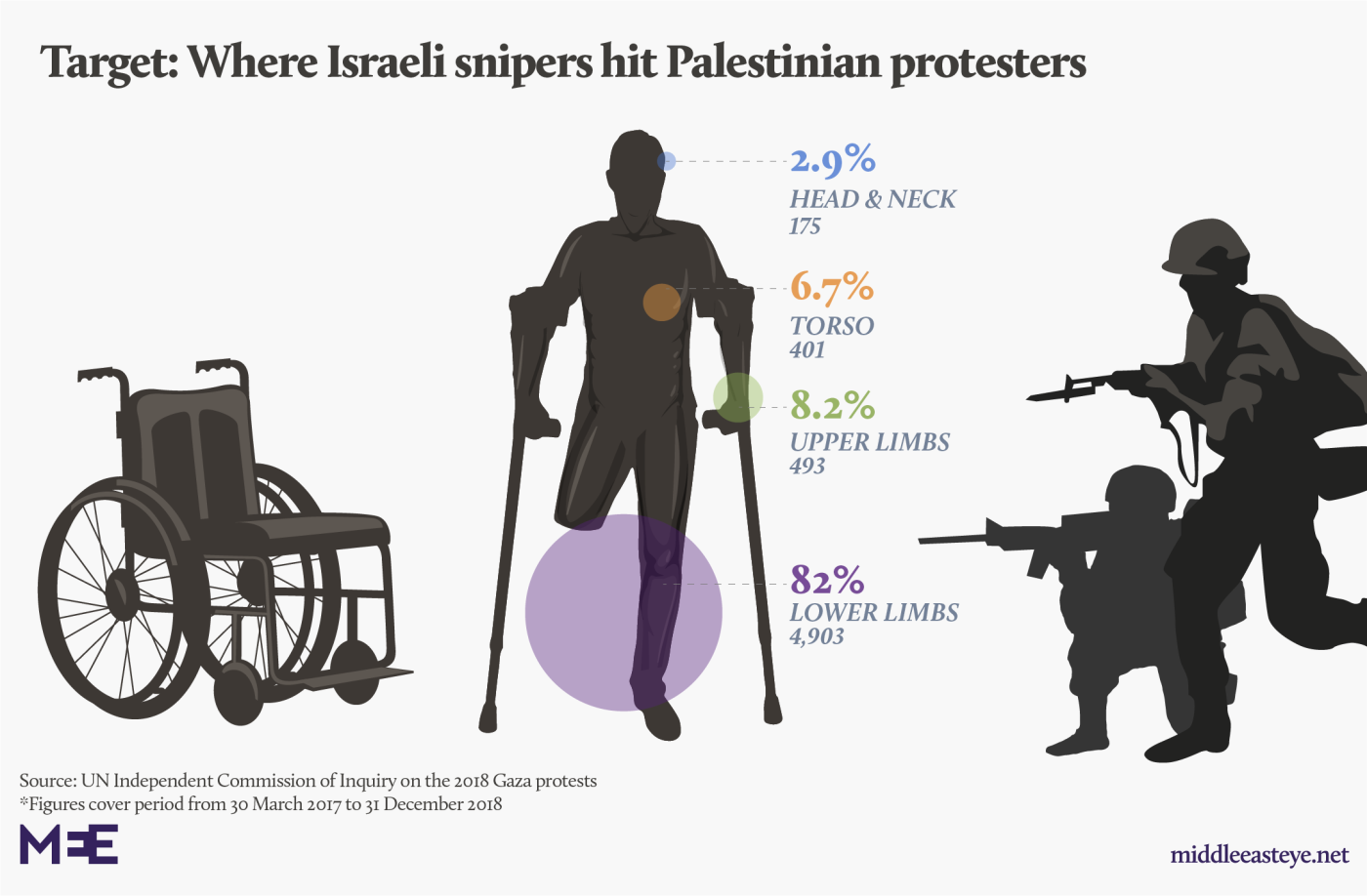
“The demonstration was supposed to be throughout the West Bank and Gaza to protest for the right to return, a need which is particularly acute in Gaza,” he said.
“Now a huge number of Palestinians have been disabled.”
For those who are successfully operated on, it can take up to six months before they are able to walk again and there is a long waiting list.
But many are not so lucky. “There were other cases where the only way of avoiding months of misery was to perform an amputation,” said English.
 'Shoot to maim': How Israel created a generation on crutches in Gaza
This is still an extraordinary achievement given the state of the health services in Gaza.
English said: “The first problem is the blockade, which makes it difficult to provide the necessary medical resources. The other issue is that conflict has destroyed a lot of the infrastructure. Hospital generators are unreliable, much of the water is undrinkable and medical supplies are in short supply.”
A few years ago, English recalls asking Dr Yousef Abu Reesh, Gaza’s deputy health minister, what serious gaps in healthcare provision needed addressing. Reesh laughed and replied: “Everything!”
Israel's blockade of Gaza has been in place since Hamas took control in 2007, after first winning legislative elections and then ousting Palestinian Authority President Mahmoud Abbas's Fatah from the coastal enclave following violent clashes between the rival factions.
Now English believes that the threat from coronavirus, with a number of cases already reported in the territory, makes the need to lift the blockade all the more urgent.
“Densely populated in a narrow strip of land and with a health service already under huge strain, there are fears that the virus would be impossible to control and have catastrophic effects,” he said.
“The people of Gaza are so very much more vulnerable. They live in very crowded conditions and there is no way they can self-isolate effectively.”
English believes that the British government has an obligation to do more for the Palestinians, because of its historic responsibility for the 1917 Balfour Declaration, in which it pledged to support the creation of a Jewish homeland in Palestine.
 The Balfour Declaration dissected: 67 words that changed the world
“I am saddened that Britain has not done more to honour its responsibilities for the Palestinians.”
His message is clear: “We have to pressure our parliamentarians to support the people of Gaza. Britain must take responsibility.”
One way in which English believes the British government could help is by talking to Hamas with the eventual aim of reconstructing a united leadership capable of representing all Palestinians in internationally-supported negotiations with Israel.
Coronavirus in Gaza: Just 40 ICU beds for two million people under siege
Read More »Such a move would take diplomatic and political courage since Hamas's military wing has been a proscribed terrorist organisation in the UK since 2001.
The British government describes its policy towards Palestine as being the establishing of “a just peace between a stable, democratic Palestinian State and Israel, based on 1967 borders, ending the occupation by agreement”.
But English fears that such a policy is in danger of being outpaced by events, as Israeli Prime Minister Benjamin Netanyahu, emboldened by the support of US President Donald Trump and domestic political machinations that look set to keep him in office, threatens to further undermine the prospects of any meaningful future agreement - with Palestinians suffering once again.
“Inevitably health services depend on politics,” English said.
“With Trump in office, Netanyahu believes he can do more or less what he wants and with him back in power he may aim to annex what remains of the West Bank.”
Subscribe to:
Posts (Atom)