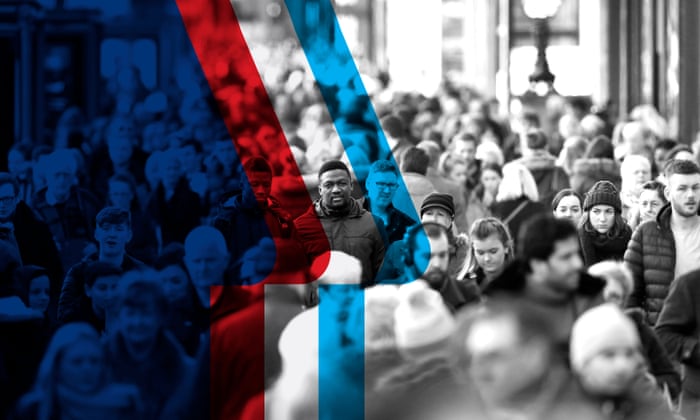
Half
of black, Asian and minority ethnic respondents in the poll said they
believed people sometimes did not realise they were treating them
differently because of their ethnicity. Photograph: Murdo MacLeod for
the Guardian
Poll commissioned to launch series on unconscious bias shows gulf in negative experiences by ethnicity
The extent of racial bias faced by black, Asian and minority ethnic
citizens in 21st-century Britain has been laid bare in an unprecedented
study showing a gulf in how people of different ethnicities are treated
in their daily lives.
A survey for the Guardian of 1,000 people from minority ethnic
backgrounds found they were consistently more likely to have faced
negative everyday experiences – all frequently associated with racism –
than white people in a comparison poll.
The survey found that 43% of those from a minority ethnic background had
been overlooked for a work promotion in a way that felt unfair in the
last five years – more than twice the proportion of white people (18%)
who reported the same experience.
The results show that ethnic minorities are three times as likely to
have been thrown out of or denied entrance to a restaurant, bar or club
in the last five years, and that more than two-thirds believe Britain
has a problem with racism.
The ICM poll, commissioned to launch a week-long investigation into bias
in Britain, focuses on everyday experiences of prejudice that could be a
result of unconscious bias – quick decisions conditioned by our backgrounds, cultural environment and personal experiences.
It is believed to be the first major piece of UK public polling to focus
on ethnic minorities’ experiences of unconscious bias, and comes amid
wider concerns about a shortage of research capturing the views of
minority groups.
The poll found comprehensive evidence to support concerns that
unconscious bias has a negative effect on the lives of Britain’s 8.5
million people from minority backgrounds that is not revealed by typical
data on racism. For example:
• 38% of people from ethnic minorities said
they had been wrongly suspected of shoplifting in the last five years,
compared with 14% of white people, with black people and women in
particular more likely to be wrongly suspected.
• Minorities were more than twice as likely to have encountered abuse or rudeness from a stranger in the last week.
• 53% of people from a minority background
believed they had been treated differently because of their hair,
clothes or appearance, compared with 29% of white people.
The Runnymede Trust, a racial equality thinktank, described the findings
as “stark” and said they illustrated “everyday micro-aggressions” that
had profound effects on Britain’s social structure.
“Racism and discrimination for BAME people and minority faith groups
isn’t restricted to one area of life,” said Zubaida Haque, the trust’s
deputy director. “If you’re not welcome in a restaurant as a guest
because of the colour of your skin, you’re unlikely to get a job in the
restaurant for the same reason. Structural and institutional racism is
difficult to identify or prove, but it has much more far-reaching
effects on people’s life chances.” David
Lammy, the Labour MP for Tottenham, said the findings were upsetting.
“Racial prejudice continues to weigh on the lives of black and ethnic
minority people in the UK. While we all share the same hard-won rights,
our lived experience and opportunity can vary,” he said.
Recalling being stopped and searched when he was 12, Lammy said:
“Stereotyping is not just something that happens, stereotyping is
something that is felt, and it feels like sheer terror, confusion and
shame.”
Half of the respondents from a minority background said they believed
people sometimes did not realise they were treating them differently
because of their ethnicity, suggesting unconscious bias, as well as more
explicit and deliberate racism, has a major influence on the way
millions of people who were born in the UK or moved here are treated.
As well as demonstrating how much more likely ethnic minorities are to
report negative experiences that did not feature an explicitly racist
element, the poll found that one in eight had heard racist language
directed at them in the month before they were surveyed.
It also found troubling levels of concern about bias in the workplace,
with 57% of minorities saying they felt they had to work harder to
succeed in Britain because of their ethnicity, and 40% saying they
earned less or had worse employment prospects for the same reason.
The poll persistently found evidence that the gap in negative
experiences was not confined to the past. For example, one in seven
people from ethnic minorities said they had been treated as a potential
shoplifter in the last month, against one in 25 white people.



 Half
of black, Asian and minority ethnic respondents in the poll said they
believed people sometimes did not realise they were treating them
differently because of their ethnicity. Photograph: Murdo MacLeod for
the Guardian
Half
of black, Asian and minority ethnic respondents in the poll said they
believed people sometimes did not realise they were treating them
differently because of their ethnicity. Photograph: Murdo MacLeod for
the Guardian Robert Booth and Aamna Mohdin-