Peace for the World World ! Your War Our Lives

The Dalai Lama
A Brief Colonial History Of Ceylon(SriLanka)
Sri Lanka: One Island Two Nations
A Brief Colonial History Of Ceylon(SriLanka)
Sri Lanka: One Island Two Nations
(Full Story)
Back to 500BC.

Monday, December 3, 2018
US-Saudi Relations: A Diabolical Rendezvous
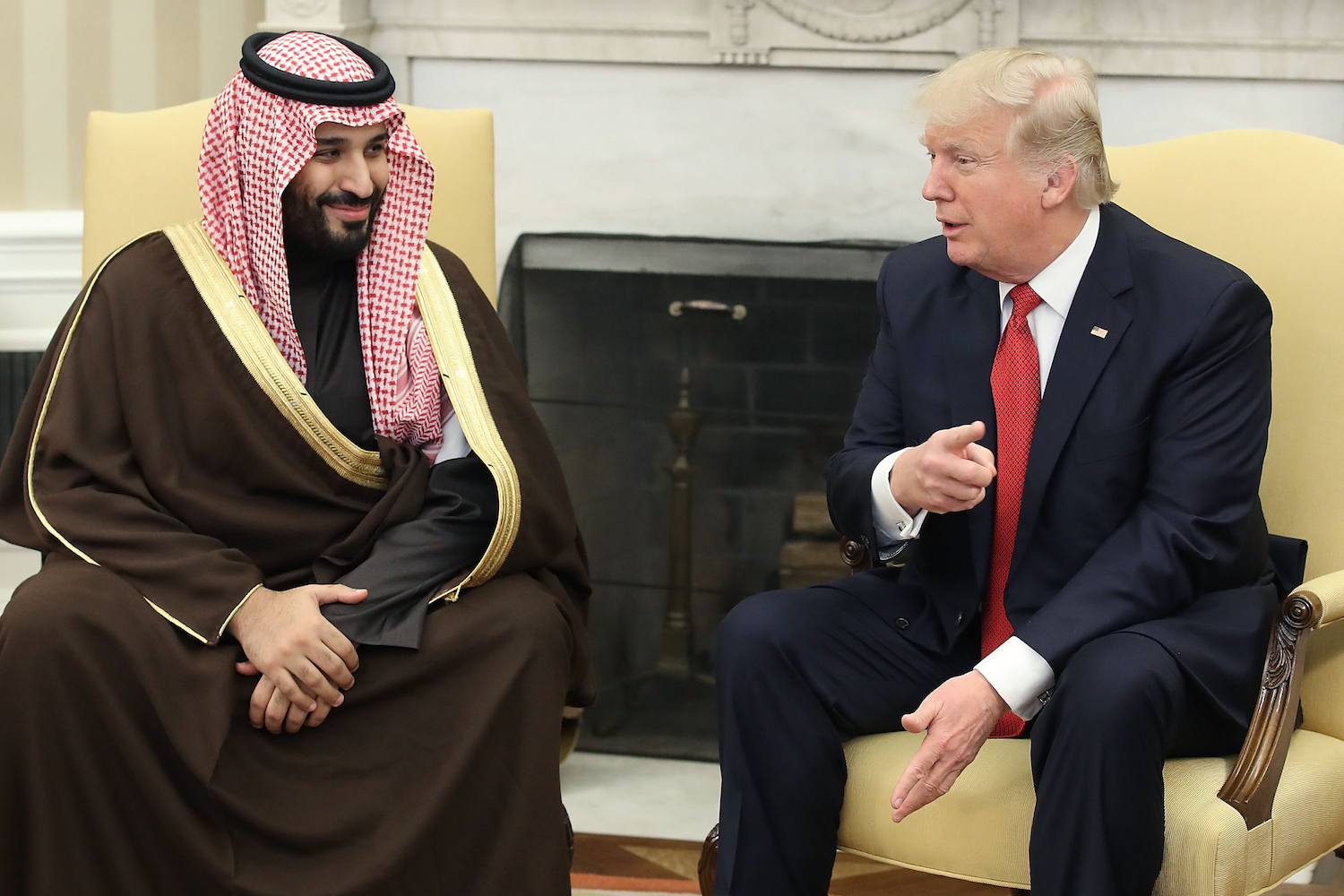
Featured image courtesy Mark Wilson/Getty Images

As democracy is perfected, the
office of the President represents, more and more closely, the inner
soul of the people. On some great and glorious day, the plain folks of
the land will reach their heart’s desire at last, and the White House
will be occupied by a downright fool and complete narcissistic moron. (H. L. Mencken, The Baltimore Evening Sun, July 26 1920)
By turning a blind eye to the brutal murder of Saudi journalist, Jamal
Khashoggi, in the name of making ‘America Great Again’, President Donald
Trump has sacrificed justice for power and profit; and by continuing
his rendezvous with the Saudi Royal household and Crown Prince Mohammed
Ibn Salman, US-Saudi “eternal friendship” has turned into a diabolic and
personal courtship. How did this come about?
The Saudi-born Jamal Khashoggi, an acute observer of developments in
that country and a fearless critic of Saudi Royalty was killed inside
the walls of Saudi Embassy in Istanbul, allegedly by a group of Saudi assassins flown to Turkey for that purpose with instructions from the Royal household (Saudi Arabia has issued varied explanations for
Khashoggi’s death inside the consulate, first denying all knowledge,
then saying he had been killed in a fight). The Saudi Government failed
to cover up what it finally accepted as a ‘heinous crime’. However,
Turkey’s president, Tayyip Erdogan, a man who has also been responsible
for the detention of 245 journalists, according to Stockholm Centre for Freedom,
had been relentless in getting to the bottom of the crime. Erdogan
produced some hard evidence and pinpointed Saudi Crown Prince Mohamed
Bin Salman, who is now accused of masterminding the operation. Recently,
the CIA released its own report and confirmed Turkey’s accusation. The
murder is said to have been premeditated and planned at least twelve
days before it was executed. The civilised world is obviously outraged,
particularly at the gruesome barbarity of that murder. There is pressure
on the UN to initiate an independent investigation. In spite of all
this, President Trump after casting doubt on Saudi’s culpability said
at last that he was not going to sacrifice the financial and business
bonanza from an important ally even though it this ally may have killed a
journalist. He has also cast doubt on CIA findings and refused to
listen to a recorded tape released by Turkey. All this boils down to one
important conclusion about this president. To him whoever or whatever
country promises money and business is an ally, no matter how murderous.
Under Trump, the US has certainly lost among many things its moral high ground to lead the world. In the case of US-Saudi relations, it is cash, carbon and cannons that cements it and nothing else.
From the day he was elected as President, Trump has behaved like the
proverbial bull in a China shop wrecking practically every previously
agreed treaty and arrangements not only nationally but also
internationally. It makes one wonder whether this president has made
Mencken, quoted above, a prophet.
Saudi Arabia, formerly known as the Kingdom of Hejaz and Nejd, was carved out of the Ottoman Caliphate by as some might say, by imperialist design from former superpower, Britain. The kingdom’s friendship with US started in 1945 when Franklin Roosevelt, while returning from Yalta, met the “robed resplendent” King Abdul Aziz Ibn Saud on USS Quincey.
That meeting, in the wake of the discovery of the first oil well in
commercial quantities in Dhahran in 1938, and withdrawal of Soviet
diplomats from the kingdom by Stalin (Soviet Russia was the first
country to recognize the kingdom and open a consulate there), partly
because of the monarch turning anti-communist after Stalin executed
Aziz’s trusted Russian Consul, Karim Khakimov and his associate Nazir
Bey Turyakulov. More importantly, it was also because of the dictator’s
decision to form friendships with Britain and join in the war against
Hitler, which heralded the beginning of a friendship, which, in the
1970s and particularly after 1979, grew into more than a strategic
alliance. Three epoch making events in that year, the Iranian
revolution, the siege of Mecca and the Soviet invasion of Afghanistan,
made Saudi Arabia an indispensable US ally in the Middle East and the
world of Islam.
After the Iranian revolution and subsequent US debacle there, the
popularity of Khomeini’s Shia radicalism leapt far beyond the Shia
borders and entered into Sunni zone threatening to bring down tyrannous
Muslim regimes, particularly in the Middle East. Inspired by Khomeini’s
revolutionary rhetoric, the second event, siege of Mecca by a small band
of Saudi Wahhabi rebels with its demand for the overthrow of Saudi
Royalty, sent shock waves into Washington. The US-designed Middle East
Order appeared in danger of crumbling under the Khomeini tsunami. US was
in desperate search for a counter strategy to check Khomeini’s
radicalism and protect the Middle East Order. In Saudi Arabia’s
Wahhabism/Salafism it found the answer. Without realising the inherent
danger of this ultra-conservative religious virus, US administration endorsed its spread internationally
to de-radicalise the Muslim youth. Shortly after the Mecca siege and
under the auspices of the World Assembly of Muslim Youth (WAMY), a new
drive towards ‘Islamic cohesion’ (al-tamasuk al-islami)
was launched by the Saudi Government on the occasion of the fourteenth
Islamic century. WAMY, the World Muslim League, Muslim Brotherhood, the
Pakistani Jamaat-e-Islami and Ahli Hadith networks were the main
agencies that joined this Wahhabi mission. By encouraging the spread of
Saudi Islam, US was aiming to kill two birds with one stone, Khomeini
radicalism and Communism.
The third event, Soviet invasion of Afghanistan, provided a magnificent
laboratory to experiment US strategy. With Saudi petrodollars and
American FIM-92 stinger missiles Wahhabi schooled mujahideen rallied
under Osama Bin Laden’s Al-Qaeda joined US forces and drove out the
Russians from Afghanistan, which ultimately led to the break-up and
demise of what Ronald Reagan dubbed as the “evil empire”. However, the
end of Communism did not mean end of Khomeini inspired radicalism.
After rejoicing the victory in Afghanistan the unemployed mujahideen warriors
overestimated their capability and decided to take on US itself. If the
September 11 2001 infamy in Washington could be called as the first and
the most daring episode of this turn around, the emergence of Islamic
State of Iraq and Levant/Syria (ISIL/S) in the summer of 2014 and
declaration of a Caliphate on 29 June the same year was perhaps its
grand finale. The ISIS/L was actually another Wahhabi state and its
leader Abu Bakr Al-Baghdadi and many of his Saudi supporters were
schooled in Wahhabism. In relation to Saudi Royalty, ISIS continued from
where the 1979 rebels stopped.
With Saudi monarchy facing existential crisis in the face of radical
Islam and US facing s crisis from radical Iran it is no surprise that
these two ‘eternal friends’, one with destructive weaponised power and
the other with cash and carbon enriched wealth, should strengthen that
friendship at any cost.
The election of Donald Trump, an unpredictable narcissist, to the White
House, and selection of Mohammed Ibn Salman as Saudi Crown Prince, an
unhinged and equally narcissistic, has brought the so called Middle East
Order to the brink of disaster. Salman’s diabolic involvement in Yemen
causing an unparalleled humanitarian crisis condemned by the world at
large, his open support to anti-Assad rebels in Syria including ISIS
fighters – whom he wants to keep at bay from interfering in Saudi
domestic politics – his hatred of the Shiites and Iran and his
uncompromising determination to put down all internal opposition to his
untrammelled power, even by killing the opponents as demonstrated by the
cruel murder of Khashoggi, is a warning to the world as to what will
happen if this so called ‘moderniser’ of the desert kingdom becomes the
King. Equally, a president of the only superpower, who is prepared to
wreck everything come what it may only for the sake of US power and
prosperity, is also a warning to the world that Hitler is not dead.
Under these two personalities, is not the US-Saudi rendezvous
malevolently dangerous?
