Peace for the World World ! Your War Our Lives

The Dalai Lama
A Brief Colonial History Of Ceylon(SriLanka)
Sri Lanka: One Island Two Nations
A Brief Colonial History Of Ceylon(SriLanka)
Sri Lanka: One Island Two Nations
(Full Story)
Back to 500BC.

Friday, February 1, 2019
Investigative Journalism in Sri Lanka: Vulnerabilities


David Kaplan, Executive Director of the Global Investigative Journalists
Network (GIJN) identifies five different characteristics of
investigative journalism:
1.Systematic enquiry:This means you are taking your time and going in a
systematic way to analyze what is going on.The work you are doing is
original and in-depth. Original reporting is investigative journalism.
2.Forming a hypothesis: This is about what is going on. To form a
theory, find the facts that will support it. If it does not, you have to
abandon it the theory.
3.Using public records and public data:Investigative Reporting is
following people, money, paper and data trails, collecting public
records, and documents leaked, and analyzing them.
4.Making public matters that are secrets that remain hidden.
Investigative Reporters are often dealing with secret information. The
people in power do not want it brought out. It is embarrassing for them.
5.Focussing on social justice and accountability.
I am not a teacher in investigative journalism. I will not, therefore,
deal with the different technical aspects. Instead, I believe, it may be
useful for those of you, who want to pursue investigative journalism,
if I share some of my personal experiences in this field.

Before I do that, please permit me to strike a personal note. Fifty
years ago, straight out of school, I walked into the office of the now
defunct SUN / WEEKEND in Hulftsdorp. It was then one of the largest
groups. I did not realize that it was going to be a turning point in my
life.
I was offered a job as a Reporter and requested to work the very next
day. I asked for time. I had to wind up a course in Sales Management. A
week later, I joined to cover Tamil political parties due to my fluency
in Sinhala and Tamil languages.
My work then took me to different parts of the North and East of Sri
Lanka, which were to later become the battleground for a deadly
separatist insurgency. I became familiar with the terrain . At that
juncture, there were only two major Tamil political parties. I covered
their annual sessions and other events of importance in these two
provinces.
By the mid-1970s, moderate politics was transcending into militancy.
Tamil political parties and groups united through what is known as the
Vaddukottai resolution to go beyond democratic pursuits. Over a period
of time, this saw the birth of a plethora of militant groups. During the
early phases of what is euphemistically called Eelam War I, they
functioned separately but were unified in their objective of confronting
the Security Forces and the Police.
The subsequent phases of what was dubbed as Eelam War II and III became
fierce in character. The Liberation Tigers of Tamil Eelam (LTTE), often
known as Tamil Tigers, literally eliminated their rival groups in some
of the crudest and bloodiest battles. New military hardware was inducted
by both the militants and the military. In May 2009, the LTTE was
militarily defeated. Thus, I was fortunate in being able to cover the
birth, growth and the death of separatist insurgency in Sri Lanka.
Murky MiG 27 Deal
Military procurements were becoming controversial. Both those in uniform
and in civvies were profiting hugely. I began exposing some of the
controversial deals. The travails I faced were far too many to list
here. I can only say I have lived to tell the story.
In September 2006, a source in the Sri Lanka Air Force (SLAF) gave me a
bulky document – a so-called contract for the procurement of four MiG 27
fighter jets. Each was to cost US$ 3,462,000 or over Rs 265 million.
These were for aircraft manufactured between 1980 and 1983. The contract
claimed they were Government to Government deals. I investigated the
matter for many weeks, talking to my sources as well as diplomats who
specialized in defense and security. A clear picture emerged.
After the break up of the Soviet Union in 1991, as you are aware,
Ukraine became another state. A fleet of MiG 27s lay in a parking lot
exposed to snow, sun and rain. A company based in Singapore was among
those which were wanting to sell these aircraft to the Sri Lanka Air
Force, and there appeared to be many irregularities.
The Sunday Times bared the details in an expose in December 2006. A few
highlights of the report: “A contract between the Air Force on behalf of
the Government of Sri Lanka and the Ukranian Government-owned firm
Ukrinmarsh is touted as a Government-to-Government deal. Such deals are
made to obviate the need to call for tenders to pick the lowest bidder.
The widely accepted principle in these deals, referred to as G to G, is
the elimination of third parties who make fat commissions and become
billionaires overnight.”
Now, this so-called contract was signed on July 2006 – just a day
before, the Lanka Logistics and Technologies Limited came into being.
This wholly state-owned concern was set up to procure all military
equipment and related items for the armed services and the police. It
was shocking to learn that the MiG 27s in question were those left over
from two different purchases which the Air Force teams that went to
Ukraine had carefully selected.
These purchases, my report in the Sunday Times said: “This was on two
different occasions. On the first occassion six years ago, the prices
were much lower. And now they have been contracted for higher prices.
The first purchase was on May 25, 2000 when four MiG 27 jets were
purchased for US$ 1.75 million each. They were manufactured between 1982
and 1985. The second purchase was on October 24, 2000. In this deal,
two MiG – 27s were purchased at a cost of at $ 1.6 million each. One was
manufactured in 1981 and the other in 1984,”
You will observe from what I said, that the last purchase was made from
MiG 27s remaining after the better ones were chosen. If the two earlier
purchases were for ones manufactured before 1985, the last were those
made between 1980 and 1983. I continued my investigations. When more
reports began to appear, those at the highest levels of the Government
were incensed. Powerful persons with a bottomless reservoir of
arrogance, vengeance and vendetta unleashed a campaign of terror against
me. Unfortunately, those travails had to be borne even by my wife and
daughter. I must confess that after studies abroad, this was the reason
why my daughter chose to work outside Sri Lanka. That was not the only
heavy price I paid in the name of investigative journalism.
Dubbed Traitor
The continued exposure in the Sunday Times saw a vicious campaign by the
state-run media. Together with them, the Ministry of Defence gave me a
dubious title in their website – Traitor. I must single out the Sirasa
television network during this troubled time for standing up to the
truth. They even broadcast a letter from Senator Joe Biden, who was to
later become US Vice President to then Sri Lanka President on my behalf.
Crowds carrying placards calling me traitor, backed by a local
councilor, demonstrated near my house. Some of those taking part
demanded my arrest. I came under close surveillance and an effort was
being made to locate my sources. Leave alone being arrested, if indeed I
was considered a traitor, no state agency questioned me. I was making
the news daily. I knew that someone somewhere was deeply hurt by my
embarrassing disclosures.
Attached to me was a security contingent from the Army. I am sure you
will agree that for a journalist, working with bodyguards around, is
anathema. Their presence will discourage of dry up sources. I had no
choice. It came on the recommendation of intelligence agencies who said
there were threats. They were subsequently withdrawn.
One day, I had a telephone call from the leader of a left-leaning
political party who had close connections with those at the Defence
Ministry. He was on visiting terms. He met me at home and did not lose
time in asking me how I got details of the MiG-27 deal. I had to open a
Pilot’s briefcase to pull out the documents and prove a point to him –
why not punish those involved, I asked. He asked me for a copy of the
contract but I said it was difficult at that point of time.
Hounded for Expose
What I heard days later from my sources in the military was distressing.
Plans were afoot to raid my house. They were after the pilot’s
briefcase. A sinister plan had already been set in motion. Loud hailers
fixed with speakers were going around the area where I live warning
residents that LTTE cadres were hiding in homes. Hence, the announcement
said, a house to house search was underway. The idea was to raid my
house. My source who was very familiar with the plans and asked me to
get out of the house with my family. The advise was because I had some
cause to protest that my house was raided in my absence.
There was a problem. A religious event in Colombo that had drawn members
of the Bohra community from world over. All hotels in Colombo were
full. My friend Amal Jayasinghe was kind enough to arrange for a hotel
in Kalutara. Two others who are common friends, including a staffer in a
diplomatic mission, drove me there. He also took charge of the pilot’s
briefcase.
There was more disturbing news just two weeks before Lasantha
Wickremetunga was murdered. A very highly placed source asked me to get
out of the house that very night. I flew to Thailand. I had spent long
stints there living in an apartment cooking food, washing clothes and
working online. The next morning, my driver who was alerted, saw a man
with an oversized bush shirt moving outside my house in a motorcycle.
When there was a strong wind blowing, the bottom part of the shirt went
up. There was a pistol on his waist. The driver noted the registration
number. I checked it on a secure phone from Bangkok. The registration
plate belonged to a lorry.
When the so-called Yahapalanaya government came to power, they set up
the Financial Crimes Investigation Division (FCID). I made a statement
to them in early 2015 and investigations began. I have learned that an
FCID team went to Ukraine. On April 25, 2016 at 10 a.m. they met top
Ukranian government officials including the Prosecutor General. When
told about the purchase of the last four MiG-27s, their response was
shocking. The answer was “we never sold any MiG 27s to Sri Lanka.”
Vindicated
Here are some of the findings: The so-called contract which the Sri
Lanka Air Force signed with Ukrinmarsh does not exist. If there were
claims that the moneys were remitted to a Bellimissa Holdings, to a drop
box number in London, it was false. It has transpired that Bellimissa
Holdings was a company formed by the previous supplier only for the
purpose of the last deal. That had been kept a secret by those involved.
I will not delve into more details since the investigations are still
underway. However, like thousands of Sri Lankans, I am skeptical whether
the findings into the MiG-27 deal will see the light of day. Yet, it is
with great delight I say I am vindicated. For those who accused me as a
traitor, I have proved I am not. I have that way done a service to the
country. The traitors are those who have milked the Sri Lankan taxpayers
money.
There is also a good side to all this. There are a vast number of
honest, committed and patriotic men in our military. They are vast in
number, the crooks are a handful. As you know, it is one of them, who
wanted the Sri Lankan public to expose the corrupt activity, who gave me
the contract. There are those who were very concerned about me and my
family. Some even diverted their own men to drive past my residence late
nights to ensure nothing was wrong.
Mystery of Missing Mortar Bombs
Since time is too short, I will briefly mention to you another instance.
One day, the Defence Attache of a western diplomatic mission invited me
to lunch. During our conversation, he asked, what I made of a fax he
had received. It neither had the name of the sender nor the title of any
organization.
The text claimed that they had seized 32,400, 81 mm mortars that were
consigned to the Sri Lanka Army. I told the officer, with whom I was
closely associated over a period of time, I would bet it was from the
LTTE. “How can you say that?,” he asked. I said that the typeface was
similar to the one used by LTTE in their news releases. He gave me the
copy and I began investigating. It took several weeks.
I learned that a stock of 81 mm mortars had in fact been ordered by the
Sri Lanka Army from the Zimbabwe Defence Industries (ZDI) in Zimbabwe.
An advance payment had also been made to an intermediary in Singapore.
The stocks, though expected, had not arrived in Colombo.
In that meanwhile, it came to light, that the Tiger guerrillas were
using an increased volume of mortars in the battle areas. I found out
how the mortars ordered by the Army fell into the hands of the LTTE.
The Zimbabwe Defence Industries did not have stocks at the time the
order was placed. Since the Army was in a hurry, a corrupt official at
ZDI had approached an Israeli arms dealer. The latter arranged for the
stock of 32,400 mortars in the surplus stocks from the Bosnian war. They
were loaded into a ship that was to first travel to Zimbabwe. I have
not been able to establish the link from there until I found that it had
been loaded into an LTTE cargo ship. That brought the stocks to the
waters off Mullaitivu.
This was why, the ship that remained anchored for weeks, was later
destroyed by the LTTE. It did not sail away. The advance paid by the
Army remains in Singapore and the story ended there. There were moves
then to prevent a detailed probe.
I chose to mention these instances purely to underscore the fact that
investigative journalism is not an easy task. There is someone somewhere
who wants to hide the secrets of wrong-doing so that the public may not
know. For those of you who aspire to become investigative journalists,
it would be good to bear in mind the words Briitish playwright
Christopher Hampton. With apologies to him, I have modified it to say
“asking what an investigative journalist what he thinks about critics is
like asking a lampost how it feels about dogs.”
In all the trials and tribulations, I must record the fact that I owe my
great gratitude to my Publisher Ranjit Wijewardene, and Editor in Chief
Sinha Ratnatunga. They have not only stood by me but have been a tower
of strength. I also owe a great thank you to my wife and daughter who
had to bear all that I went through for no fault of theirs
(The
above was the keynote speech of Iqbal Athas at the inauguration of
Center for Investigative Reporting Sri Lanka held in Colombo on January
30, 2019. Athas was the only Sri Lankan member of the Washington-based
International Consortium of Investigative Journalists (ICIJ). The
membership is peer recommended. ICIJ is the first global organization to
use the cyberspace to collaborate in investigative projects. Years
earlier, Athas had collaborated in their project titled: “The Business
of War.” Now in the form of a book, it deals with mercenary groups and
how some of them gained legitimacy in battle zones. It included a part
on Sri Lanka).

How INDEPENDENT is JUDICIARY?

President’s Counsel, former BASL Secretary and former Ambassador to UAE and Israel
Difficult Question to Answer
 2019-01-31
This is a very difficult question to answer and it is only the average citizen/litigant that is capable of answering this million dollar question. In the West and many other countries in the Commonwealth and civil law jurisdictions the Judiciary is independent with sufficient checks and balances. But in a highly politicized society with rampant bribery and corruption which has ripple effects all over the society as cancer and lowering of standards in the lowest ebb, it is not a breeding ground to maintain such standards.\
Barometer of Democracy
 Independence
of the Judiciary is the barometer of the computation of the democracy,
and culture of a nation expecting justice and fair play for the
resolution of their disputes from impartial and politically insulated
independent judges appointed under the constitution. It is a good sign
that in Sri Lanka judiciary today is well paid remunerated protected and
looked after respected and gained the confidence of the citizen
maintaining impartiality and trust of the litigants.
Independence
of the Judiciary is the barometer of the computation of the democracy,
and culture of a nation expecting justice and fair play for the
resolution of their disputes from impartial and politically insulated
independent judges appointed under the constitution. It is a good sign
that in Sri Lanka judiciary today is well paid remunerated protected and
looked after respected and gained the confidence of the citizen
maintaining impartiality and trust of the litigants.Are Judges politically insulated and not influenced by media and political influence linked to perks and promotions?
Is the mode of selection of judges especially the highest judiciary non-political when the majority of the selecting body is political towards the State, when the minor judiciary is selected by the Apex Judiciary appointed by the politicized apex commission.
Are judges well trained, exposed to the wider world jurisprudence and competent or keep pace with the rest of the jurisdictions and the past we can be proud of them.
Are they updated with the modern developments in the digital age in par with the rest of the jurisdictions that are unanswered valid questions?
Are the judgments clear, deep, exhaustive, and do they maintain the highest standards maintained by the predecessors like traditional judgments respected by the jurists worldwide? Our judges and judiciary have passed these litmus tests of world standards leaving room to raise standards further.
In the West and many other in the Commonwealth and civil law jurisdictions Judiciary is independent with sufficient checks and balances
Ultimate Decision over Life
Judges should be free to take decisions because they are charged with the ultimate decision over life, properties, rights and duties of the citizen including all kinds of freedoms enshrined in the Constitution and by way of Conventions Powers and Traditions vested with the Executive with great trust to be impartial and should not be undermined overlooked or destroyed. They are the guardians of the supreme law and the citizen. It is also unfortunate that successive governments and the leaders of the Executive have misused and violated this sacred responsibility entrusted to them as the guardians and temporary trustees of the Temple of Justice, which is the backbone of freedom and equality.Are judges competent, educated, and trained and temperamentally sound to judge the complicated issues pertaining to individuals, companies and the state and constitutional matters involving the supreme law of the Nation? Supreme Court Judges are well paid with a substantial pension to discourage them being employed and engaged in other financial lucrative arenas including political activism after retirement and many improvements are required for our judiciary to be on par with real-world standards.
Trust and faith of the citizen
The Judiciary should be acceptable and recognized, for the citizen to have trust or faith on; being the branch of government primarily responsible for the judiciary is interpretation. According to UN guidelines and accepted norms of constitutional law under the doctrine of separation of powers which are outlined in detail in international instruments and conventions, to be followed by the family of nations which trickles down to national laws in democratic models.Recent famous case on the conduct of a general election is a litmus test on the independence quality and competency of the highest and judiciary with no further appeal to any other local or world judiciary It is also necessary to follow the guidelines in the world judicial arena in Sri Lanka and concepts of good governance in the conduct of justice and fair play. It is essential to explore the recent judgments worldwide with new approaches such as concepts of necessity applied worldwide including our neighbours in matters of national importance.
Temperament and Qualities of a Judge
Judges always command respect and therefore need not demand respect. How do judges show respect? By treating everyone with dignity, by being polite and courteous, by listening carefully to the testimony presented and arguments of counsel, by being patient, and in general showing that the judges genuinely care about the matters being presented, understand that it is an impartial meeting of those involved and convey the attitude that he/she will do the best to decide the case forming objections on the evidence presented and applicable to the law and judges should not be political animals and have any interest in politics, any religion or any activism in any form other than fair and impartial adjudication. In the United Kingdom and Sri Lanka judges are paid well and well looked after with perks, respect and facilities.Judges should be careful as they are similar to public exhibits in glass boxes! It is unbecoming of a judge to maintain close contacts with the media and politicians however much one is tempted to be in the limelight and likes publicity. A judge should not be a social or religious activist or a centre for public controversies. Judges are human beings and liable to make mistakes.
Highest Judiciary should be extra careful
The highest Judiciary in a country must be extra careful in their deliberations as it is difficult to challenge the decision of the final court. Compassion, Decisiveness, Open-mindedness, Sensitivity, Courtesy, and Patience, Free from bias, and Commitment to equal justice are some of the main qualities of a judge with the correct judicial temperament. The system of judicial independence depends on the citizens’ faith and the trust that judges will decide disputes impartially and fairly free from bias or prejudice.Judges traditionally have been accorded respect from citizens. In return, judges must respect all those who include the parties to the dispute, the attorneys, jurors, court reporters, staff and members of the public.
Appointments of Judges and Practices in other Jurisdictions
In the USA some judges are elected by the people. First amendment to the USA guarantees the protection and tenure of the judges as in the case of many common law jurisdictions. Judiciary is the fourth branch of the government and severely scrutinized by the people and the media. David Blankette, once the Home Secretary and Secretary of State in the United Kingdom was compelled to resign in 2004 as a result of the pressure from the media and the activists on matters pertaining to judges and judiciary. Commonwealth countries including the UK, India follow the same procedures and traditions in the appointments and conduct of the judges and the judiciary, which is one of the main components of democracy.In common law jurisdictions, courts interpret law including constitutional status, laws and regulations. They also make law based upon prior case law in areas where the legislature has not made law. We mainly follow English Law in this area and the principles and procedures accepted are from the English and Commonwealth practices. Appointment of judges is clearly laid down in the constitution, with safeguards and freedom to the Executive to take impartial and correct decisions.
It is unbecoming of a judge to maintain close contacts with the media and politicians however much one is tempted to be in the limelight and likes publicity.
Commissions to be non-political
The nation expects President and the apex Commission to make the best appointment to be the Judiciary deciding crucial and decisive junctures future of the destiny and future of the subject. Chief Justice is the head of the Judiciary and under the Constitution, legislature and conventions entrusted with enormous powers in Legal Education, (vide the article in Daily News on legal education by this author on 29th June 2008 on the subject Law College, Legal Profession, Bar Association and Judicial System by the author) Disciplinary matters of the judges and lawyers and as the head of the final court of appellate with ultimate and final powers of adjudication and administration of justice.Time to rethink revisit and re-adjust
Today the time is ripe to rethink, readjust, and revisit for reforms and the systems with a new vision and a new mandate from the citizen waiting for an opportunity for their future decisions which is denied to them due to petty power-hungry politicians.Citizen is the ultimate decision maker and should be given to fulfil the aspirations at the first available opportunity to decide the wish and will of the people to decide the destiny of the children and the nation they love most.
(Not by passing arbitrary judgments does a man become wise? A wise man is one who investigates both right and the wrong. He who does not judge others arbitrarily according to the truth, that sagacious man is a guardian of law and is called just. One is not wise because one speaks much. He who is peaceful, friendly and fearless is called wise. A man is not versed in Dhamma because he speaks much. He who, after hearing a little Dhamma, realizes its truth directly and is not heedless of it is truly versed in Dhammapada.”)
The writer can be contacted via sarath7@hotmail.co.uk
Peoples’ Perspective For National Budget 2019

By Emesha Piumini Perera –JANUARY 30, 2019

Emesha Piumini Perera
 Lanka
is now recovering from the political chaos due to the constitutional
coup leading to the ouster of the Prime Minister. The economic
volatility remains. Sri Lanka requires a well –planned budget that also
takes into consideration principles of fairness and equity that will
improve the lives of people. Moreover the budget is a mirror that
reflects the government‘s direction and commitment towards ensuring
human rights particularly economic, social and cultural rights.
Lanka
is now recovering from the political chaos due to the constitutional
coup leading to the ouster of the Prime Minister. The economic
volatility remains. Sri Lanka requires a well –planned budget that also
takes into consideration principles of fairness and equity that will
improve the lives of people. Moreover the budget is a mirror that
reflects the government‘s direction and commitment towards ensuring
human rights particularly economic, social and cultural rights.
Mr. Juan Pablo Bohoslavsky, United Nations Independent Expert visited Sri Lanka (3-11
September 2018). In his report he highlighted the effects of foreign
debt and other related international financial obligations on the
advancement of human rights, particularly economic, social and cultural
rights (ESCR). His report is an eye-opener and one that the government
(at all levels) and the civil society organizations should take into
account and use as a prism through which to review the programs on
development – both in their design and execution. It appears that so
when far none of the governments have taken the human rights dimension
into account formulating economic and development policies. Human rights
tend to be confined to the political arena but not to the economic and
social spheres. The report of the independent expert calls for a
paradigm shift so that total development efforts are approached from a
human rights perspective.
The report grapples with four objectives, namely, a) to examine the
effects of public debt, structural adjustment, fiscal consolidation and
other economic reform policies on the realization of human rights; b) to
assess the efforts made by the Government to curb illicit financial
flows; c) to analyse the effects of international development assistance
and lending to Sri Lanka from a human rights standpoint, and; d) to
study the efforts deployed by the Government to integrate human rights
standards in the financial sector with a particular interest on micro
finance.
On June 11, 1980, nearly forty years ago, the Government of Sri Lanka
(GoSL) ratified the International Covenant of Economic, Social and
Cultural Rights (CESCR) pledging that it would take necessary steps
towards the progressive realization of ESCR within the given limits of
country’s maximum available resources. Though the Sri Lankan
constitution of 1978 recognizes some of the ESCR as directive principles
of the state under Article 27, they are not enforceable in any court or
tribunal. The attempts were made 2016, during discussions around the
draft constitution to include them as justiciable. However, the proposal
of the Subcommittee Report on Fundamental rights 2016, have floundered
along with the broader constitutional reform process.
The UN independent Expert recognised that, “while maintaining
macroeconomic stability is an important concern, this aim should not
prevent human rights assessments of these planned reforms, in line with
international human rights standards.” In Sri Lanka, the government’s
focus is to maintain fiscal consolidation with the goal of achieving a
budget deficit of 3.5 percent of the GDP (Gross Domestic Product) (GDP)
by 2030. It transpires this target stems from the conditionalities
associated with structural reforms prescribed by the International
Monetary Fund and other finacial agencies.Sri Lanka is a constant
receiver of IMF financial assistance. The Sri Lankan government received
another extension of IMF loan of $1.5 billion for three years under the
Extended Fund Facility (EFF) on 3rd of
June 2016. The loan granted was to support “the country’s economic
reform agenda” which is to be based on the six pillars of neoliberal
policies. As prescribed by the IMF, the government’s strategy to address
short-term imbalances and medium-term challenges rests on 1) Fiscal
consolidation 2) Revenue mobilization 3)Public financial management 4)
State enterprise reform 5) Enhancing monetary policy 6) Trade and
investment facilitation. These pillars, are premised on the needs for
fiscal consolidation and revenue mobilization together with Public
financial managements. They are premised on the imposition of austerity measures and a substantial reduction of public expenditure.
These budget cuts mainly affects eduction, health, welfare and other
social security programs. For example, there is a 20.7 percent decline
of budgeted expenditure on education in 2017, fueled by around 2 percent
reduction in the recurrent expenditure and more than 40 percent drop
down in the capital expenditure. This is a worrisome fact since the
capital expenditure is the most vital segment of investments required
for improving the education sector while recurrent expenditure focuses
on the maintenance of the existing infrastructure. An underutilization
of budgeted funds can also be observed in both the education and health
sectors in the recent past. For instance, in 2016 the government has
only spent 71 percent of what it had been budgeted on education and 79
percent of the amount that had been allocated for health. Sri Lanka can
be proud of the free health and education provided to its citizens,.
This policy has maintained the literacy and health standards at a
reasonably high level. However, in recent years the investments in these
sectors have declined and standards have declined.
In
the words of the UN independent expert, “These efforts of public
private partnerships should not replace the Government’s primary
obligation of ensuring the economic, social and cultural rights equally
among everyone and its obligation in allocating maximum available
resources.”As such the government cannot undermine the provision of
these services to the citizen in the framework of ensuring the ESCR and
this must be taken in to account in preparation of the budget estimates
of for 2019.
It is noteworthy that these so called austerity measures were not
successful in many countries that obtained the same prescription from
the international financial agencies and were harshly criticized by the
economists such as Joseph Stiglitz, Paul Krugman and Mark Blyth.
According to their argument raising taxes and cutting public expenditure
too aggressively can potentially lead to a recession and can result
worse outcomes during a period of economic contraction. Even if total
debt is reduced, the debt to GDP ratio can increase because the gross
domestic product (GDP) can shrink in tandem. As
Krugman noted in his column titled “The Austerity delusion”, the more
austere the countries are, the lower the rates of growth. In the cases
of Greece, Spain, Argentina and Portugal, the austerity measures have
devastated the economies. The troika (the European commission, the
European Bank and IMF) tyranny forced austerity measures on Greece and
although it was followed by the biggest bailout in the world’s economic
history, it only made the situation worse. As such, the failure of these
austerity measures both in the social sphere but also in economic
sphere has been confirmed.
Read More
HUMAN RIGHTS COMMISSION SL READY TO INQUIRE INTO ASSAULT, KILLINGS AND DISAPPEARANCES OF MEDIA PERSONNEL – DR. DEEPIKA UDAGAMA

Image: FMM team in front of the Human Rights Commission, Sri Lanka.
 Press Release/2019-01-29.
The Human Rights Commission is ready to accept any basic information
that could be provided in order to commence further inquiries into
Assault, Killings and Disappearances of Journalists, Chairperson, Human
Rights Commission, Dr. Deepika Udugama says.
She stated this when she met the executive committee members of the Free
Media Movement on Tuesday (29), who requested her to mediate to take
suitable action to grant justice to journalists and media institutes
that came under attack.
Complaints to the police, eyewitness accounts and information regarding
the slain and assaulted media personnel play an important role in meting
out justice in these cases, and if the police has not taken action on
the complaints made, the Commission can take action in these instances,
the Chairperson said.
The FMM handed over a comprehensive report indicating instances where
Killings, Assault and Disappearances of Journalists and Media Institutes
have taken place without any action being taken against such incidents.
We request all civic minded parties to provide any information
pertaining to Killings, Assault and Disappearances of Media Personnel
to fmmsrilanka@gmail.com or to, Convener, Free Media Movement, No 96, Bernard Soysa Mawatha, Narahenpita, Colombo 5.Sri Lanka.
The complaint made by the Free Media Movement to the Human Rights Commission has been directed through this channel.
.C. Dodawatha
Convener
The letter handed over by FMM follows:
2019′ 01′ 29
Dr . Deepika Udagama,
President
Human Rights Commission of Sri Lanka
Dear Madam,
Seeking justice for media persons and media institutions subjected to criminal activities
Sri Lankan experience in ensuring justice for crimes against journalists
and media institutions has been tragic. We, the Free Media Movement,
strongly believes that you are completely aware of this unsatisfactory
circumstances. The Free Media Movement and citizens who value justice
and human rights, repent this failure and negligence in ensuring justice
to these victimized journalists and media institutions.
Under these circumstances the FMM carried out a detailed study on crimes
against journalists and media institutions that has taken place from
year 2000 to 2015 for engaging in their professional work. The research
unearthed a massive stock of information, yet most depressing is to
observe lack of records for some of these incidents. For example some
crimesthat has taken place in the North, lack police complaints filed.
Even though a number of media workers also got subjected to crimes,
theFMM for its initial study selected 30 incidents that represent the
FMM, journalists and media institutions. It can be observed that the
freedom of expression guaranteed under the Constitution, the freedom of
holding an opinion or belief, the right to access to justice, equality,
fundamental rights and the right to live were severelyviolated. FMM
believes that if this trend gets allowed to continue, in the absence of a
proper solution, it will be a irreparable threat on human rights, in
its entirety.
With this we,the FMM presents a summary of the findings of the survey
requesting the Human Rights Commission of Sri Lanka to progressively
intervene in creating a conducive non-violent environment for
journalists and for the freedom of expression in Sri Lanka.
C. DodawatteConvener
Summary of report of journalists and media institutions subjected to criminal activities
The FMM study covered the period fromyear 2000 to 2015, taking into
consideration 30 incidents representing different parts of the country,
different surroundings and various sections of the media. The following
table gives a summary of the incidents.
Incident list -2000 to 2015
Victim Nature of incident date
- MailvahanamNimalarajan Murder 19.10.2000
- RushanganKodhiswaran Assault 08.08.2002
- Aiyathurai G. Nadeshan Murder 01.05.2004
- NandasamyAiyyarBalanadaraj Murder 16.0082004
- DharmaratnamSivaram Murder 28.04.2004
- RelangiSelvaraja Murder 28.04.2005
- Sudaroli Newspaper Institution Bomb attack 29.08.2005
- SubramaniamSugeerdharrajan Murder 24.01.2006
- SampathLakmal de Silva Murder 01.07.2006
- Subramaniam Ramachandran Disappearance 15.02.2007
- SubashChandrabosh Murder 16.04.2007
- SelvarajaRajivwarman Murder 29.04.2007
- SahadevanNilakshan Murder 01.08.2007
- T.M.G.Chandrasekara Assault 27.12.2007
- Lal HemanthaMawalage Assault 25.01.2008
- Keith Noyhar Abduction & Assault 22.05.2008
- ParanirupasinghamDevakumar Murder 28.05.2008
- NamalPerera Assault 30.06.2008
- Radhika Devakumar Assault 08.09.2008
- Sirasa Institution destruction of studios 06.01.2009
- LasanthaWickrematunga Murder 08.01.2009
- UpaliTennakoon Assault 23.01.2009
- N.Vidyatharan Abduction & Assault 26.02.2009
- Poddala Jayantha Abduction & Assault 01.06.2009
- PrageethEkneligoda Disapperance 24.01.2010
- Siyatha Institution Assault 30.07.2010
- Lanka-e-news institution Setting on fire 01.02.2011
- GanasundaramKuganathan Assault 29.07.2011
- Udayan Newspaper Institution Attacked/set on fire 13.04.2013
- Mandana Ismail Threating 23.08.2013
Further details about the above incidents are attached as annexure 01.
A study on the incidents separately reveals that so far none of the
suspected perpetrators has been punished by the Sri Lankan judiciary. As
observed court cases for incidents such as murder of
LasanthaWickrematunga and missing of PrageethEkneligoda, has shown slow
progress. Yet in the majority of cases are documented under category ‘C’
claiming information on perpetrators can not be traced.
We have identified the following reasons for the failure to ensure justice and continuity of impunity practices.
01. Obstacles for further legal action- The fear that some of the survivors may face life threats again (Especially journalists living in the North and East)
- Fear of the family of victims of losing another family member(s) by being visible for the rights of their lost loved ones
- Lack of credibility in Institutions responsible of ensuring justice (Especially persons affected in the North and East do not trust the Police that they would ensure justice to them).
- Absence of proper investigations, despite the existence of credible evidence
(The incident where former Minister Mervyn Silva and his guards stormed
the Sri Lanka Rupavahini and assaulted News Director T.M.G.Chandrasekara
was broadcast live and the victims complained giving names of those
responsible, but no investigation was held.)
- Lethargic progress of investigations despite the enthusiasm of the law enforcement agencies to initiate investigations
(Sandya Priyangani Eknaligoda, the wife of missing journalist Prageeth
Eknaligoda, tirelessly carried her campaign for nine long years with the
support of CSOs seeking justice for her husband, yet investigations are
processed extremely slow.)
2. The delay in the judicial system and failures of the legal structure
- The Police responsible for arresting and producing suspects before courts after carrying out preliminary inquiries have failed and not shown interest.
- Ineffective role played by the Attorney General(despite conventional reasons such as lack of resources)
- Conventional shortcomings of the judicial system
It is noted through observing the ongoing investigations on crimes
against journalists that piling up of cases in magistrate courts due to
court delays has led to delay in justice for the victimized journalists.
3. Lack of Political will
- The attack on Journalist T.M.G.Chandrasekara by a politician from the ruling party that ended without any investigation is an example. The government in power until 2015 followed a silent policy over these matters. The lack of commitment of all stakeholders including the Police can be analysed as a direct impact of lack of the political will to bring justice. As the civil society organisations continued the pressure on the accountability of the Government, the new government which came into power in 2015 resumed some of the investigations, yet eventually the momentum of the Government got diluted.
4. The link between the armed forces and the para-military groups
- According to current revelations on suspects, above group has been identified as main factors to commit crime against journalists. Since these groups are directly linked with politicians there cannot be a commitment from politicians to further progressinvestigations of these cases. It became evident with circumstances that emerged following preliminary investigations.
5. The lack of a powerful contribution from the civil society and media consumers to end impunity and ensure justice.
- Though the civil society organisations and media activist groups continued to campaign against impunity and violation of Human Rights, the force has not been sufficient to push the political will and commitment.
6. The insufficient intervention from media ownership to ensure justice.
- We can clearly point out that there had been extremely insufficient commitment from media house owners to ensure justice and human rights to their own victimized journalists and end impunity. Under the circumstances that existed in the Northern and Eastern Provinces, many media institutes became reluctant and maintained silence due to lack of trust and fear of increasing the levels of threat. Overall, commitment of media owners was below justifiable levels.
Free Media Movement 2019. 01. 29
Sri Lanka’s debt- ridden independence

Sri Lanka needs to drop the debt. Picture (CC - Flickr - Rachel Docherty)

 Friday, 1 February 2019
On 4 February, Sri Lanka will clock 71 years since we got our independence from the British. Sri Lanka, today, has an estimated $ 87 billion GDP, an economy which is much bigger than what the numbers really reflect. However, the $ 87 billion economy is saddled with unbearable debt. It is estimated that loan repayments between 2019 and 2022 would be around $ 21 billion. The country’s foreign debt is estimated at $ 55 billion. Chinese hold 14% of this debt, Japan accounts for 12%, the Asian Development Bank 14% and the World Bank 11%. Sri Lanka’s debt is 78% of its GDP. This is one of the highest debt-to-GDP ratios in the SAARC and ASEAN region.
During 2010 till 2015, the Chinese pumped in $5 billion worth of loans into building the Mattala Airport, Hambantota port, a coal power plant, a communications tower, and expressways. By 2018, China had loaned Sri Lanka over $ 8 billion. Ironically, for the people of Sri Lanka, some of those investments have been put to unfruitful infrastructure, giving very little return to the people of Sri Lanka. To add to our woes, the current-account deficit continues to worsen. Our debt to be paid out for the next 15 months is around $ 6 billion, according to informed sources. Not very comforting as we celebrate our 71st Independence Day next week.
 Unfortunately
for Sri Lanka, out of the 225 legislators in the present Sri Lankan
Parliament, 94 MPs have not even passed their GCE (O/L) examination, and
they don’t really understand what is going on - and those who do are
conveniently blind to the reality.
Unfortunately
for Sri Lanka, out of the 225 legislators in the present Sri Lankan
Parliament, 94 MPs have not even passed their GCE (O/L) examination, and
they don’t really understand what is going on - and those who do are
conveniently blind to the reality.Debt repayments
In 2019, the Sri Lankan rupee reached an all-time high of 182.80 in January, and recovered marginally. The prognosis going forward for Sri Lanka is certainly challenging, but can very well be managed, as articulated by business tycoon Dhammika Perera recently on a TV program. According to market sources, Sri Lanka has paid back a $ 1.2 billion international sovereign bond this month by dipping into its foreign exchange reserves, after attempts to raise funds from the international bond market did not fully materialise. Sri Lanka’s economic woes in 2018, in some ways, was aggravated by a self-inflicted political crisis.
A constitutional stunt by President Maithripala Sirisena towards the end of 2018 precipitated a major political crisis. The President first dismissed the Prime Minister in his all-party Government and replaced him with Mahinda Rajapaksa, who failed to get a parliamentary majority and had to step down. Secondly, the President dissolved Parliament, which was subsequently dismissed by the Supreme Court. The two top ratings agencies, Fitch and Standard & Poor, swiftly downgraded Sri Lanka, raising the cost of international borrowing overnight. The country also saw around $ 900 million move out from the stock and bond markets overseas because of the political instability. The tourism sector was the worst hit, due to cancellation of bookings during the peak season.
The Sri Lankan rupee in 2018 deprecated around 15% against the dollar, largely due to a poor economic performance, global political unrest, rising US interest rates, and also due to political turmoil. The largest part of the country’s foreign loan portfolio is today in dollar-denominated international sovereign bonds, estimated to be nearly 50% of the total debt. This is certainly a challenge, given the possibility of further interest rates rises in the US, which could push debt payments even higher.
Way forward
The Government therefore must do more to strengthen the capital account, through attracting FDIs and increasing exports, both of which are under severe stress. There is now a need for steady dollar revenue to flow in to help pay up the dollar debt. This government still enjoys goodwill in the world. Therefore it is up to them to leverage on those advantages to kick start the economy.
Technically, there is a drop in exports from 33% of gross domestic product 20 years ago to 13% currently. The International Monetary Fund has agreed to review the suspended program. According to State media, IMF Managing Director Christine Lagarde said: “The IMF remains ready to support the Sri Lankan authorities in their endeavors and an IMF team is scheduled to visit Colombo in mid-February to resume program discussions.”
Today, Sri Lanka’s biggest lenders include the China Development Bank, the Governments of Japan and India, as well as development institutions like the Asian Development Bank and World Bank. Sri Lanka, however, is slowly turning to key Asian allies for financial support to manage the balance of payment crisis. According to market sources, the Government is in discussions with India and China to meet any unprecedented foreign debt obligations. The Reserve Bank of India had agreed this month to provide a $400 million currency swap facility to the Central Bank of Sri Lanka. The Bank of China is meanwhile reported to have offered a $300 million loan. The only real sign of hope for Sri Lanka, is that the Bank of China and the Reserve Bank of India, given Sri Lanka’s geographical importance, is showing increasing interest to scale up their support and could very well become Sri Lanka’s lender of last resort.
Meanwhile, the Government must devise a plan in the shortest possible time to attract FDI, get some serious grants and boost exports. Sri Lanka, unfortunately, has a history of putting the cart before the horse.
(The writer is a thought leader)
The Kiralagala Affair: A Lesson On Basic Logic


Farweez Imamudeen
The
holy site was apparently unmarked. No signs indicating an ancient
religious site, were to be seen in the vicinity. In addition, people had
in the past taken pictures standing on it. Yet, when it was brought to
the attention of the Horowopathana police that seven South Eastern
University students had taken pictures, while standing on the Kiralagala
sthupa they were apprehended and remanded with a sensational news story
to supplement the whole drama.
Fair enough. Those who intentionally revile a religious site need to
make amends by going through the systematic process of law and order,
for treating such an act with indifference may have grave consequences
for the society at large.
However, justice is not to apprehend civilians for merely climbing atop
an ancient ruin, which is claimed to be an ancient religious site;
justice is not to remand a group of students for standing on an ancient
sacred site, which apparently bore no signs or indications of its
sacredness; justice in fact is to consider the context of the incident
before randomly throwing people behind bars.
To find out whether it was justice that was truly served we need to
assess the site in which the so called abominable act took place. Was
there any indication to say that it is an ancient religious site?
Apparently NO! There are hundreds of ruins all over the island, but how
many of them are religious and thus holy? How is anyone to know if there
is nothing to indicate to distinguish the sacredness of the site? If
there’s nothing to indicate that the site is sacred, and therefore ought
to be treated with respect, what is the logic behind apprehending
someone for reviling it by standing on it?
After all every ruin are merely remains of building materials. Thus in
the absence of a sign to distinguish a sacred location, the general and
lay public will merely and naturally regard it as another ancient
building. It is the responsibility of the archeological department to
label the sacred sites. Why did they not take measures to inform the
public? Do they expect the citizens to carry a manual of all the
archeological ruins wherever they go, or to have knowledge of the
sacredness and non-sacredness of every single archeological ruin in Sri
Lanka?
Read More
PacNet #8 - Sri Lanka Is Poised for a Wild and Rocky Year

 Taylor Dibbert-January 25, 2019
Lanka looks to have averted a political disaster. On Oct. 26, President Maithripala Sirisena illegally appointed Mahinda Rajapaksa as
prime minister and fired Ranil Wickremesinghe, who had served as prime
minister since 2015. The nation’s awkward and ineffective coalition
government – led by Sirisena’s Sri Lanka Freedom Party and
Wickremesinghe’s United National Party – fell apart.
Wickremesinghe was reinstated as prime minister on
Dec. 16 as the coup attempt failed. The relationship between Sirisena
and Wickremesinghe remains in terrible shape, however; the causes underlying the crisis (mostly pertaining to domestic politics) remain unresolved. Consequently, Sri Lanka is likely in for a bumpy ride in 2019.
The coalition government that formed in 2015 became increasingly
unpopular as the Sirisena-Wickremesinghe relationship fell apart,
although an unconstitutional power grab was impossible to predict.
During the crisis, Rajapaksa and other members of the purported Cabinet
took over government ministries and supporters of the attempted coup
took control of state media.
Sirisena moved to dissolve Parliament in November and wanted to hold a
parliamentary election in January. Meanwhile, Rajapaksa lost two no
confidence motions in Parliament and Wickremesinghe won a confidence
vote. Throughout the crisis, Wickremesinghe maintained that he was the
legitimate prime minister.
On Dec. 13, the Supreme Court ruled
that Sirisena’s decision to dissolve Parliament early was
unconstitutional. This was a historic moment that led to Rajapaksa
backing away from his claim to being prime minister; he “resigned” from the post on Dec. 15.
Prior to the crisis, Rajapaksa and his allies were favored to win the
next round of national elections; that might still happen. Under
Rajapaksa’s leadership, the Sri Lankan military crushed the Tamil Tigers,
a separatist movement fighting for a Tamil state in the northern and
eastern parts of the country. For many ethnic Sinhalese, Rajapaksa is a
courageous war hero who oversaw the defeat of the ruthless Tigers.
Yet the war, which raged from 1983 to 2009, resulted in massive civilian casualties and credible allegations of
war crimes and crimes against humanity have plagued Sri Lanka ever
since. After the war, Rajapaksa ruled in an increasingly corrupt,
nepotistic, and authoritarian fashion. Sirisena served as a Cabinet
member in Rajapaksa’s administration, which ruled from 2005 to 2015. But
he unexpectedly unseated Rajapaksa in a January 2015 presidential contest.
During more than seven weeks of chaos and uncertainty, Sri Lanka’s institutions – including the Supreme Court, the Court of Appeal,
Parliament, and civil society – were tested and they’ve held up well,
consistently pushing back against Sirisena’s lawless escalations.
The crisis has had significant consequences. The nation has taken a huge hit economically. Tourism, foreign investment, and foreign aid have been affected. Ratings agencies have downgraded Sri Lanka’s credit. More worrying, the attempted coup has damaged the island nation’s messy democracy.
Sirisena has been irreparably tarnished and has no real hope of winning a
second term as president unless something changes. Ironically,
Sirisena’s unconstitutional appointment of Rajapaksa as prime minister
was largely because the president saw no other way to garner a second
term. From anticorruption to improved governance to economic reform and
more, the coalition government was unable to implement key parts of its
agenda. Sirisena doesn’t have a political base and needed Rajapaksa’s
support to have any chance of winning a forthcoming presidential
contest.
Rajapaksa has been hurt as well, though he remains a political force to
be reckoned with. Wickremesinghe has emerged stronger. The same could be
said for his United National Party. However, if Wickremesinghe and his
party don’t immediately start to display more competence than they have
over the past four years, don’t expect them to fare well in upcoming
elections.
A new United National Party-dominated Cabinet has been sworn in and Rajapaksa now leads the opposition in Parliament. The 225-member body will probably struggle to get much done;
meaningful democratic or political reform before the next round of
national elections looks unlikely. There’s been no reconciliation
between the president and the prime minister. Rajapaksa and his
associates remain eager to return to power; they’ll do whatever they can
to foment chaos, promulgate misinformation, and thwart the government’s
agenda.
Had the coup succeeded, the country would have descended into a more
authoritarian phase; Tamils and Muslims – oppressed minorities in a
country that is overwhelmingly Sinhala-Buddhist – would have suffered
disproportionately.
A longstanding democracy has flirted with full-scale authoritarianism.
After Wickremesinghe returned to a position that was his to begin with,
the situation appears to have stabilized – for now. Unfortunately, the underpinnings of
the imbroglio – from power-sharing and policy failures to personality
differences and political calculations – haven’t been resolved.
Volatility, uncertainty, and friction should be expected in the months
ahead.
Taylor Dibbert (tmd2126@columbia.edu) is an adjunct fellow at Pacific Forum. Follow him on Twitter @taylordibbert.
PacNet commentaries and responses represent the views of the
respective authors. Alternative viewpoints are always welcomed and
encouraged. Click here to request a PacNet subscription.
Tea stories which make us depressed - EDITORIAL

2019-02-01

 he
breathtaking sceneries at tea estates would not be complete without the
pluckers who know the art of choosing which two leaves and the bud
should go into their baskets. These pluckers have for generations smiled
for photographs, appeared in television commercials and given the
inspiration to writers and poets to come out with creative pieces of
writing. But what we see and hear about them isn’t anywhere close to the
real lives they are forced to live in tiny ramshackle rooms, called
‘line rooms’.
he
breathtaking sceneries at tea estates would not be complete without the
pluckers who know the art of choosing which two leaves and the bud
should go into their baskets. These pluckers have for generations smiled
for photographs, appeared in television commercials and given the
inspiration to writers and poets to come out with creative pieces of
writing. But what we see and hear about them isn’t anywhere close to the
real lives they are forced to live in tiny ramshackle rooms, called
‘line rooms’. These pluckers also have survived miraculously on the pittance paid to them as their salary when others doing a little better than them have moved to using smart phones, full option vehicles and houses of their own.
Newspapers these days quite unusually have put the plight of the tea
plucker under the spotlight. A humble demand of Rs 1000 a day as their
wage hasn’t been met favourably by their paymasters. These workers have
been promised a revised daily wage of Rs 700, made possible as a result
of an agreement reached between the Estate Workers’ Union and Estate
Employers’ Federation. It seems that the workers’ union that carries the
voice of the workers to the authorities have let them down, because the
workers maintain that they would not settle for anything less than what
they demand.
These humble tea pluckers have been manipulated for years with the politicians and union reps often promoting their cause in the open, but benefiting from this whole exercise. Otherwise how could the two parties strike a deal that the workers don’t seem to fancy?
These humble tea pluckers have been manipulated for years with the politicians and union reps often promoting their cause in the open, but benefiting from this whole exercise. Otherwise how could the two parties strike a deal that the workers don’t seem to fancy?
The latest person to offer support to them is Infrastructure Development Minister P. Digambaram of the Tamil Progressive Front (TPF). The minister has said that his party will pull out of the Government if estate workers aren’t granted an increase of Rs 150 to their daily wage. The TPF has scheduled a meeting with Premier Ranil Wickremesinghe on 1 March, where the plight of the workers would be highlighted. But there is no guarantee that a solution can be found if the tea estate employers aren’t present at this crucial meeting.
As the agitation campaigns by the estate workers continue the rest of the island will have the time and the frame of mind to sip their tea and munch their biscuits. News seekers picking up bits and pieces from conversations have heard people share a common view that “the tea pluckers’ problem is not our problem”.
In this uncertain situation what’s positive is that the pluckers, mostly females, continue to find the time to engage in agitation campaigns despite having to pluck a quota of tea leaf a day. We have also heard stories about how financially indisciplined estate workers are and that their employers not showing any will as a result to give them a better remuneration for their efforts. Employees have also turned down workers’ requests for better pay citing a dip in profits.
Much has been said about the work of human development trusts in estates which work in unison with estate owners and the Government to better the lives of the tea estate workers. In much of the estates where these programmes are in operation we also get to hear about the adoption of the revenue share model where tea harvesters as a family earn better income by maintaining property and plucking the leaf as well. But these success stories are akin to unexpected sporadic showers during a drought which never wet the land in any significant manner.
Artistes like Freddy Silva, Annesley Malewana and Chitra Somapala tried their best to showcase the ‘stories behind our cups of tea’ through lyrical efforts which were much appreciated as the hot beverage itself. However the prose that has been used to relate the plight of the tea pluckers makes us depressed like a cup of tea that has run cold.
On Sri Lanka Naming Shavendra Silva Army Chief of Staff Still Silence from UN Guterres As ITJP Details War Crimes
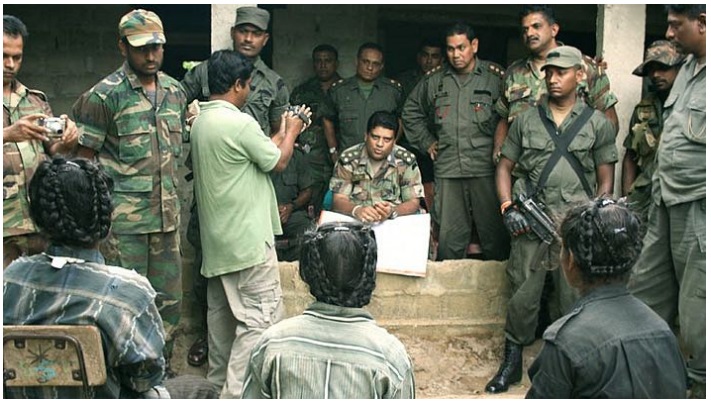
 By Matthew Russell Lee, CJR PFT Lanka
UNITED NATIONS GATE, January 28 – Once Mahinda Rajapaksa who oversaw the 2009 war crimes dubbed the bloodbath on the beach on October 26 was named the country's prime minster by Sirisena whom UN Secretary General Antonio Guterres has praised, Guterres was very slow in making any comment, despite or continuing the UN's shameful history on Sri Lanka including pulling out and allowing and covering up the slaughter in 2008 and 2009. Now Shavendra Silva, who despite his UN documented rolein the killings in 2008 and 2009 was allowed for a time to advise the UN Secretary General on Peacekeeping and host a movie screening with the pro-Guterres correspondents group, has been named Army Chief of Staff.
 By Matthew Russell Lee, CJR PFT Lanka
UNITED NATIONS GATE, January 28 – Once Mahinda Rajapaksa who oversaw the 2009 war crimes dubbed the bloodbath on the beach on October 26 was named the country's prime minster by Sirisena whom UN Secretary General Antonio Guterres has praised, Guterres was very slow in making any comment, despite or continuing the UN's shameful history on Sri Lanka including pulling out and allowing and covering up the slaughter in 2008 and 2009. Now Shavendra Silva, who despite his UN documented rolein the killings in 2008 and 2009 was allowed for a time to advise the UN Secretary General on Peacekeeping and host a movie screening with the pro-Guterres correspondents group, has been named Army Chief of Staff.
On Sri Lanka Naming Shavend... by on Scribd
By giving a ‘war criminal’ the top Army post, Sri Lanka proves Tamil lives don’t matter
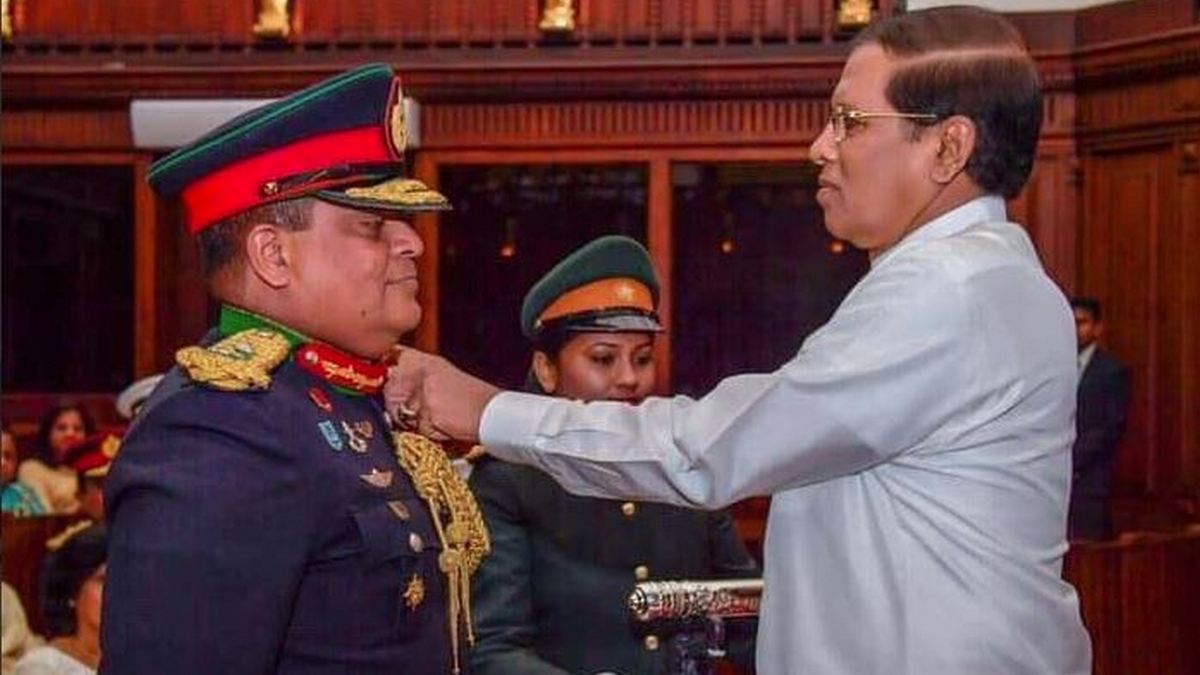
Major General Shavendra Silva with Sri Lankan President Maithripala Sirisena | @MaithripalaS/Twitter
President
Sirisena has made it abundantly clear that the Sri Lankan military will
not be held accountable for wartime violations.
 Sri Lanka’s abysmal record in dealing with alleged war criminals is well documented. And, with the recent appointment of
Major General Shavendra Silva—an alleged war criminal—as second in
command in the Sri Lanka Army, the South Asian nation has drawn fresh
international ire.
Sri Lanka’s abysmal record in dealing with alleged war criminals is well documented. And, with the recent appointment of
Major General Shavendra Silva—an alleged war criminal—as second in
command in the Sri Lanka Army, the South Asian nation has drawn fresh
international ire.
In 2012, he was removed from a UN advisory committee due to alleged war crimes and other egregious violations.
That same year, he was prevented from assuming a diplomatic position in
South Africa. Yet, in March 2017, Silva was appointed adjutant general
of the Sri Lanka Army.
His recent promotion attests to the fact that in Sri Lanka, the more things change the more they stay the same.
History repeats itself
In October 2018, Sri Lanka entered a period of profound crisis.
President Maithripala Sirisena fired Prime Minister Ranil
Wickremesinghe and replaced him with his erstwhile ally Mahinda
Rajapaksa, an alleged war criminal who served as president from 2005 to
2015. The coalition government that had ruled for the past several years
deteriorated. Chaos and confusion engulfed the country for over seven
weeks; Sirisena and Rajapaksa trampled the constitution and Sri Lanka
lacked a functional government.
The crisis appears to have settled—the coup attempt failed—and Wickremesinghe has been reinstated as prime minister.
In the days leading up to the crisis, an important development went largely unnoticed. The United Nations (UN) requested that the commander of its peacekeeping force in Mali, Sri Lanka’s Lt Col Kalana Amunupure, be sent home.
The request was the result of new evidence pertaining to his human
rights record—his involvement in crimes against humanity that were committed during Sri Lanka’s civil war.
And Amunupure was not the first to face such accusations.
His repatriation was the result of efforts by the International Truth
and Justice Project (ITJP), an organisation that has done excellent work
to record the egregious human rights violations committed by Sri Lankan
security personnel.
ITJP has continued to document major violations which have occurred since Sirisena became president in January 2015.
In a press release,
ITJP mentioned: “For the first time, the UN has asked the Government of
Sri Lanka to repatriate a peacekeeper because of his participation in
alleged war crimes during the country’s civil war.”
Amunupure played a notable role during the end of Sri Lanka’s civil war
and it would be utterly naive to think he doesn’t have blood on his
hands. Of course, a deeper and more thorough examination of Sri Lankans
hoping to become UN peacekeepers is long overdue.
After all, the consistent shelling of hospitals and the slaughter of
Tamil civilians (among a range of other appalling human rights
violations) have been documented extensively through credible investigations and reports.
The Tamil Tigers too committed wartime violations, but virtually most of
their leadership died during the war—it is widely believed that the
majority were killed extrajudicially by Sri Lankan government forces.
Zero accountability policy
Accountability for Sri Lanka’s wartime abuses—if at all—is guaranteed to
be a long, hard slog. And let’s keep in mind that there is not going to
be any real accountability through a purely domestic (Sri Lankan)
judicial mechanism. In such a milieu, an international mechanism is
essential.
Sri Lanka, of course, doesn’t want such intervention. President Sirisena
has made it abundantly clear that members of the Sri Lankan military
will not be held accountable for wartime violations.
What is more, significant security sector reform—which the country
urgently needs—has never been on the agenda. Besides, given the recent political crisis in Sri Lanka, it is clear that the window for meaningful reform will remain closed in the foreseeable future.
Sirisena, unsurprisingly, has promoted alleged war criminals on other occasions and will probably continue to do so.
Much ado about repatriations
Repatriations obviously don’t constitute justice. They are, however,
reminders that the way the country’s civil war ended remains relevant.
These war crimes allegations aren’t going away. In fact, Sri Lanka’s
continued failure to address wartime crime foments impunity in a country
that has already witnessed much violence.
In recent times, Tamil affairs have ostensibly gained currency because
Colombo had sought to placate international actors, deflect
international pressure and differentiate itself from the Rajapaksa
regime.
But the fact remains that Colombo doesn’t care about addressing Tamil grievances.
And Silva’s appointment sends a very clear message to the Tamil
community: Tamil issues don’t matter to the central government. They
certainly didn’t when Rajapaksa was in power. And, now that he’s out of
power, they still don’t.
The author is an Adjunct Fellow at Pacific Forum. Follow him on Twitter @taylordibbert.
Subscribe to:
Posts (Atom)